Discomfort and disbelief with 9/11 coverage

I had considered writing a personal 9-11 perspective for this past weekend’s remembrances, but felt it would have been an inappropriate self-indulgence.  So many others were more directly and frightfully affected by the events of that day, to add my own personal noise to the remembrances of survivors and those who lost friends and family members seemed superfluous.

However, after reading much of what was published Sunday in The Philadelphia Inquirer, I became sufficiently motivated to address what I consider the wayward perspectives on what has happened since that day in this country and in its responses to those attacks. 

The Inqy’s coverage of such an emotional event was quite detailed, complete, and somber.  It’s certainly not easy to strike the right balance when trying to accurately portray such a huge, complicated picture.  This is especially true when trying to put into perspective the hard data (costs in blood and treasure) along with the social, psychological, and emotional toll of such an event.  Maybe the smart thing would have been to treat this data separately, perhaps at another time even.  And yet – I’m sure – many people would have complained had not “the other half” of this story been presented on such a momentous anniversary.  

For instance,  The Inqy ran two charts in its paper edition on Sunday, describing both The Human Toll and The Financial Toll since the 9/11 attacks.  I thought it an unfortunate juxtaposition, having both of these displayed together.  (I would link them here, if I could find them on the philly.com site.  After two days of searching, I have given up.) 

Several data points caught my attention.

  • The Financial Toll of 9/11 was split between War Costs and Security Costs.  Among the latter category (Totaling $819 billion) was included $100 billion for the “Cost of delay to passengers for airport screening”! 

After seeing that, I was interested in how that was calculated and searched for the source from which the numbers came.  What I found was a study performed for an financial-based risk-assessment/benefit analysis by two professors analyzing the costs of preventing terrorist attacks vs. the actual risk of loss from such attacks.  The authors attempt to equate the value or benefit of prevention to a number of successful attacks needed to reach a so-called break-even point.

I was – almost immediately – sorry I dove into the deep end of this pool.  My problem being that one must be able to put a price tag on the value of a life.  And although this is something that’s certainly done in instances such as the cost and design of highway/auto safety features or in analyzing the costs of environmental protection measures; it’s still a nasty concept with which to deal.  

In this case, it’s a lose-lose situation, even if you’re able to get past the human element of the equation.  The psychological effects of massive casualty events puts an equation-type approach in evaluating responses to such attacks well beyond the realm of acceptability. 

For example, one conclusion made by the authors was that it would require 1667 Times Square-type attacks (i.e. like the one thwarted by poor design this past New Years Eve) to reach the break-even point of security measures needed to prevent any such attacks.  I doubt we could get to the point – psychologically – where, if one such attack was successful, that even two such events would be acceptable. 

You just have to wonder whether the likes of an Osama bin Laden understood that concept to the extent that it did not matter – to him anyway – what might happen to himself or to his organization.  They would win either way.  

It’s not a comforting thought.  But it’s not like we, as a nation that cherishes its domestic freedoms, would have the choice to consider the alternatives of such cost-benefit analyses either.

(I never did find an explanation of how they calculated the cost a traveler incurs waiting for a security screening, as opposed to the coast of being vaporized as a passenger on an 175 ton missile.  I guess I’d have to buy the book to find out, but that’s not going to happen.)

  • The Human Toll of 9/11 included U.S. and Iraqi military casualties, the civilian losses on 9/11, and a section on Iraqi civilian deaths, estimated to be 125,000.  The fine print attributed the Iraqi casualty estimate to a professor working on the Costs of War project at Boston University.  It attributed an estimated 15% of those Iraqi deaths to American and Iraqi military operations; the rest to sectarian violence, insurgent assassinations, and other criminal acts.

It was as early as 2006 that Iraqi War protestors were claiming upwards of 600,000 civilian Iraqi deaths as the result of the war.  Supposedly, these estimates were gleaned by surveys conducted on less than 2,000 Iraqi households and were then extrapolated for the entire war-ravaged country.

I never bought that methodology.  It was just too difficult to balance the claims of such widespread and willful violence and death in an almost lawless environment with what I imagined were census-type surveyors going door-to-door in Baghdad.  Even the margin-of-error (426,369 to 793,663 deaths) was over three times the figure now claimed in The Inqy chart!

I also found it odd that there was no information provided on estimated Afghanistan civilian deaths.  If your intent is to present “the whole picture”, it’s difficult to get past this glaring omission.

In another area of Sunday Inqy Karen Heller, a regular contributor, provided her perspective on that day in Forgetting isn’t possible.  One segment drew my attention.  

Everything about that morning, and almost all that came after, was characterized by speed: the planes crashing, the buildings falling, the deaths mounting, the rush to a wrongheaded costly war.

Now Ms. Heller and I rarely agree.  She being quite to left of me in her opinions and writings.  And my first take on this statement was that she was speaking about Iraq, not Afghanistan.  On the other hand, her piece was presented as a reflection on the events of 9-11 and the developments that resulted from the events of that day.  Yet she never once mentions Afghanistan; but does make mention of Saddam Hussein and even Niger yellowcake.  

So I’m left to wonder whether the “rush to a wrongheaded war” is an oblique reference to Afghanistan that coyly attempts to seek cover from the later – more deliberate – decision to overthrow Hussein.  Or was she unwilling to concede that Afghanistan was a “rightheaded war”, and so glosses over that episode in order to stick to the Liberal storyline. 

I suspect that latter, since I cannot fathom one suggesting after 9-11 that invading Afghanistan wasn’t “rightheaded”.  Then again, there is that storyline …

Finally on Sunday, a Letter to the Editor in the Currents section (no link still available) relates how the writer called his mother on 9-11 to check on her, and in their conversation compares the events of the day to Pearl Harbor.  Mom rather pointedly declares that the attacks were nothing like the 1941 attack that kicked off World War II.  She claims the 9-11 attacks were the result of America’s years of bullying other countries.  He concludes after ten years that he agrees with her, ” … as he watches America … launching one preemptive war after another.”

Sentiments like these are difficult to accept, given how ignorant the logic is. 

Bin Laden’s so-called justification for the 9-11 attacks was the presence of U.S. troops in Saudi Arabia, as they protected Islam’s holiest lands from the invasion threat posed by Saddam Hussein, who had just crushed the Kuwaiti armed forces.  This son should be prohibited from further editorials until he lists the multiple preemptive wars we have launched since 9/11. 

But I know of only two wars initiated by the U.S. since 9/11.  One was reactive, one preemptive.  Am I missing a few wars?!?  Even the “preemptive” war on Iraq was preceded by a decade of U.N. pronouncements and Congressional resolutions under the Clinton Administration declaring Hussein a lethal threat to his regional neighbors, the international community, and national security!

It boggles my mind the extent to which people cannot – or simply will not – admit who the aggressor was that day; why they attacked us; or that our response had to go beyond flushing out and punishing the cowards who perpetrated 9/11 and were responsible for everything that followed. 

 What’s really, really disturbing is that I’m not at all surprised that they still don’t get it.
Book Review: American Gospel by Jon Meacham

When I saw Jon Meacham‘s book, American Gospel: God, the Founding Fathers, and the Making of a Nation,  I put it on my reading list.  I was looking for a book that would provide a layman’s perspective of how the relationship between God and government developed in this country.  Having read Meacham’s work on Andrew Jackson (American Lion: Andrew Jackson in the White House), I was hoping it would be another concise and enjoyable read. 

Meacham  is executive editor and executive vice president at Random House,  former editor of Newsweek and a Pulitzer Prize winning author.  I’m most familiar with Meacham as a guest political commentator on MSNBC’s Morning Joe (weekdays, 6-9 am), a show I usually watch while getting ready for work in the morning. 

Meacham starts off by highlighting the theme that’s consistently drawn upon throughout the book, the difference between Public religion and Private religion as the Founding Fathers had envisioned.  The concept of Public religion recognizes faith in God (in all forms in which He exists and is worshipped) as a unifying influence, one that unites “the virtue of the populace”.  In this regard, the concept and belief in God takes on whatever religious form is meaningful to an individual, be they Christian, Jew, Hindu, Buddhist, Muslim, etc. 

Private religion seems a concept that is self-explanatory.  That all people have the right to worship – or not worship – God in whatever manner they choose.  This was the antithesis of the religious atmosphere in Europe which led to the founding and colonization of America, which Meacham covers in the first chapter, God and Mammon.  The American experiment provided that no individual would be prevented from worshiping God – if so inclined – in whatever form they should choose, a direct result of what drove the early pilgrims to hazard the perilous Atlantic crossing.

From the beginning, the thinkers among the Founders recognized the importance of religion.  Although they were almost all Christian, almost all Protestant (Several deists, such as Ben Franklin and Thomas Jefferson, were also prominent players.), they recognized the importance of religious tolerance.  Yet they also appreciated the threat to religion that government could pose should the two become too close and become intertwined.  These principles hold true regardless of who you worship or how you worship them. 

(This is why I find The Founding period in our country’s history so fascinating!  The timelessness of The Founders wisdom and foresight is amazing.  The Founders were far from perfect.  Their failure to resolve issues such as slavery and women’s rights – among others – would complicate the road ahead; but the foundation and framework were sound and have survived multiple tests throughout our history. Despite their shortcomings, The Founders were incredibly prescient.)       

Meacham’s greatest accomplishment here is his discussion of the concept most commonly referred to as The Wall between church and state.  A common theme throughout the book, Meacham subscribes to the concept that The Wall was intended more to protect religion from the state as opposed to the other way around.  This is why he finds no contradiction in expressions of God in the public sphere, including mentions of God on our money or in the Pledge of Allegiance.   

As he explores the role of Public religion in America, Meacham takes us through many of the nation’s struggles and accomplishments where Public religion served to unite the country behind the causes that defined the nation, such as the fight for Liberty; the struggle to end slavery and Jim Crow laws; the Great Depression, and the defeat of both Nazi and Communist suppressions in Europe.  In these instances as well as others, Meacham illustrates how American Presidents, political and social leaders invoked the concept of God and the values that flowed from that belief as a compelling, uniting influence for the country.

The book reads much shorter than it looks, running only 250 pages in narrative length.  The rest of the book is a compendium of extensive source notes and bibliography, references to historical letters and documents, even excerpts of presidential inauguration speeches where religious themes were integral. 

Meacham’s effort here is not intended to be taken as an in-depth, historical essay.  He attempts only to provide a historical perspective to the questions “What part did religion play in the founding of the American experiment?” and “How has religion affected the moral development and success of the country?”  Regardless of where you stand on – or know of – the relationship of religion to the American experiment and American governance, you will enjoy Meacham’s perspective on how that relationship came to be.

On this date 30 years ago …

… President Ronald Reagan was shot by John Warnock Hinckley, Jr. as he emerged from the Hilton Hotel in Washington, D.C.  Reagan had been at the hotel to address an AFL-CIO conference.

As with many such attempts, the perpetrator was six doughnuts short of a dozen mentally.  Hinckley had an acute obsession for Jodie Foster of all things.  His attempt to kill The President was an equally unusual effort to impress Foster.  The assassination attempt closely paralleled the storyline of the movie Taxi Driver, where the character Travis Bickle (Played by Robert DeNiro) plots to assassinate a presidential candidate.

Oddly enough, the Bickle character was based in part on Arthur Bremer, who shot presidential candidate George Wallace in 1972.

Unlike many such events where people can instantly recall where they were when it happens, I have been trying all day to recall where I was and what I was doing that day. 

In theory I would have been at my new federal job that afternoon, having been hired the previous April.  But for some reason the recesses of my oft stilted memory give me flashes of being home, watching the events unfold shortly after they had occurred. 

I’m guessing my murky recollections are at least partly accurate.  Why I might have been home that day, I have no idea.  Sick day perhaps … But I was such a dedicated employee, it’s hard to accept. 

OK … Maybe not that hard to accept.

Part of the problem might have been that I was hardly a fan at all of President Reagan at the time.  As mentioned elsewhere here, I had severe issues with the then new President that had me a bit verklempt at times.  But as some pundits theorize, the assassination attempt on Ronald Reagan may have kick-started the country’s – and my own – eventual love affair with the 40th President.

But let’s take a look at those other individuals whose lives and careers where greatly affected by Hinckley’s actions.

Secret Service Agent-in-Charge Jerry Parr was famously credited for dumping the President into his awaiting limo; recognizing Reagan’s injuries; and re-directing the White House-bound driver to George Washington University Hospital.  This despite missing Reagan’s injury at first and getting a verbal drubbing from the shocked and hurting President, who thought Parr had broken presidential ribs when he landed on the Chief Executive in the limo.

But the real heroes in the protection detail that day were Secret Service Agent Timothy McCarthy and D.C. patrolman Thomas Delahanty.  The D.C. officer was struck in the back when he turned to protect the President.  Agent McCarthy took a bullet to the abdomen as he bravely put his body between the shooter and Reagan’s only method of egress.  Both men were fortunate in that they recovered from their wounds.

It is interesting to see McCarthy standing large and tall as the shooting starts, while military members of the White House detail can be seen hitting the ground.  This illustrates the difference in training between the military, counseled to make themselves small targets when the lead starts flying, and that of Secret Service Agents, instructed to stand in front of a bullet to protect their charges. 

Not nearly so lucky was Reagan Press Secretary James Brady, who was struck in the head and never recovered entirely from his wounds.  He would spend years in a wheelchair, but eventually recovered most of his speech function and mobility.  Brady’s experience led him and his wife to found the Brady Center to Prevent Gun Violence.  And the Brady Handgun Violence Prevention Act was named in his honor.

It is also interesting to compare the modern-day threats to U.S. Presidents as compared to the simpler days when Chief Executives – up to the time of Harry Truman – were generally free to walk the streets of Washington (or New York or Philadelphia).  When Truman barely avoided a run-in with Puerto Rican nationalists, the days of carefree presidential outings ended.   

From the sad days that followed the assassination of John F. Kennedy,  I’ve seen way too many such attempts.  And maybe that’s why I’m not too quick in recalling the specifics of this one. 

Rest easy, Mr. Reagan.

Review: “Decision Points” by George W. Bush

At times I have been accused of being an apologist for former President George W. Bush.  Rightfully so, I must add.  That’s why I have been looking forward to reading Bush43‘s memoir, Decision Points

The book starts out with a frank, introspective look at Bush’s struggle to overcome his problem with alcohol.  Most telling was his failure at Laura Bush’s urging to remember a day when he had not had a drink.  Unable to do so, he begins to realize that he just might have a problem.  From my perspective, it was a surprising way for an ex-President to kick off his memoir.  But it conveyed the obvious importance that struggle was to his future success.  It also helps to understand his reliance on Laura’s strength and wisdom.  They were married just three months after they met!

Of course the linchpin event of George Bush’s presidency was the attack of September 11, 2001.  Through all the smoke, fire and loss of life from that day comes the one pledge that overshadowed the rest of his presidency.

Yet after 9/11, I felt my responsibility was clear. For as long as I held office, I could never forget what happened to America that day. I would pour my heart and soul into protecting the country, whatever it took. (page 151)

This is the prism through which one must view his subsequent decisions and actions, both here and abroad.  Afghanistan was a no-brainer; but going into Iraq was a dicier decision that resulted in a major distraction from the Afghan operation.  

However a decade after Operation Desert Storm, the Saddam Hussein situation required a solution.  The international community, the U.N., and the Clinton Administration had been convinced that Hussein had WMDs; and the reliance on no-fly zones was not the solution to Hussein’s cruelty, oppression, and perceived threat to the region.  That no WMDs were found does not diminish the validity of these widely held beliefs.

President Bush’s 9/11 pledge also explains the decisions to house captured terrorists at Guantanamo Bay, The Patriot Act, creation of the Department of Homeland Security, and the development of the Bush Doctrine and the Freedom Agenda.  And no matter where you stood on the pro-con scale as the Bush Administration enacted these measures, they are still in place two years after President Barack Obama entered The Oval Office!

The book’s tone is straight-forward and conversational.  My impression was that the book read much the way his speeches and national addresses sounded (minus the ill-timed gaffes).  Those who regarded President Bush as a fumbler and stumbler would be impressed by GWB’s efficient style.  I found the book to be an easy and enjoyable read.

The common thread throughout the book is how Bush43 approached the problems and decisions he faced.  Oft times criticized for not being naturally inquisitive, he relied heavily on experts and leaders in applicable fields of research and study – both from within his administration and in industry and academia – when facing complex issues and problems.  And when it came to making a decision, GWB viewed all situations through his strongly held core values.  Although he was not pretentious in his religious beliefs, his beliefs were the foundation of those values.

And yet President Bush was capable of making sound value-based decisions that were not restrained by the desire to pander to his political base.  An example was his decision on stem cell research.  Despite the fervent wishes of the religious right, GWB was adamant in his commitment to seek out all sides of the controversy.  His final decision was based on several factors: stem cell research offered the potential for monumental breakthroughs in medical research; research was already progressing on several dozen stem cell lines (per the National Institute of Health), and the number of lines in development were plentiful for current and future medical research.  His decision to allow federal funding for existing stem cell lines, while affirming the dignity of human life and preventing the use of federal funds for future stem cell harvesting was a practical and compassionate solution to a difficult problem.

If the measure of a good compromise is the reality that neither side is entirely satisfied with the solution, then George Bush certainly hit the mark with stem cell research.  A good leader can never be burdened with the concept that he must please everyone all the time.

Several other aspects of the book were very interesting; some surprised me:

  • As Governor of Texas, GWB was renown for his ability to work across the aisle.  Something that was essential as a Republican Governor with a State House and Senate headed by seasoned and well-respected Democrats.  In fact, Bush and Lt. Governor Bob Lubbock – a Democrat – respected each other to the point where Lubbock not only endorsed Bush for his second term as Texas Governor, he predicted that Bush would be the next President of the United States!
  • Laura Bush was a real cutie when she landed GWB!  (See third page of the first photo section.)
  • The Bush Administration committed $15 billion over 5 years to fight the spread of AIDS in Africa.  After a 2003 visit to AIDS-ravaged Uganda, Bush was inspired to push the country to do more in fighting the disease.  He envisioned the President’s Emergency Plan for AIDS Relief (PEPFAR) as a medical version of The Marshall Plan.  In addition to testing, counseling and treating tens of millions for AIDS, there was also considerable commitment to eradicate malaria.
  • During the 2008 presidential campaign and the banking crises that resulted in the Toxic Asset Recovery Program (TARP), Republican candidate for president, Arizona Senator John McCain insisted that The White House host an emergency meeting of both candidates, the leadership of both parties in the House and Senate, and the Bush Administration.  Expecting McCain, who instigated the meeting, to address the issues and how Congress could support TARP, the President was astounded at McCain’s silence in contrast to Barack Obama’s succinct analysis of the program.

In my opinion, anyone interested in politics and government whether a supporter or critic of President George W. Bush would enjoy reading a Commander-in-Chief’s view of his eight years in The Oval Office. 

DISCUSSION TOPICThe Bush Doctrine included the concept that America’s interests would be maximized by promoting freedom and democracy wherever possible.  It supported fledgling democracies in the Ukraine, Georgia, Lebanon and the Palestinian Territories as well as Iraq and Afghanistan.  And it lent encouragement and support for dissidents and reformers in places like Syria, Iran, North Korea, and Venezuela.

“America’s vital interests and our deepest beliefs are now one.”

Given the uprisings in Egypt, Yemen, Bahrain, Libya, etc., can the argument be made that the Bush strategy of supporting democratic reforms in that region has been much more successful than illustrated by the novice democracies in Iraq and Afghanistan?

On this date in 1875 …

… President Ulysses S. Grant signed into law the Civil Rights Act of 1875

This tends to surprise many people, even those who can refer to the Civil Rights Act of 1964, maybe even the Act of 1957.  But it’s a bit of a shock that Civil Rights was the topic of an act of Congress only ten years after the end of The Civil War.  Yet political and legal battles would be waged for almost another century before full civil rights law was established.   

The 1875 Act was written in an attempt to provide equal access to public accommodations such as restaurants, trains, theatres, etc.  The reason why so many have problems recognizing the earliest civil rights law was that it was declared unconstitutional by the U.S. Supreme Court in 1883.  Its rejection by the country’s highest court was based on the law’s lack of standing within the context of the 13th and 14th Amendments.  Fact is, in its eight-year existence the 1875 Act was rarely – if ever – enforced anyway. 

What is most telling to me, is the realization as early as the 1870s that only reliance upon national law held any potential for mitigating the heinous treatment of African-Americans, both pre-Civil War freemen and newly liberated slaves.  And that despite this realization, it would take another 89 years before full civil rights legislation was enacted.      

In 1957, the Civil Rights Act of 1957 provided voting rights to black Americans in a way that was ineffectual in increasing their political power.  Then-Senator Lyndon Baines Johnson is touted with the tricky political accomplishment of both progressing the measure through Congress, while at the same time ensuring the bill’s evisceration by assigning it to a Judiciary Committee run by anti-civil rights Senator James Eastland (MS).  The bill’s eventual passage also had to survive the longest lasting Senate filibuster by Senator Strom Thurmond, who railed on about nothing in particular for 24 hours, 18 minutes.      

It would not be until the Civil Rights Act of 1964 that full civil rights to women as well as blacks would be institutionalized.  Oddly enough, the Act of 1964 was signed into law by the very same, now-President Lyndon Baines Johnson, after President John F. Kennedy was assassinated in 1963.

On this date in 1945 …

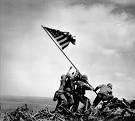
… One of the most iconic events in American history occurred with the raising of the Stars and Stripes by U.S. Marines on the Pacific island of Iwo Jima (now known as Ioto). 

Raising the flag on Mount Suribachi

It is important to keep these incredible feats of bravery in the collective field of vision.  Generations of Americans to follow will become – very naturally – more removed from and less aware of these proud military accomplishments.

I readily admit, I have very little knowledge on the heroics of those who served in World War I.  This due to the fact that fewer and fewer of those veterans were around, and their exploits were in many ways overshadowed by other events – like WWII – that followed.

Whenever I take the time to sit and watch a favorite WWII flick (Saving Private Ryan and In Harm’s Way are two of my favs) or docudrama (Band of Brothers), I always have to remind myself that these were kids doing incredibly difficult and mortally dangerous acts. 

So simply take a moment from time to time to consider the immense sacrifices made in the past to the benefit of the nation and its people, from the American Revolution to present day Afghanistan and Iraq. 

An overwhelming majority of the real heroes never make it home again.  So if the opportunity presents, thank a veteran for their service and sacrifice.  Appreciate the fact that for so many that opportunity was lost long ago.     

———————————————————————————————————–

Other events from this date:

1836 – Alamo besieged by Santa Anna; entire garrison eventually killed .

1847 – 5000 U.S. troops under General Zachary Taylor defeats 15,000 Mexican soldiers under General Santa Ana near Buena Vista, Mexico.

1861 – With assassination threats rampant, President-elect Lincoln arrives secretly in Washington DC to take office.

1896 – Tootsie Roll introduced by Leo Hirshfield

1903 – Cuban state of Guantanamo leased to USA.

1904 – Control of Panamá Canal Zone acquired by US for $10 million.

1960 – Demolition begins on Brooklyn’s Ebbets Field.

1967 – 25th amendment (Presidential succession) declared ratified.

Birthdays:

George Handel, German-born composer (1685)

W. E. B. Du Bois, black American historian and sociologist (1868)

Peter Fonda, actor (1940)

Deaths:

John Keats, Romantic poet (1821)

John Quincy Adams, 6th POTUS (1848)

Thomas Woodrow Wilson, 28th POTUS (1924)

Aleksei Tolstoi, Russian poet/writer (1945)

Belated Happy Birthday, Mr. Reagan!

To commemorate Ronald Reagan’s 100th birthday this past Sunday, it seems appropriate to devote a blog entry to his significance for me, given the effect his two-term presidency had on my political views. 

An American Hero

For much of my post-college years I proved to be much more liberal in my political and social views than many of my life-long friends.  I can recall – with general fondness – the abuse I used to take at the hand of life-long friends during discussions that tended to spring up when young working-class guys get together over beers or maybe a card game.  Looking back at it now, it seems odd that so many of them held such conservative views, when all of us grew up in a blue-collar, urban environment that would normally be viewed as traditionally more liberal than conservative.    

But I learned to live with it. 

Then Jimmy Carter was elected President.  When Carter made his “crises of confidence” speech, which later morphed in the country’s “malaise”, I had enough of his weak – bordering on whiny – presidential leadership.  There had been an intolerable lack of presidential leadership in this country, as was clearly the case with Lyndon Johnson (Vietnam), Richard Nixon (Watergate) and Gerald Ford (being Gerald Ford).  Carter seemed like the latest in an undistinguished line of presidents.

Ronald Reagan was not what I was looking for in 1980.  I can remember watching Reagan in a televised debate, and quickly turning it off because my impression of him was one of a guy clearly in over his head.  I must have missed a helluva comeback performance, because Reagan went on to beat the stuffing out of Carter in November.  I’ve always wondered what chances Reagan would have had if there had been a stronger incumbent than Carter in The Oval Office.

In the end, I think I actually sat out the 1980 presidential election.

But what I learned in those early Reagan years was that he was the consummate manager.  He knew how to pull in the most qualified people to execute his strategies, then he got out-of-the-way and let them do their jobs.  Mr. Reagan eventually proved to demonstrate values, policies and initiatives that I came to appreciate. 

His administration’s efforts to build a 600 ship navy placed unmanageable pressure on the Soviet military and economy.  It was just one more factor adding cracks to the facade of the soon-to-fail Soviet bloc.  Reagan’s foreign policy initiatives included added emphasis on reducing the nuclear arsenals of both the USA and USSR in the Intermediate-Range Nuclear Forces (INF) treaty that laid the framework for the Strategic Arms Reduction Talks (START) treaty.  In fact, Reagan became such a popular icon in the Soviet Union that Mikhail Gorbachev asked Reagan to give a speech on free-market philosophy at Moscow State University.

But what struck me most was the way Reagan restored a sense of strength and leadership in The Oval Office.  Reagan’s performance, whether one agrees with his pragmatic approach to governance and belief in American exceptionalism (the shining city on the hill),  turned the attitude of country around from the aimlessness of the Carter years. 

By the end of Reagan’s first term I was a convert, not only to the Reagan philosophy but to more conservative views on social and economic matters.  I voted for Reagan in his re-election campaign against Walter Mondale.  And by the end of his presidency in 1988, I viewed Ronald Reagan as an American hero.

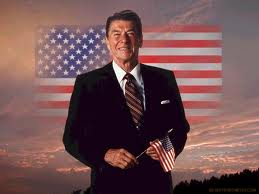
The above is one of my favorite pictures of Reagan.  I had it taped on my desk at work for years; and on more than one occasion it was suggested that the picture was disrespectful.  When confronted with this observation, I would explain that the picture was a favorite because it portrayed a side of Reagan no other President in recent memory would allow to peek through.  (When asked why he allowed himself this lapse in presidential decorum, the President simply said he had always wanted to do that to the press.) 

Ronald Reagan was unafraid to appear human, even self-deprecating.  I loved the picture because it showed President Reagan as a human being who cared more for that “shining city on the hill” than he did for the pretense of invulnerability.

Happy Birthday, Mr. President!

We miss you!

Reading List: “Game Change” – Heilemann & Halperin

(I’m sure many blogs are delving deeply into the recent SOTU Address and the analysis thereof.  But the SOTU has become such partisan political demonstration, I have a hard time even reading the media analyses, let alone actually watching the speeches themselves.  So today I’ll stick to a less aggravating topic, political history.)

Game Change was written by two political journalists, John Heilemann (New York) and Mark Halperin (Time). Both are regular contributors on Joe Scarborough’s morning MSNBC offering, Morning Joe.

Game Change takes a look at the 2008 U.S. Presidential race, including the critical Democratic primary run-up that saw the rise of Barack Obama to national prominence.

By far the most interesting aspect of the book is the meteoric rise of Obama, and the unseating of Hillary Clinton as heir to the throne.  John Kerry’s decision to invite a little known State Senator from Illinois to give a keynote address at the 2004 Democratic Convention resulted in recognition on a national level of Obama as a charismatic leader with the potential to unite and excite the various factions with in the Democratic Party.

But the depth and breadth of his appeal with little experience at the national level and absolutely no executive background puzzled many.

In one scene (p. 65) – to which many of us who watched this drama from the Republican side can relate –  a white woman in an Iowa focus group leading up to the caucuses there states, “There’s something about that guy; that’s the guy I want. I can’t even put it in words.”  The occurrence nicely summarizes the phenomena that launched his successful quest for The Oval Office.  Who is this guy?  How did he get here?  What’s the appeal?

For me, it’s a fascinating story. 

The play between the Obama and Clinton camps is the best part of the story.  Hillary actually coaches the newly elected Senator Obama during his very short stint in The Senate (141 days).  Yet the animosity for the Clintons within the Democratic Party, which lies just beneath the facade of support demonstrated by party leaders becomes all too easy for Obama to tap.  Just goes to show that if you’re considered the playground bully – as the Clintons were, it doesn’t take much to instigate a palace revolt!

Obama slowly starts to pull in party support and endorsements, including the defection of Bill Richardson, former New Mexico governor who served as Secretary of Energy and Ambassador to the U.N. in Bill Clinton’s administration.  And the theme of the book quickly becomes the befuddlement of the Clintons as political rugs are pulled out from beneath them time and again. 

Of course my first reaction to all this, as it peaked during the caucus and primary season in the summer of ’08, was not particularly flattering.  I kept recalling the campaign and election of James Earl (Jimmy) Carter.  I would shudder when I recalled all the excitement and media frenzy surrounding the peanut farmer with the big toothy smile.  Ever since, I can’t look at Planter’s Peanuts commercials featuring Mr. Peanut without getting nauseous.  Afterall, Carter has to go down as one of the worst Presidents in U.S. history.  I can still see the cardigan sweater-clad Carter sitting leisurely by a fireplace as he chided America about its defeatist attitude, which would later be described by Carter staffers as a national “malaise”.  Just a complete lack of leadership …

On the other hand, John Edwards and his late wife, Elizabeth, do not fare well in Game Change.  From John’s $400-1200 haircuts, his Rielle Hunter affair, and the knock-down drag-out fights it produces between them to Elizabeth’s unfortunate bout with cancer, her high maintenance needs and general surliness towards everyone, it’s an ugly picture.  How exactly Edwards thought he could pull off an affair with the attention-whore Hunter and still think he could be a good president is simply mind-boggling.  It’s the height of self-absorbed elitism.

Once Obama seals the Democratic nomination, the story turns to John McCain and Sarah Palin.  They come out looking better than the Edwards’, but not by much.  McCain comes off as an aloof candidate, prone to angry outbursts sprinkled with expletives; more concerned about dinner plans with his much younger wife, Cindi, than he is about campaign issues.  This includes a White House strategy session McCain instigates to offer his plans to right the economy during the banking crises.  McCain arrives at the meeting completely unprepared.  Obama end up doing a much better job of presenting his views and call to action.  As a result, even Bush43 wonders what the heck McCain’s point was in betting his political life by proposing the crises meeting.  

Sarah Palin shows her ability to wow a crowd, but becomes more of a drag on a sinking McCain candidacy.  Her obliviousness to even the most rudimentary political and foreign policy issues is alarming for anyone who was concerned about her readiness for the international spotlight.  I’m not a fan of hers, so some might conclude I’m letting the media influence me.  But there’s an awful lot of baggage there.  In the end though, it was the McCain campaign that did her in by shoving her into the national spotlight when she wasn’t ready for the national stage.

As you can see there’s a lot of meaty political nastiness and intrigue in Game Change.  Even as an avid reader, I NEVER read books on politics.  Political history, biographies?  Absolutely!  (Pick up some of Edmund Morris’ works on Theodore Roosevelt and Ronald Reagan!)  But never political tomes. 

But I was fascinated by the 2008 campaigns …  the changing fortunes of the Clintons, the meteoric rise of Obama, the RNC settling for an indifferent and low-energy McCain, Palin, the Edwardses …  It was a political soap opera.  If you feel – like I do – that the 2008 election cycle was so atypical for what we have grown used to over the past 20 years or so, you should definitely pick this book up! 

4 stars out of 5

(Hope you enjoyed this.  It’s been DECADES since I did a book report!)