Thoughts for a Memorial Day

memorial-dayAnother Summer is upon us!  As always, the quasi-official start of Summer is marked by the three-day Memorial Day weekend and its rituals of beach days, barbecues, and neighborhood parties.

It is no doubt the most favorite time of the year for Americans from Georgia to Oregon, Minnesota to New Mexico.

As Americans however, it is also important that we take a bit of time during what looks to be a glorious weekend in the greater Philadelphia area to remember the meaning of Memorial Day, a day set aside to honor the sacrifices made by thousands and thousands of citizen soldiers since the founding of the United States of America in 1776.

Common people – not unlike many of us – chose to leave families, to forego careers, and to risk the opportunities that a full and vibrant life offers in order to preserve those same possibilities for their fellow Americans.  It’s a Choice many of us, be it through luck or timing or fortuitous periods of peaceful coexistence, may never have had to face.

This post is dedicated to those who faced the danger, to the sacrifices they made, and to the loved ones they too often left behind.

There but for the Grace of God …

.

One Congressional Medal of Honor posthumous recipient only recently returned home after 50 years lying in a North Korean grave.

Army Lt. Col. Don C. Faith Jr.

Army Lt. Col. Don C. Faith Jr.

Army Lt. Col. Don C. Faith Jr. of Washington, Indiana

At the time of his death, Faith and his unit — 1st Battalion, 32nd Infantry Regiment — were attached to the 31st Regimental Combat Team as it advanced along the eastern side of the Chosin Reservoir in North Korea.

During attacks by the Chinese People’s Volunteer Forces, Faith assumed command with his supervisor missing, and he continuously rallied his troops, personally leading an assault on an enemy position.

He was seriously injured by shrapnel on Dec. 1, 1950, and died a day later from those injuries. However his body was not recovered by U.S. forces at the time.

In 2004 a joint U.S.-North Korea team returned to the spot where Lt. Col. Faith was last seen and recovered his remains.  He was returned to his family and interred on U.S. soil just this past April.

.

Throughout American military history, there have been 15 Congressional Medal Honor recipients who earned The Medal for actions taken on the date May 27th.  Eleven of those 15 Medals were awarded during the American Civil War, five of which were earned by crew members aboard the Union ironclad U.S.S. Cincinnati when the ship was shelled and sank during a maritime assault on Confederate gun emplacements in the Siege of Vicksburg, Mississippi.

.

U.S.S. Drexler (DD-741)

U.S.S. Drexler (DD-741)

On May 27, 1945 – Okinawa, Japan – American forces attacking southward, continue to encounter heavy Japanese resistance. Japanese aircraft begin a two-day series of strikes against the Allied naval forces around the island. The destroyer U.S.S. Drexler is hit by two kamikaze planes and sinks so quickly 158 sailors are killed.

.

One particular Medal of Honor recipient from the Vietnam era caught my attention for his selfless bravery.

CHARLES CLINTON FLEEK

Rank and organization: Sergeant, U .S. Army, Company C, 1st Battalion, 27th Infantry, 25th Infantry Division. Place and date: Binh Duong Province, Republic of Vietnam, 27 May 1967. Entered service at: Cincinnati, Ohio. Born: 28 August 1947, Petersburg, Ky.

UnknownCITATION:  For conspicuous gallantry and intrepidity in action at the risk of his life above and beyond the call of duty. Sgt. Fleek distinguished himself while serving as a squad leader in Company C, during an ambush operation. Sgt. Fleek’s unit was deployed in ambush locations when a large enemy force approached the position. Suddenly, the leading enemy element, sensing the ambush, halted and started to withdraw. Reacting instantly, Sgt. Fleek opened fire and directed the effective fire of his men upon the numerically superior enemy force. During the fierce battle that followed, an enemy soldier threw a grenade into the squad position. Realizing that his men had not seen the grenade, Sgt. Fleek, although in a position to seek cover, shouted a warning to his comrades and threw himself onto the grenade, absorbing its blast. His gallant action undoubtedly saved the lives or prevented the injury of at least 8 of his fellow soldiers. Sgt. Fleek’s gallantry and willing self-sacrifice were in keeping with the highest traditions of the military service and reflect great credit on himself, his unit, and the U.S. Army.

.

The purpose of these posts during our most American of holidays is not to spoil the mood of a dawning Summer or to lay guilt at the feet of those of us who benefitted from selfless acts in far, far away locales.  It’s simply a reminder that as you enjoy your long weekend, take a moment or two to reflect on those – both living and deceased – who have made good times and fun weekends possible.

Lifting-an-Inflatable-Tank-620x412In closing I leave you with a happier story.  It’s about a group of soldiers in World War II, known as The Ghost Army, whose actions were purported to have saved many American lives in the lead-up to the invasion of Normandy, France and later in battles across western Europe

These soldiers were responsible for the creation of fake Army units designed to mislead German intelligence-gathering efforts and the tactical decisions that would result.  The unique way in which they were able to deceive enemy strategists was through the use of inflatable forms in the shape of tanks, vehicles, airplanes and artillery.

Although there is no definitive way to determine how many Allied soldiers might have been spared over Ghost Army efforts, one would conclude that the efforts German units undertook to destroy what amounts to an Army of Balloons, including artillery bombardment and air attacks, certainly had the desired effect on enemy decision-making!

And with that, I send wishes for a glorious Memorial Day weekend!

70 years ago this week: Battle of Midway Island (June 4-7, 1942)

(Today our Navy command observed the 70th anniversary of the Battle of Midway as in commemoration of the recent Memorial Day holiday.  This was a different take on Memorial Day observations as it took a look at a specific, historical battle.) 

Japanese Admiral Isoroku Yamamoto

As was mentioned in my previous Memorial Day post, the Japanese fleet set off for Midway Island on May 27, 1942.  Their intent was draw U.S. Navy carrier forces into a trap by attacking Midway Island, one of the few military installations U.S. forces occupied west of Pearl Harbor and the Hawaiian Islands.  Once U.S. carriers responded to the Midway attack by seeking out Japanese carrier force, the hammer of Japanese battleship forces would then attack and destroy the U.S. carrier fleet.  All the U.S. battleships assigned to the Pacific theatre had been destroyed or damaged just six months prior to the Battle of Midway when the Japanese attacked Pearl Harbor.

Several factors contributed to the eventual U.S. victory at Midway.

  • U.S. cryptologists had successfully figured out the Japanese code used for its operational forces.  The Japanese had been delayed in fielding their own more advanced code in the weeks leading up to Midway.  As a result, Allied forces in the Pacific were able to read Japanese message traffic, and knew both where and when – within a day or two – the Imperial Forces were expected to hit Midway Island.
  • Aircraft carrier U.S.S. Yorktown (CV-5), heavily damaged and thought by the Japanese to have been sunk during the Battle of the Coral Sea (May 7-8), limped back to Pearl Harbor on May 27 and was turned around in sufficient fighting condition in just 3 days!  Yorktown was able to sail as the core of Task Force 17 on May 30.
  • On 29 May, seaplane tender (destroyer) USS Thornton (AVD-11) arrived at French Frigate Shoals to relieve light minelayer USS Preble (DM-20) on patrol station there. The presence of U.S. ships at French Frigate Shoals prevented the Japanese from refueling flying boats to reconnoiter Pearl Harbor.  As a result, the Japanese had no intelligence on the departure and makeup of Task Forces 16 (U.S.S. Enterprise and U.S.S. Hornet) and 17 (U.S.S. Yorktown). 
  • Radio silence insisted upon by Japanese Admiral Isoruku Yamamoto prevented what sporadic information Japanese intelligence could discern about Task Force departures from Pearl Harbor from reaching Vice Admiral Nagumo Chuichi‘s Carrier Strike Force.

Overview of the fighting during the Battle of Midway, as taken from the Naval History and Heritage Command, Battle of Midway link:  

U.S. Admiral Chester W. Nimitz

Just after midnight on 4 June, Admiral Chester W. Nimitz, based on patrol plane reports, advised Task Forces 16 and 17 of the course and speed of the Japanese “main body,” also noting their distance of 574 miles from Midway. Shortly after dawn, a patrol plane spotted two Japanese carriers and their escorts, reporting “Many planes heading Midway from 320 degrees distant 150 miles!”

The first attack on 4 June, however, took place when the four night-flying PBYs attacked the Japanese transports northwest of Midway with one PBY torpedoing fleet tanker Akebono Maru. Later that morning, at roughly 0630, Aichi D3A (“Val”) carrier bombers and Nakajima B5N (“Kate”) torpedo planes, supported by numerous fighters (“Zekes”), bombed Midway Island installations. Although defending U.S. Marine Corps Brewster F2A (“Buffalo”) and Grumman F4F (“Wildcat”) fighters suffered disastrous losses, losing 17 of 26 aloft, the Japanese only inflicted slight damage to the facilities on Midway. Motor Torpedo Boat PT-25 was also damaged by strafing in Midway lagoon.

Over the next two hours, Japanese “Zekes” on Combat Air Patrol (CAP) and antiaircraft fire from the Japanese fleet annihilated the repeated attacks by the American aircraft from Marine Corps Douglas SBD (“Dauntless”) and Vought SB2U (“Vindicator”) scout bombers from VMSB-241, Navy Grumman TBF (“Avenger”) torpedo bombers from VT-8 detachment, and U. S. Army Air Force torpedo-carrying Martin B-26 (“Marauder”) bombers sent out to attack the Japanese carriers. Army Air Force “Flying Fortresses” likewise bombed the Japanese carrier force without success, although without losses to themselves.

Between 0930 and 1030, Douglas TBD (“Devastator”) torpedo bombers from VT 3, VT-6, and VT-8 on the three American carriers attacked the Japanese carriers. Although nearly wiped out by the defending Japanese fighters and antiaircraft fire, they drew off enemy fighters, leaving the skies open for dive bombers from U.S.S. Enterprise and U.S.S. Yorktown. VB-6 and VS-6 “Dauntlesses” from Enterprise bombed and fatally damaged carriers Kaga and Akagi, while VB-3 “Dauntlesses” from Yorktown bombed and wrecked carrier Soryu. American submarine Nautilus (SS-168) then fired torpedoes at the burning Kaga but her torpedoes did not explode.

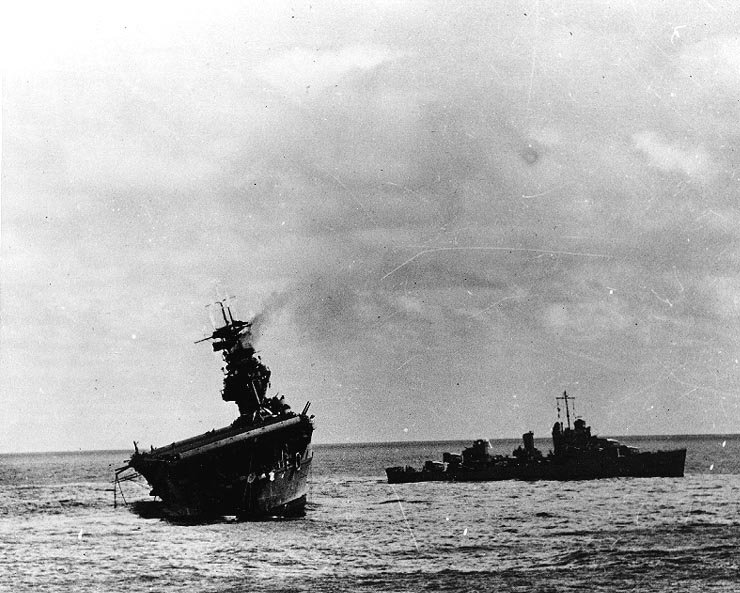
USS Yorktown – June 4, 1942

At 1100, the one Japanese carrier that escaped destruction that morning, Hiryu, launched “Val” dive bombers that temporarily disabled Yorktown around noon. Three and a half hours later, Hiryu’s “Kate” torpedo planes struck a second blow, forcing Yorktown’s abandonment. In return, “Dauntlesses” from Enterprise mortally damaged Hiryu in a strike around 1700 that afternoon. The destruction of the Carrier Strike Force compelled Admiral Yamamoto to abandon his Midway invasion plans, and the Japanese Fleet began to retire westward.

On 5 June, TF 16 under command of Rear Admiral Spruance pursued the Japanese fleet westward, while work continued to salvage the damaged Yorktown. Both Akagi and Hiryu, damaged the previous day, were scuttled by Japanese destroyers early on the 5th.

The last air attacks of the battle took place on 6 June when dive bombers from Enterprise and Hornet bombed and sank heavy cruiser Mikuma, and damaged destroyers Asashio and Arashio,as well as the cruiser Mogami. At Admiral Spruance’s expressed orders, issued because of the destruction of three torpedo squadrons on 4 June, “Devastators” from VT-6 that accompanied the strike did not attack because of the threat to them from surface antiaircraft fire. After recovering these planes, TF 16 turned eastward and broke off contact with the enemy. COMINT intercepts over the following two days documented the withdrawal of Japanese forces toward Saipan and the Home Islands.

Meanwhile, on the 6th, Japanese submarine I-168 interrupted the U.S. salvage operations, torpedoing Yorktown and torpedoing and sinking destroyer USS Hammann (DD-412). Screening destroyers depth-charged I-168 but the Japanese submarine escaped destruction. Yorktown, suffering from numerous torpedo hits, finally rolled over and sank at dawn on 7 June.

Luck also turned out to be on the American side as well; but it was luck that was made possible through better intelligence gathering, cryptology breakthroughs, industrial capabilities (e.g. U.S.S. Yorktown’s quick shipyard turnaround), superior naval leadership and carrier tactics.  Not the least of any of the aforementioned factors, the fighting spirit, dedication, and bravery of U.S. military personnel determined the course of the Battle of Midway and by doing so, defined the high-water of Japanese designs for the Western Pacific.

Casualties were relatively light for American forces (300 dead, U.S.S. Yorktown sunk) compared to the over 3000 dead and four aircraft carriers lost by the Japanese.  The real measure of U.S. and Allied success was what the defeat did to Japanese designs to force the Allies out of the central Pacific so that Japanese forces could have their way in the western Pacific. 

From Midway forward, the World War II Pacific Theatre would slowly but decidedly turn to the Allies favor.  Due to the significant losses in aircraft carriers, airplanes, pilots, and even their trained aircraft mechanics, Japanese forces would suffer from the loss of air superiority.  And Japanese weaknesses in manufacturing capacity and the flow of raw materials made replacing lost ships extremely difficult and virtually impossible in the case of aircraft carriers.  As a result,  Japanese military operations would turn from offensive to defensive in nature as the Allies slowly closed the circle around the Japanese homeland.

The Battle of Midway, along with those at Coral Sea and the Doolittle Raid over Japanese home islands, marked the beginning of the Age of the Aircraft Carrier, which after 70 years still serves as the backbone of any prolonged American military presence in oceans around the world.

So despite that our Memorial Day has already passed, take a few moments to reflect on what these men and their machines accomplished in interests of freedom and American interests 70 years ago this week.

Beyond Barbed Wire

Beyond Barbed Wire, Kit Parker Films production, is a thought-provoking, emotional look at one of the most controversial events in American history.  The film takes a personal look at the Japanese-Americans affected by the American government’s short-sighted, knee jerk reaction to the Japanese attacks on Pearl Harbor and other targets in the Pacific that kicked off America’s direct involvement in World War II.  The message is amplified by the primary focus of the documentary, those Japanese-American men who – despite the humiliation foisted upon their families – still felt duty and honor bound to fight for their country.

This is one of those incidents in American history that has always intrigued me.  And so, it was another foray to the Horsham Library looking for cheap music (Read: Free!) and something interesting to watch.  The interment of Japanese- Americans holds a fascination for me for the following reasons:

  • Only Japanese-Americans were ever interred in large numbers during World War II.  This despite the early war whispers of atrocities being committed by Germans on Jews and other “undesirables”.  Never were German- or Italian-Americans interred nor were they prohibited from fighting against their ethnic homelands. 
  • As the above would suggest, the racial implications are quite telling at a time when most Americans did not even know where Pearl Harbor was located.  Oriental cultures and their people were unfamiliar to most Americans.  Even in areas along the Pacific Coast where Americans of Japanese descent had been living for decades, they were often misunderstood or outright distrusted due solely to their racial and cultural differences.
  • These events occurred during the Democratic administration of Franklin Delano Roosevelt, arguably the most socially conscious, socially activist and – some might say – socialist Presidents.  In every other facet of the war’s management, execution and victory, Roosevelt is rightfully praised; which makes it all the more confounding how this suspension of liberty for a people both innocent and in many cases generations removed from direct contact with their ethnic homeland was allowed to occur.

Beyond Barbed Wire focuses on the Nisei (Japanese descendents born in the U.S.) who fought in Europe and in the Pacific theatres of war.  Both the 442nd Infantry Regimental Combat Team and the 100th Infantry Battalion served with distinction in France and Italy respectively.  Their actions overcame initial resistance expressed by American military leaders to trust Japanese-Americans to fight during the war.  In fact, Japanese-Americans were prohibited from fighting in the Pacific against hostile Japanese forces  (unlike the the welcomed participation of German and Italian-Americans in Europe).  Many other Japanese men, fluent in their native tongue, were recruited or ordered to serve in the Military Intelligence Service (MIS) as spies and translators.

Many of these men came from families that were stripped of homes, businesses and all the comforts of normal American life.  The distinction made between Japanese living on the Mainland as opposed to those living in Hawaii is a story unto itself.  Hawaiian Japanese were treated differently than those on the Mainland.  Many Hawaiian Japanese had no idea what was happening to their Mainland cousins.  One of the interesting segments of the film deals with the visit of a group of Hawaiian Japanese to a Mainland interment camp.  The contrast is powerful.

It is very easy to become misty-eyed over the emotional stories being told and written by the slowly disappearing Greatest Generation.  Those men and women who set aside personal lives, goals and the safety of civilian life to rescue Europe and the peoples of the Pacific.  The stories of war’s horrors, of friends lost, of emotional traumas so difficult to imagine – for those of us who have never had to face war – are magnified by the realization that many of these aging Japanese warriors volunteered despite the way their country treated them and those they loved.

I continue to find this moment in history both troubling and extremely gratifying.  Beyond Barbed Wire is well worth the investment of one’s time to gain an appreciation for a vastly under-appreciated segment of America’s Greatest Generation!

Franklin and Winston

Franklin and Winston: An Intimate Portrait of an Epic Friendship by Jon Meacham, an accomplished author, media executive and social/political commentator, is a great read on the close, personal relationship of the primary protagonists – Franklin Delano Roosevelt and Winston Churchill – behind the Western Hemisphere’s defeat of German fascism and Japanese hegemony during World War II. 

I became a fan of Meacham’s approach to historical figures and concepts through my weekday habit of catching segments of MSNBC’s Morning Joe while getting dressed for work.  Meacham has always struck me as a down-to-earth commentator on political and social issues.  He won the Pulitzer Prize for his treatment of Andrew Jackson in American Lion (not reviewed here); and his book on religion’s influence on the American experiment in American Gospel: God, the Founding Fathers and the Making of a Nation is an excellent guide to discussions on the spiritual foundation of American governance.  

Meacham’s approach in Franklin and Winston is similar to the other works mentioned above.  He takes an overview approach to the subjects, and provides plenty of source notes and references for the serious scholar who wishes to dig deeper.  It is this approach that makes his books enjoyable reads regardless of your reasons for picking up a Meacham historical study.

In Franklin and Winston Meacham focuses on the personalities of FDR and Churchill, including their family lives and how their personal backgrounds, ambitions and political situations played into the Allied war effort and the friendship that developed between the two during the war. 

Both men were the products of rich American mothers; Churchill’s mother marrying Lord Randolph Churchill, Member of Parliament, Chancellor of the Exchequer, and Leader of the House of Commons (1886).  Their parental relationships – or lack thereof – influenced both men in their very public lives.

Churchill’s parents were almost entirely absent; his father did not like him; and his upbringing and education was left to his nanny and the prescribed boarding schools for England’s power elite.  As a result, Churchill was driven to be the center of attention.  He was vigorous in all things he did, but was also impulsive and stubborn.  Churchill needed to be liked by those he highly regarded.  This would become a continuing theme in the Roosevelt-Churchill relationship, as Churchill found himself constantly chasing the more aloof, confident Roosevelt. 

FDR’s upbringing was quite the opposite.  He was doted on constantly by his mother.  Very little is mentioned of his father.  His mother’s coddling became even more prevalent when Roosevelt was diagnosed with polio in 1921 at the age of 39.  What FDR found at home as a child and even as an adult was everything Churchill’s early home life lacked.  As a result FDR did not feel compelled to seek anyone’s approval, even Churchill’s.  FDR greatly admired Churchill’s strength and leadership however, especially his skills at oratory during the dark days of 1940-41 (Battle of Britain). 

The friendship that these men forged in the year-and-a-half leading up to America’s entering the war and throughout the conflict resulted in a vision and strategy that freed Europe from the Nazis and chased the Japanese back to their home islands.  In this regard, Churchill did not have much choice but to follow the lead of Roosevelt on most matters of strategy.  Britain desperately needed the resources and manpower of the United States for their ultimate survival.  Only the thinnest of margins kept the Germans from attempting a cross-Channel invasion in 1940-41. 

Roosevelt – on the other hand – had to deal with an American electorate that for the most part wanted nothing to do with another war in Europe.  Yet he understood that the United States had to eventually enter the war or Europe would be lost to fascism.  He characterized his plight as ” … no leader should get too far ahead of his followers.”  FDR’s political strength permitted him to push such programs as Lend-Lease, which allowed for the sale of supplies and munitions to England (and eventually to all Allies) on a cash-and-carry basis.  Earlier under the Destroyers for Bases Agreement Roosevelt was able to send 50 aging destroyers to England for basing rights in the Caribbean.  Britain’s loss of those bases – though painful – provided FDR with necessary political cover, allowing the country to fulfill Roosevelt’s vision as “the arsenal of democracy”.

Despite Churchill’s standing as #2 in his relationship to FDR and to a greater extent England’s relationship to the U.S., he was a loyal and sensitive confidante to Roosevelt.  He protected FDR’s image in light of his crippling disease when the two met for the first time as world leaders at sea aboard the U.S.S. Augusta.  And he admired Roosevelt’s ability to transcend his disability and to accept the dependence on others that it required.  The description of the two leaders enjoying the view atop La Saardia in Marrakech in January 1943 is one of a caring Churchill overseeing the spiritual well-being of a cherished friend.

Like all friends, they also had their disagreements and slights that resulted in hurt feelings.  Churchill was upset when Roosevelt neglected to acknowledge Churchill’s cable of congratulations following FDR’s successful election in 1940.  And Roosevelt was miffed when Churchill sought a meeting of minds with Wendell Wilkie, FDR’s opponent in the 1944 election.  To make matter worse, Churchill ends up with Roosevelt on the phone due to a miscommunication and fails to recognize Roosevelt’s rather unique voice when the call goes through to the wrong man.  As the war winds down, Roosevelt realizes that stability in the post-war world requires greater interaction between the U.S. and Soviets as opposed to the British; and Churchill is – for a time – left out in the cold.

At the core of what would normally be an arm’s-length diplomatic relationship, the two most important men at such a critical juncture of history shared much.  Both had children serving in theatres of war.  Something not seen much these days aside from Britain’s royal family.  They leaned on each other at times of darkness, be it Dunkirk or Pearl Harbor.  They not only cooperated strategically and politically during the most trying of times, but genuinely liked each other and were lifted in spirit whenever they had the chance to get together.

And at times like those, what else are friends for?

On this date in 1945 …

… One of the most iconic events in American history occurred with the raising of the Stars and Stripes by U.S. Marines on the Pacific island of Iwo Jima (now known as Ioto). 

Raising the flag on Mount Suribachi

It is important to keep these incredible feats of bravery in the collective field of vision.  Generations of Americans to follow will become – very naturally – more removed from and less aware of these proud military accomplishments.

I readily admit, I have very little knowledge on the heroics of those who served in World War I.  This due to the fact that fewer and fewer of those veterans were around, and their exploits were in many ways overshadowed by other events – like WWII – that followed.

Whenever I take the time to sit and watch a favorite WWII flick (Saving Private Ryan and In Harm’s Way are two of my favs) or docudrama (Band of Brothers), I always have to remind myself that these were kids doing incredibly difficult and mortally dangerous acts. 

So simply take a moment from time to time to consider the immense sacrifices made in the past to the benefit of the nation and its people, from the American Revolution to present day Afghanistan and Iraq. 

An overwhelming majority of the real heroes never make it home again.  So if the opportunity presents, thank a veteran for their service and sacrifice.  Appreciate the fact that for so many that opportunity was lost long ago.     

———————————————————————————————————–

Other events from this date:

1836 – Alamo besieged by Santa Anna; entire garrison eventually killed .

1847 – 5000 U.S. troops under General Zachary Taylor defeats 15,000 Mexican soldiers under General Santa Ana near Buena Vista, Mexico.

1861 – With assassination threats rampant, President-elect Lincoln arrives secretly in Washington DC to take office.

1896 – Tootsie Roll introduced by Leo Hirshfield

1903 – Cuban state of Guantanamo leased to USA.

1904 – Control of Panamá Canal Zone acquired by US for $10 million.

1960 – Demolition begins on Brooklyn’s Ebbets Field.

1967 – 25th amendment (Presidential succession) declared ratified.

Birthdays:

George Handel, German-born composer (1685)

W. E. B. Du Bois, black American historian and sociologist (1868)

Peter Fonda, actor (1940)

Deaths:

John Keats, Romantic poet (1821)

John Quincy Adams, 6th POTUS (1848)

Thomas Woodrow Wilson, 28th POTUS (1924)

Aleksei Tolstoi, Russian poet/writer (1945)