That day in November …

riderless horse

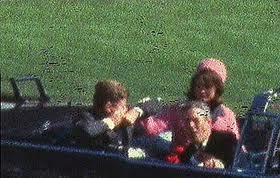
A look at the assassination of President John Fitzgerald Kennedy through the eyes of a 7-year-old …

My memories of that day in 1963 are disjointed and spotty.  About what you would expect from a 7-year-old, who was too young to grasp the significance, the gravity of what had happened … A child too innocent to realize how harsh the world could be.

I was barely aware that John F. Kennedy was President.  My appreciation for what he meant to the country politically or to my Irish-Catholic parents culturally was lost among the toys and activities of a sheltered childhood.

Lyndon B. Johnson  takes The Oath of Office

Lyndon B. Johnson
takes The Oath of Office

I can remember sitting in Sister Ann David‘s first-grade class at the Immaculate Conception grade school on Chelten Avenue in the East Germantown section of Philadelphia, PA.  It was nearing lunchtime.  I had yet to completely synchronize my internal clock to the rigidity of your typical Catholic school day.  So I was constantly counting down the minutes to when I could leap from my seat (single file line, of course!); grab my lunch; then run around the schoolyard until the interminable afternoon session began.

The first announcement was sudden and confusing.  Something along the lines of “Please say a prayer, the President has been shot!”

Then several minutes later the statement – much more subdued and unrushed than the first – resulting in days of dread for those older than me, including those selfless Sisters of the Immaculate Heart of Mary …

TV shot“The President is dead.”

Much of the rest of that morning is lost, that is until I got home early that afternoon after a hurried dismissal.

The oddities in a chain reaction, started on an unknown street in Texas, rippled for days through the country and the rest of the world like a rock that’s dropped into a still pond.  Our home was no different.

Coming home to find Mom on the living room couch, tears in her eyes, hand to her mouth as she watched the small black and white TV.  Dad coming home from work at the steel plant early and joining her in front of the TV – before even showering – for what seemed like hours.  Watching unfolding scenes from Dallas, Washington, D.C., and Philadelphia.  Mom beside herself; Dad comforting her with that dazed look on his face.

philly.com: When TV discovered what it could do

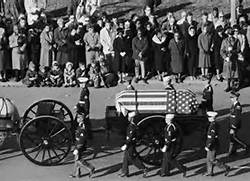
caissonDays where even the slightest sound or disturbance would illicit an urgent ‘Shhhhh …!” or a more comforting invitation to watch with them something I could not quite grasp.  A nighttime broadcast of an airplane, a hearse, a coffin on a high lift, groups of solemn people, a woman named Jackie, a new President …

Even in my child-eyed innocence I knew something profound had occurred … something ominous, unexpected, and shocking to every adult I saw.  You sensed their disbelief, their anger, their mourning.

They tried to explain what had happened, to whom it had happened, and why it was so incredibly sad.  You tried to understand.  You stayed close to your parents because you could feel an overwhelming sadness coming from them.  As a child, it was unsettling.

For four days our little world among a small strip of working-class homes revolved around a tiny TV set.  Back then this was an extraordinary exception to normal life.  I struggled to make sense of the images.

AP: Nation stopped for funeral

Entering Arlington National Cemetary

Entering Arlington National Cemetary

A closed casket sitting for days in front of a ceaseless procession of everyday citizens and dignataries, a parade like no other you had ever seen … a riderless horse, a two-piece caisson, funeral dirges in lieu of John Phillip Sousa marches, a church funeral service shown live on TV, a little boy caught in a child’s salute, something called an eternal flame …

At some point, it seemed like everything went back to normal, although I doubt any of those people I had seen or stayed close to over those four endless days ever felt that it did.

eternal flame

JFK’s Eternal Flame
at Arlington National Cemetary

Thomas Jefferson: The Art of Power (Jon Meacham)

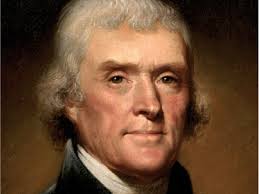
Thomas Jefferson 3rd President of the United States

Thomas Jefferson
3rd President of the United States

Jon Meacham‘s Thomas Jefferson: The Art of Power is the fourth book of his I have read.

Meacham makes history easy to read for even the most casual fan of U.S. history.  His management of theme through the issues of the day and the personality of the subject helps the reader see a broader picture of a man like Thomas Jefferson.

His approach to describing in overview the important events and critical issues; developments and solutions that evolved; giving the reader the essential insights without bogging down in a load of minutia.  Meacham’s works are thoroughly footnoted, which helps the real history junkie decide where they might like to do more in-depth reading or research.

The American Revolution, and the birth of the country which followed is a favorite subject of mine.  Of particular interest is the collection of men that came together in challenging times to take a dangerous stand against England; risking life and property for Liberty; then steering a course towards constitutional government that resulted in a Republic now over two centuries old.

These men were the wealthiest, most educated, and most successful in the American colonies.  But …

These men were not perfect.  They had their flaws.  Yet they came together and created a politically complex national union out of disparate regions and competing interests in such a way that enabled growth; promoted its survival through the tests of time; and allowed it to emerge from the crucibles of several dramatic – even catastrophic – national and international crises as an even stronger nation.

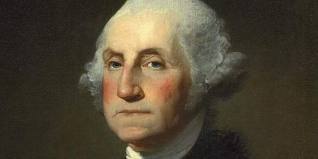
George Washington appointed Jefferson  the first U.S. Secretary of State

George Washington appointed Jefferson
the first U.S. Secretary of State

Thomas Jefferson‘s contributions to the success of The Great American Experiment in the period between George Washington‘s inaugural as our first President and Jefferson own presidency (following John Adams) were – in my opinion – the most compelling .

Citizens with a casual appreciation for American history might believe that once the U.S. Constitution was ratified as the Law of the Land, the Forefathers simply finger-skimmed the honored document whenever a question of function or politics arose.  But The Constitution was but a “blueprint” with many operational and philosophical issues undefined or at the very least open to all manner of nuance and interpretation.

Thomas Jefferson was one of those flawed individuals that rose to play a prominent role in taking that constitutional blueprint and – if I can stretch an analogy – installing the wiring and plumbing that allowed the Government to relate as best as possible to the People it would govern.  It was a herculean task that required the input and at times the nastiest of opposition between Federalists and Jefferson’s Democratic-Republicans to negotiate a national vision from contending philosophies of governance.

Jefferson was a study in contradictions throughout his personal life and public service.

Sally Hemings

Sally Hemings

1.  He was a man who passionately subscribed to the concept of Individual Liberty.  He made several attempts early in his public career to advance the concept of slave emancipation in the Virginia colony.  He provided insights for the French Declaration of the Rights of Man and of the Citizen via the Marquis de Lafayette, which became the central theme of the French Revolution; and he fought hard against John Adam’s Alien and Sedition Acts.

Yet he continued to own slaves; using one – Sally Hemings – as a concubine; and went so far as to maintain their offspring as slaves until they turned age 21 or until his death in 1826.

2.  As a member of Washington’s first American government, serving as its first Secretary of State, Jefferson fought aggressively with fellow Democratic-Republican James Madison to counter the Federalist’s efforts (Led by Alexander Hamilton and John Adams.) to create a strong national government with a singularly powerful Chief Executive.  Jefferson was fearful that such a strong centralized authority, with the prospects for close ties with Great Britain, would eventually whittle away at individual liberties.

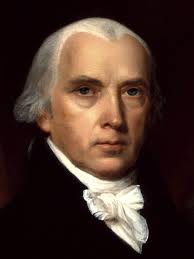
James Madison Fellow Democratic-Republican

James Madison
Fellow Democratic-Republican

However, when he served as President himself, he found a way to expand the powers of the presidency in order to take full advantage of a French proposal to effectively double the size of the United States through the Louisiana Purchase.

3.  Jefferson was an accomplished author of A Summary View of the Rights of British America (a list of grievances against King George III), The Declaration of Independence, and as contributor to the French Constitution.

But he wrote only one published book in his life, Notes on the State of Virginia.  And he was not much of a public speaker for such a renown politician and communicator!

Meacham’s primary theme emphasizes that in his quest for power, that he wanted for the good he felt he could accomplish, Jefferson was a practical politician.  He had his ideologies, his strongly held positions.  But Jefferson believed in “limited government” only to the extent that it was practicable.  If he thought a more expansive government was the better option in the best interests of the country (e.g. Jefferson’s quick actions to accept and ratify the Louisiana Purchase), he held no qualms about pushing the National Government’s reach and authority.

In the end, both the Federalists and Democratic-Republicans enjoyed a mixed success influencing the path of The Grand Experiment.  As bad as contentions grew in the early years of the Republic, it was clear both Federalists and Democratic-Republicans were advocating what they believed was best for The Country.

One can only hope the current crop in Washington, D.C. feels the same way for all the right reasons.  They certainly give you reason to question their over-arching objectives

A very cool John Adams

A very cool John Adams

Thomas Jefferson and John Adams formed the opposing poles of American political thought from 1790 to 1809, when Jefferson left the presidency.  They were close friends at one point, including Jefferson’s pleasant plutonic relationship with Abigail Adams; strong allies during the colonial confrontations with Britain; friends and co-commissioners to Europe (along with Ben Franklin) for the infant U.S.; and then nasty political opposites during those formative years of the constitutional republic.

They served as consecutive Presidents, then went to their separate corners of the country after leaving office.  They eventually renewed their friendship years later with frequent letters.  And on July 4, 1826 – coincidentally the 50th anniversary of the issuance of The Declaration of Independence – within hours of each other, first John Adams and then Thomas Jefferson shook lose their mortal coils and left the rest of the work on the grand experiment to later generations of Americans.

Other interesting aspects of Thomas Jefferson learned from Meacham’s Thomas Jefferson: The Art of Power:

  • Jefferson received his early inspiration for public life and politics at the age of 22, when he heard Patrick Henry give his treasonous Stamp Act speech in opposition to British taxation.
  • Jefferson’s term as Governor of Virginia changed his view on the use of authority.  His oft criticized indecisiveness and timidity during the British invasion of the colony in 1780 were also valuable lessons in leadership and government.

    Patrick Henry gives his Stamp Act speech

    Patrick Henry gives his
    Stamp Act speech

  • Jefferson was derisively referred to as “the negro president” by opposing Federalists, who disliked the congressional advantage Virginia and the other southern states enjoyed due to the 3/5 clause on The Constitution.
  • It took 36 ballots in the House of Representatives to finally confirm Thomas Jefferson as the 3rd U.S. President.  (Electoral College ties, which go to the House of Representatives, were common early in the Republic.)
  • Jefferson may have been the earliest President subject to an assassination plot (December 1804), although no overt attempt was actually made.
  • He requested just three of his accomplishments be etched upon his gravestone:  The Declaration of Independence, the Statute of Virginia for Religious Liberty, and Founder of the University of Virginia.

    Memorial marker at Jefferson's Monticello gravesite

    Memorial marker at Jefferson’s
    Monticello gravesite

  • Sally Hemings accompanied Jefferson’s daughter when he summoned her to France during his ambassadorship there.  By French law, as soon as she stepped foot in France Hemings was a free person.  Jefferson convinced her to return with him to America (additional evidence of their relationship) by negotiating an agreement with her that ensured eventual freedom for their offspring.
  • Philly Connection:  Jefferson leased a house from Thomas Leiper, a merchant and politician, at 274 High Street in the east Germantown section of Philadelphia when he served in the then nation’s capital as Secretary of State under George Washington.
The real John Adams

The real John Adams

Interesting Jefferson quotes …

  • Jefferson’s oft quoted words on fertilizing the Tree of Liberty was written in a letter to John Adams in comment on British criticism of U.S. instability in the wake of Shay’s Rebellion in western Massachusetts, which erupted over early financial difficulties in the infant U.S.

” … what country can preserve its liberties if their rulers are not warned from time to time that their people preserve the spirit of resistance? Let them take arms. The remedy is to set them right as to the facts, pardon and pacify them. What signify a few lives lost in a century or two? The tree of liberty must be refreshed from time to time with the blood of patriots and tyrants. It is its natural manure.”

  • Jefferson’s famous position on the separation of Church and State came from a letter to the Danbury Baptist Association in Ceaderbrook, Connecticut as they planned to celebrate religious liberty.

“Believing as you do that religion is a matter between Man and his God, that he owes account to no one for his faith or his worship, that the legitimate powers of the government reach actions only, and not opinions. I contemplate with solemn reverence that act of the whole American people which declared that their legislature should ‘make no law respecting the establishment of religion, or prohibiting the free exercise thereof,’ thus building a wall of separation between Church and State.”

  • Jefferson loved the use of guns for hunting and sport, and recognized their importance in defending Home and Homeland.

“I am a great friend to the manly and healthy exercise of the gun.”

  • Finally, Jefferson felt that  the U.S. Constitution was a worthy effort as imperfect as the brave men who declared independence in ’76.  But he was much dismayed by the lack of a bill of rights in the original version.  Still he saw hope for the good conscience of the American people.

“If they approve the proposed Convention in all its parts, I shall concur in it cheerfully, in the hopes that they will amend it whenever they find it work wrong.”

images-5

The Admirals (Walter R. Borneman)

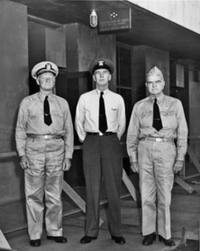
Fleet Admirals Chester W. Nimitz, Ernest J. King and Bill Halsey

Fleet Admirals Chester W. Nimitz, Ernest J. King and Bill Halsey

I have always enjoyed reading American history, especially about both the American Civil War and World War II.  One – a domestic conflict – determined the future course of America’s development as a “united nation”; the other – a world-wide conflict – resulted in America’s emergence as a global leader.

That’s not to say I have read everything out there on either subject.  And from time-to-time I run across a book that teaches me a new thing or two.  In the case of The Admirals, I gained a new perspective on America’s military leadership during the last world war to end all world wars.

Walter R. Borneman ‘s enlightening work focuses on the four admirals, who transcended the U.S. Navy’s pre-World War II rank hierarchy, to become the first five-star admirals in American history.  This development was made necessary by the British Allies’ penchant for Fleet Admirals and Field Marshalls.  The 5-star rank was added (by Act of Congress in June 1944) to the American military ranks to place U.S. admirals and generals on equal footing with their European counterparts.

Flag of the Fleet Admiral of the U.S. Navy

Flag of the Fleet Admiral of the U.S. Navy

Five-star ranks of Fleet Admiral were bestowed on the four U.S. Navy Admirals and subjects of the book: William D. Leahy, Ernest J. King, Chester W. Nimitz, and William F. Halsey, Jr.  Fifth stars have not been issued to a Navy officer since 1945 and the conclusion of World War II.

Prior to reading The Admirals I was much more familiar with the four U.S. Army Generals, who carried the five-star rank of General of the Armies:  George C.Marshall, Douglas MacArthur, Dwight D. Eisenhower, and Henry H. Arnold.  (Omar Bradley was added as a five-star General in 1950, the only officer in U.S. military service so honored after WWII.)

In The Admirals a new appreciation is gained for the leadership exhibited by two men often overlooked in most media presentations on the War in the Pacific.  Those men are Admirals Leahy and King.  Until I picked up The Admirals, I had no appreciation for the contributions they made in the prosecution of America’s WWII efforts.

The exploits and accomplishments of Admirals Nimitz and Halsey during the Pacific campaign are well-known and referred to relatively often.  For instance, the other night I could not resist watching part of the movie, Midway in which Nimitz and Halsey are prominent.  For that reason, the following speaks mostly of Bill Leahy and Ernest King.

____________________
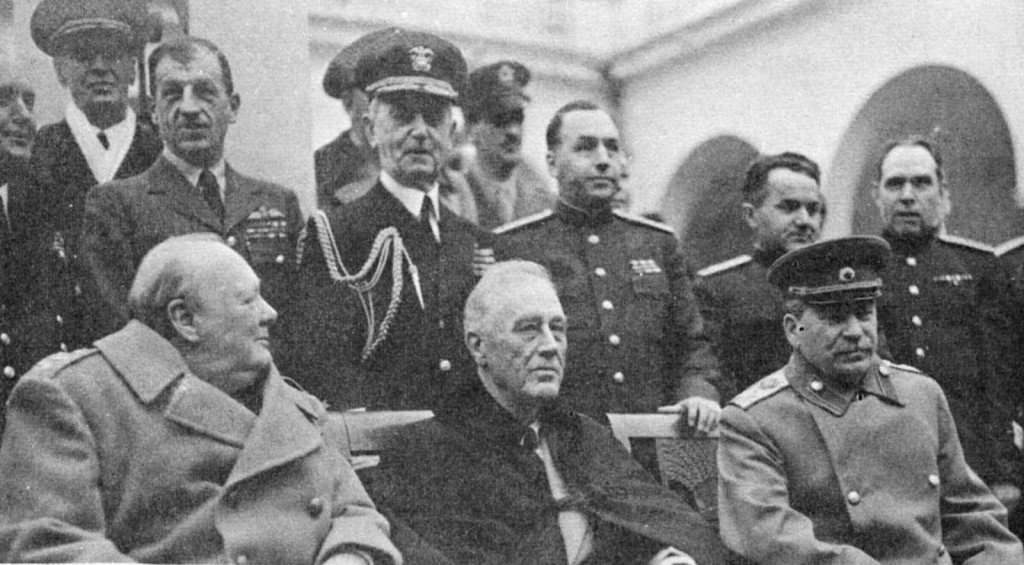
Admirals King, top left and Leahy, behind FDR, at the Yalta Conference in June 1945

Admirals King, top left and Leahy, behind FDR, at the Yalta Conference (June 1945)

Bill Leahy had been age-retired and was serving as Governor of Puerto Rico when the long-anticipated conflict with Japan broke with the attack on Pearl Harbor on December 7, 1941.  His friendship with Franklin Delano Roosevelt, cultivated during a period in his Navy career when – as a Navy captain – Leahy ferried the then Assistant Secretary of the Navy up and down the U.S. eastern coast.  Their relationship led to Leahy being named the Ambassador to Nazi-controlled Vichy, France when the Germans had overrun most of Western Europe.

Leahy’s role as ambassador was to influence the Vichy government from total subservience to the Nazi government, especially when it came to the remnants of the French fleet.  When the Vichy eventually fell in line with the Nazis through the elevation of the pro-German Pierre Laval to the head of its government, FDR kept his promise to the previously retired Admiral Leahy; brought him home from France; and recalled him to military service to help fight the war.

Leahy, left, and King, top right, in conference with Generals George C. Marshall, right, and Henry "Hap" Arnold, top left

Leahy, left, and King, top right, in conference with Generals George C. Marshall, right, and Henry “Hap” Arnold, top left

Tragedy befell Leahy as he prepared to leave the Vichy.  His wife, Louise died suddenly from medical complications of a rushed hysterectomy performed in France.

In time Leahy came to be viewed by  FDR and – almost as importantly – General George Marshall as the perfect candidate to become Chief of Staff to the Commander-in-Chief and Chairman of the Joint Chiefs of Staff.  From this position Bill Leahy would not only coordinate the military’s strategic implementations with FDR’s global considerations, he became the man The President relied upon more and more for all manner of domestic and foreign policy execution.

Admiral Leahy accompanied President Roosevelt to most of the major war conferences, being left behind once in Tunis and missing Casablanca due to a high fever.  He acted as a gatekeeper to information, communications, and personal access to FDR; coordinated execution of the both military and domestic presidential directives; and as Roosevelt’s health diminished, assumed responsibility for the daily functions of The Chief Executive.

The true testament to Admiral Bill Leahy’s effectiveness in those positions was his retention by Harry S Truman as his Chief of Staff for the entirety of his first term following FDR’s death in April 1945.

_______________

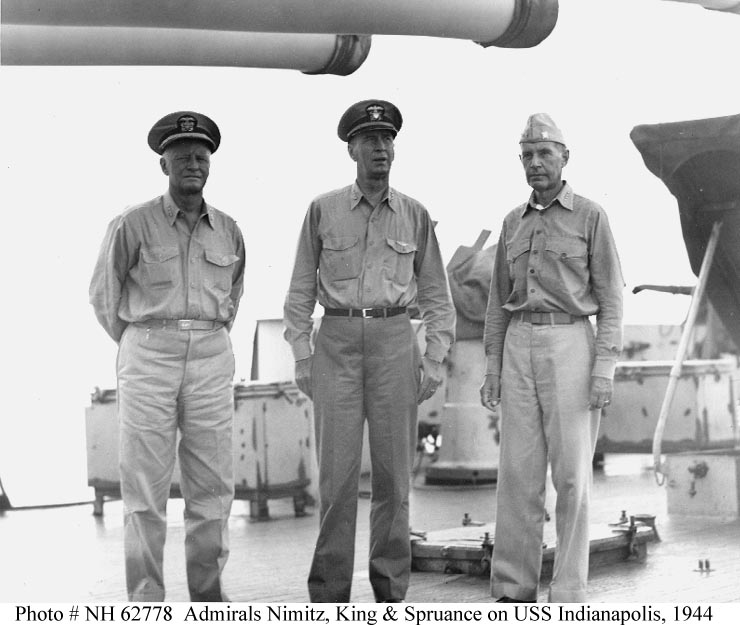
Fleet Admirals Nimitz and King with Admiral Raymond Spruance aboard the U.S.S. Indianapolis

You gain keen insight from the earlier, less exciting chapters of The Admirals for the process through which the U.S. Navy ensures its officers and future leaders are well-rounded and thoroughly trained.  In the pre-World War II chapters, Borneman concentrates on the early careers of his four study subjects.  What is learned is the important role played by the Navy’s Bureau of Navigation (Bureau of Navy Personnel since 1942), an administrative position that controls the assignment and detailing of naval officers throughout the vast opportunities offered by Navy service.  Each of the World War II five-stars is exposed to the various types of boats, ships and planes.  From destroyers, to submarines, through cruisers, battleships and aircraft carriers …

Although none of the four officers Borneman follows gains experience in every possible Navy assignment, the reader sees how each officer’s background developed and how those experiences contributed to their efforts, ideas and strategies during the war.

For a U.S. Navy plying the seas leading to an intriguing World War II theatre of operations in a Pacific Ocean covering tens of millions of square miles, this background provides perspective to the Navy’s evolution from a force built around the great battleships of the Great White Fleet to a fighting force oriented around the aircraft carrier and the long-distance reach of ship-borne aircraft.

It was this kind of ingenuity, an ability to take what was experienced and learned in career assignments that led to a vastly improved vision of modern ocean combat.  The kind of vision that most adequately prepared the U.S. Navy for the challenges of fighting a veteran Japanese navy in the expansive Pacific Theatre.

For this reason, Borneman’s focus remains almost exclusively on the Pacific side of the two-front war America faced during World War II.  There is little mention – aside from Admiral King’s assignment as Commander-in-Chief, Atlantic Fleet – of the Atlantic conflict that was more narrowly focused in the fight against the German U-boat.

__________________
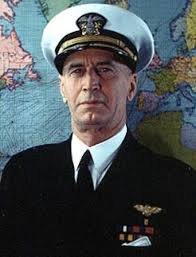
Fleet Admiral Ernest J. King

Fleet Admiral Ernest J. King

Ernest J. King was known as cold, career-oriented, hands-on boss with a penchant for hard-drinking, something which changed in the years just before the war broke out.  One of the most senior Navy officers, who was on the short list for mandatory retirement when the Japanese bombed Pearl Harbor.

Recalled to active fleet duty, King was initially assigned to lead the Atlantic campaign against the German U-boats.  After convincing FDR to use his flag-ship, U.S.S. Augusta in his initial meeting with Winston Churchill off the coast of Newfoundland, King began consolidating a leadership position that would eventually land him as Commander-in-Chief, U.S. Fleet (COMINCH).  From this position he would direct the overall strategy of fending off the advances of the Japanese in the Pacific even as the U.S. and its allies pursued its Germany First war strategy in Europe.

King realized that to leave the Japanese free to roam the Pacific, if the Allies became exclusively focused on Fortress Europe, would make retaking the largest ocean in the world that much harder.  Throughout the war King would beg, borrow and steal to keep the Japanese at bay, then slowly start pushing them back towards their home islands.

It was King who charged Nimitz with preserving the vital ocean links from the U.S. west coast to Hawaii and Wake Island as well as the ocean routes to Australia through New Caledonia and Saipan. A strategy that led to the early and successful battles at Coral Sea and Midway.

Admiral "Fighting Bill" Halsey on a Victory poster

Admiral “Fighting Bill” Halsey on a Victory poster

King also endorsed a plan, developed by his Operations Officer, Captain Francis “Frog” Low to bomb Tokyo with Army Air Force bombers launched from aircraft carriers known as the Doolittle Raid.  King’s global strategic vision made winning the war in the Pacific less costly than a myopic obsession with Germany First could have cost the Allies in time, lives and treasure.

As with such major world conflicts, even Allies don’t always get along.  Besides clashes with British and Soviet priorities and strategic visions, American military leaders had to deal with their own internecine struggles over power, resources, and tactical ideas.  As one would expect the U.S Army and Navy did not always see eye-to-eye on how and where the great battles should be fought.  And with personalities as large as Generals George Marshal and – more pointedly – Douglas MacArthur there were more than a few opportunities for paralyzing disagreement.

Borneman credits Admiral King for smoothing the often ruffled feathers of his Army counterparts, particularly MacArthur.  King’s relationship with General Marshall got off to a slow start; would never be particularly close; but was always of mutual respect.  King wholeheartedly endorsed Eisenhower to head the North African invasion (Operation Torch), a success that led to Ike’s leading of the D-Day invasion of Normandy, France (Operation Neptune).

MacArthur, as most who competed with or tried to control would learn, was another story.  But King was deft at keeping MacArthur from interfering too much in the Navy’s war efforts; and usually was able to keep him happy enough to remain an effective threat to the Japanese.

_________________

In an attempt to summarize this very long post, Borneman’s The Admirals forces the reader to focus on the complexities of developing properly trained, strategic-thinking naval officers; the prosecution of wide-ranging global warfare on a scale rarely seen in any generation; and the way personalities and the politics of leadership comes together in just one arm of the U.S. military.  In a war that encompassed much of the globe and no less than three major Allied powers, respective political establishments and military organizations, it is a tribute to confident and visionary Allied leadership that the effort didn’t simply collapse under the weight of its divergent personalities and priorities.

Admiral of the Fleet Chester W. Nimitz at Japanese surrender Behind him stand MacArthur, Halsey and Admiral Forrest Sherman

Admiral of the Fleet Chester W. Nimitz at Japanese surrender
Behind him stand MacArthur, Halsey and Admiral Forrest Sherman

Other random bits of knowledge picked up from reading The Admirals:

  • Vice Admiral Ernest King staged an attack on Pearl Harbor in 1938 from the U.S.S. Saratoga as part of Fleet Problem XIX manuevers.  The result was complete surprise.
  • When asked what won the war in the Pacific, Bull Halsey stated, “I would rank them in this order: submarines first, radar second, airplanes third, bulldozers fourth.”
  • By FDR’s fourth inaugural, Roosevelt was so weakened and Bill Leahy so trusted by the President that it was Leahy who rendered Roosevelt’s remarks at his fourth inaugural dinner.
  • In early December 1941 Vice Admiral Bill Halsey commands Task Force 8 on a mission to reinforce one of America’s isolated island bases.  Bad weather delays their expected return to Pearl Harbor on Saturday, December 6.
  • Ensign Chester A. Nimitz ran his very first ship command, the destroyer U.S.S. Decatur, aground on a reef near Manila Bay in 1908, an event that usually dooms a Navy officer’s career.  He also once jumped into the water to rescue an overboard sailor who could not swim.
  • Admiral Nimitz almost died in a PB2Y Coronado (flying boat) crash at
    PB2Y Catalina

    PB2Y Catalina

    NAS Alameda after the Battle of Midway.  The crash was caused by a telephone pole-sized piling allowed to drift into the landing area.  The aircraft flipped onto its back and broke apart.  Although Nimitz escaped without injury, the co-pilot, Lt. Thomas M. Roscoe of Oakland, CA, was killed.

  • Early in the war, U.S. submarines were plagued by a host of defective torpedoes.  Many exploding prematurely or, when they did hit, simply emitting a hollow thud and sinking.  The problem wasn’t solved until well after the summer of 1943.
  • In another torpedo story, as FDR – with Admiral Leahy in tow – was sailing across the Atlantic Ocean to the Teheran Conference (November 1943 with Churchill and Stalin) aboard the battleship U.S.S. Iowa, the destroyer U.S.S. W.D. Porter decided to track the Iowa in a targeting exercise.  Inexplicably, with the President on the main deck watching a gunnery exercise, someone on the Porter accidentally hit the FIRE button for one of the torpedo tubes.  The Iowa’s skipper, Captain John McCrea, was forced to take violent evasive action to prevent the accidental assassination-by-friendly-fire of much of the country’s war leadership!

As you can see, there’s a lot of good sea and war tales in this very enjoyable and informative book.  And despite the length of this post, it barely scratches the surface.  If you have a “WWII habit” like I do, you should find a few new topics in The Admirals to scratch that itch.

Thoughts for a Memorial Day

memorial-dayAnother Summer is upon us!  As always, the quasi-official start of Summer is marked by the three-day Memorial Day weekend and its rituals of beach days, barbecues, and neighborhood parties.

It is no doubt the most favorite time of the year for Americans from Georgia to Oregon, Minnesota to New Mexico.

As Americans however, it is also important that we take a bit of time during what looks to be a glorious weekend in the greater Philadelphia area to remember the meaning of Memorial Day, a day set aside to honor the sacrifices made by thousands and thousands of citizen soldiers since the founding of the United States of America in 1776.

Common people – not unlike many of us – chose to leave families, to forego careers, and to risk the opportunities that a full and vibrant life offers in order to preserve those same possibilities for their fellow Americans.  It’s a Choice many of us, be it through luck or timing or fortuitous periods of peaceful coexistence, may never have had to face.

This post is dedicated to those who faced the danger, to the sacrifices they made, and to the loved ones they too often left behind.

There but for the Grace of God …

.

One Congressional Medal of Honor posthumous recipient only recently returned home after 50 years lying in a North Korean grave.

Army Lt. Col. Don C. Faith Jr.

Army Lt. Col. Don C. Faith Jr.

Army Lt. Col. Don C. Faith Jr. of Washington, Indiana

At the time of his death, Faith and his unit — 1st Battalion, 32nd Infantry Regiment — were attached to the 31st Regimental Combat Team as it advanced along the eastern side of the Chosin Reservoir in North Korea.

During attacks by the Chinese People’s Volunteer Forces, Faith assumed command with his supervisor missing, and he continuously rallied his troops, personally leading an assault on an enemy position.

He was seriously injured by shrapnel on Dec. 1, 1950, and died a day later from those injuries. However his body was not recovered by U.S. forces at the time.

In 2004 a joint U.S.-North Korea team returned to the spot where Lt. Col. Faith was last seen and recovered his remains.  He was returned to his family and interred on U.S. soil just this past April.

.

Throughout American military history, there have been 15 Congressional Medal Honor recipients who earned The Medal for actions taken on the date May 27th.  Eleven of those 15 Medals were awarded during the American Civil War, five of which were earned by crew members aboard the Union ironclad U.S.S. Cincinnati when the ship was shelled and sank during a maritime assault on Confederate gun emplacements in the Siege of Vicksburg, Mississippi.

.

U.S.S. Drexler (DD-741)

U.S.S. Drexler (DD-741)

On May 27, 1945 – Okinawa, Japan – American forces attacking southward, continue to encounter heavy Japanese resistance. Japanese aircraft begin a two-day series of strikes against the Allied naval forces around the island. The destroyer U.S.S. Drexler is hit by two kamikaze planes and sinks so quickly 158 sailors are killed.

.

One particular Medal of Honor recipient from the Vietnam era caught my attention for his selfless bravery.

CHARLES CLINTON FLEEK

Rank and organization: Sergeant, U .S. Army, Company C, 1st Battalion, 27th Infantry, 25th Infantry Division. Place and date: Binh Duong Province, Republic of Vietnam, 27 May 1967. Entered service at: Cincinnati, Ohio. Born: 28 August 1947, Petersburg, Ky.

UnknownCITATION:  For conspicuous gallantry and intrepidity in action at the risk of his life above and beyond the call of duty. Sgt. Fleek distinguished himself while serving as a squad leader in Company C, during an ambush operation. Sgt. Fleek’s unit was deployed in ambush locations when a large enemy force approached the position. Suddenly, the leading enemy element, sensing the ambush, halted and started to withdraw. Reacting instantly, Sgt. Fleek opened fire and directed the effective fire of his men upon the numerically superior enemy force. During the fierce battle that followed, an enemy soldier threw a grenade into the squad position. Realizing that his men had not seen the grenade, Sgt. Fleek, although in a position to seek cover, shouted a warning to his comrades and threw himself onto the grenade, absorbing its blast. His gallant action undoubtedly saved the lives or prevented the injury of at least 8 of his fellow soldiers. Sgt. Fleek’s gallantry and willing self-sacrifice were in keeping with the highest traditions of the military service and reflect great credit on himself, his unit, and the U.S. Army.

.

The purpose of these posts during our most American of holidays is not to spoil the mood of a dawning Summer or to lay guilt at the feet of those of us who benefitted from selfless acts in far, far away locales.  It’s simply a reminder that as you enjoy your long weekend, take a moment or two to reflect on those – both living and deceased – who have made good times and fun weekends possible.

Lifting-an-Inflatable-Tank-620x412In closing I leave you with a happier story.  It’s about a group of soldiers in World War II, known as The Ghost Army, whose actions were purported to have saved many American lives in the lead-up to the invasion of Normandy, France and later in battles across western Europe

These soldiers were responsible for the creation of fake Army units designed to mislead German intelligence-gathering efforts and the tactical decisions that would result.  The unique way in which they were able to deceive enemy strategists was through the use of inflatable forms in the shape of tanks, vehicles, airplanes and artillery.

Although there is no definitive way to determine how many Allied soldiers might have been spared over Ghost Army efforts, one would conclude that the efforts German units undertook to destroy what amounts to an Army of Balloons, including artillery bombardment and air attacks, certainly had the desired effect on enemy decision-making!

And with that, I send wishes for a glorious Memorial Day weekend!

Killing Kennedy

300806jfkIt has become cultural cliché that everyone – old enough to be aware that day – remembers where they were when they heard JFK had been shot … or when the planes hit the World Trade Center … or 70 years ago when the Japanese attacked Pearl Harbor.

Yet by whatever definition we now describe such memories does not change the fact that they indeed will last a lifetime.  And as in the events described above, they will also transcend generational experience.

Friday, November 22, 1963 was a pleasant day for the week before Thanksgiving.  I was a first-grade student at the Immaculate Conception Roman Catholic elementary school located on Chelten Avenue in the Germantown section of Philadelphia.

UnknownIt was close to lunch when the quiet of the classroom was broken by the unexpected squawk of the intercom system.  At first just a confusing message to this 7-year-old, “Please say a prayer, the President has been shot!”  Initially all of us were puzzled, but the one image that was seared into my memory was the look of horror on Sister Anne’s normally placid face.

Minutes later came the words I remember so clearly, as though it was only yesterday, “The President is dead.”

111026.1L

A sign of those times in a Romans Catholic family, though not exactly what hung in our home.

What I remember most from then, particularly those days after the assassination was the reaction of my parents.  As Irish Catholics, the Kennedy election and inauguration held a special sense of pride for them.  In our house one wall contained two pictures, one of John F. Kennedy, the other Pope John XXIII … side by side.  The days after November 22 were filled with an almost non-stop vigil in front of the television, where we first witnessed some of the images that accompany our never-fading memories of those emotional days.
Recently I came across Killing Kennedy: The End of Camelot (Bill O’Reilly and Martin Dugard) in an unexpected place – my 23-year-old son’s bedroom.  It was a bit surprising given the way many historical events get lost within our natural focus on more current events.  But Brian has always been a bit of a book-worm, and was never very parochial about his reading choices.

And in his room I also found a Steven King fiction, 11/22/63, that revolves around the Kennedy assassination.  Of course I immediately confiscated it; and added it to my reading list as well.

Apparently, the Kennedy assassination had indeed transcended Brian’s generational experience and interests.

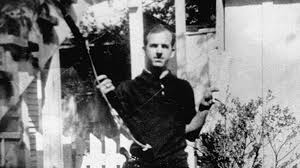
Lee Harvey Oswald

Lee Harvey Oswald

This is certainly not the first book on the Kennedy tragedy I have picked up.  My first in-depth look into that day in Dallas was Josiah Thompson‘s conspiracy piece Six Seconds in Dallas, a book that sowed all sorts of doubts in my young mind on the official version of the assassination as set forth in the Warren Commission Report.

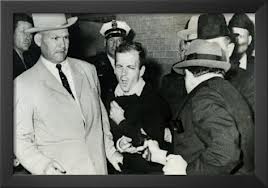
O’Reilly and Dugard do a credible job of identifying those organizations and criminal elements long considered as potential conspiracists in the Kennedy assassination.  Yet they do an even better job of describing Lee Harvey Oswald as a dejected reject of both the Soviets and Cubans, a man who always believed he was deemed for “greatness” despite doing little to achieve even a passing notoriety.

Even his relationship his wife, Marina, an increasingly disenchanted spouse, shows a man who had a very difficult time living up to even pedestrian expectations.  Oswald was the loser lone gunman that has become the all too familiar figure in many objectified killings, be they the assassination of key public figures or the serial killing of more common citizens.

Oimages-1ne of the well-developed themes of Killing Kennedy is the ability to look back through the perspective of time and pull an entire picture together.  The book looks back at the figures and events that led up to that bloody day in Dallas.  But it is even more interesting to relive those legends that surrounded the troubling facade of the Kennedy Camelot.

  • Most Americans from that era are familiar with JFK’s propensity for extra-marital relationships.  Chapter 5 of Killing Kennedy deals openly with Kennedy’s well-known affair with Marilyn Monroe.  But how many people dazzled by the Kennedy mystique ever considered the lengths to which his wife, Jacqueline Bouvier Kennedy (and later Onassis) went to enable – if not condone – said dalliances?

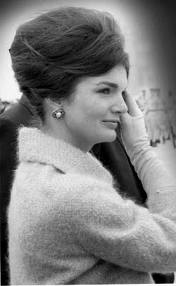
    Jacqueline Bouvier Kennedy

    Jacqueline Bouvier kennedy

Jackie was known to leave The White House almost every Thursday for weekends away at the family’s Glen Ora estate in Virginia.  She was no fool when it came to JFK’s escapades, yet she left him each weekend alone with Dave Powers, who kept a constant stream of young women accessible to the President.

Kennedy actually claimed that he needed sex almost every day to prevent debilitating headaches (the male twist on the headache-sex relationship?).  As for Jackie, she eventually took the unusual step for the 1960s and sought frank, explicit sex advice from Dr. Frank Finnerty, a cardiologist and family friend, in an attempt to improve the First Couple’s intimacy and keep The President from wandering.

  • Another interesting facet of Killing Kennedy is its frank discussion of the Bay of Pigs disaster, that ill-advised, poorly executed attempt to invade Cuba and overthrow the young revolutionary, Fidel Castro.  One  factor in the military disaster was Kennedy’s own part in forcing the Bay of Pigs plans to its infamous conclusion.  Kennedy was particularly hard on the images-2Eisenhower Administration’s for what he described as its soft stance on Communism – and Cuba in particular – in the 1960 election campaign against Vice President Richard Nixon.

After such a showing Kennedy was in no position to forego a plan that had its origins in the Dwight Eisenhower administration despite his obvious misgivings in the lead-up to the invasion.  Once it became apparent that the invasion would fail, Kennedy further complicated his mistake by being indecisive and timid; and then abandoning the effort completely, leaving many of the Cuban expatriates spearheading the invasion to die or to suffer years of imprisonment in Castro’s new Cuba.

  • Amazingly enough it appears that the Soviet-Cuban Missile crisis resulted in Kennedy’s far wiser embargo strategy against Communist Cuba; and it also may have saved the Kennedy marriage.  Many within the Kennedy inner circle, even the men on the Secret Service detail, saw a marked change in JFK’s womanizing after the Soviets almost forced a nuclear showdown over placing offensive, nuclear-capable missiles on the island just 90 miles from Florida.  As a result of that nuclear near-miss, the President appeared to become a much more family oriented and accessible husband and father.
  • It is not difficult to appreciate JFK’s actions to end racial discrimination in the South.  Although his
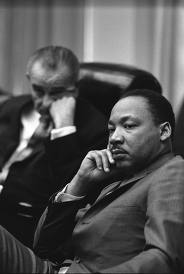
    Martin Luther King, Jr and LBJ at a meeting in the Kennedy White House

    Martin Luther King, Jr and LBJ at a meeting in the Kennedy White House

    civil rights efforts really found their impetus in Attorney General Bobby Kennedy, the actions – and reactions – taken in the early stages of the 1960s would continue as a central theme of the Lyndon B. Johnson administration and culminate in the Civil Rights Act of 1964.

As I read Killing Kennedy much attention was being given to the 50-year anniversary of the Birmingham campaign to protest racial discrimination .  It’s sobering to consider that just 50 years ago African-Americans – some as young as elementary school students – were motivated to expose themselves to physical violence at the hands of white law enforcement authorities to press their case for equal treatment under the law in the racially hostile South.  The author’s description of the Birmingham Children’s Crusade is provocative.

Other facts I found interesting and enlightening in Killing Kennedy:

  • Jack Kennedy was hardly the decisive Navy PT boat Commander immediately after PT-109 was cleaved in half by a Japanese warship in the South Pacific.  Initially Kennedy is hesitant to make command decisions, instead polling his crew as to the best course of action.  But he certainly made up for his timidness as the episode progressed.
  • Kennedy was in constant pain over most of his adult life as the result of injuries from the PT-109 incident.  To relieve his back pain, Kennedy liked to swim naked in the since removed White House pool.  This activity also led to some embarrassing episodes with young female staff members.
  • During the Bay of Pigs Kennedy was beset with diarrhea and urinary tract infection that severely tested his ability to concentrate.
  • Jackie Kennedy was a closet chain-smoker, who continued the practice even during pregnancy!
  • UnknownThe Kennedy’s despised LBJ; and him them.  This is not difficult to understand, given the way the Kennedy brothers brought Johnson onto the 1960 ticket in order to land the Electoral College votes of Texas then eviscerated his political power as Vice President.
  • Just weeks before his death, Kennedy already has the U.S. heavily involved in the survival of the South Vietnamese government.
  • JFK greatly embarrassed Frank Sinatra when he cancelled long-made plans to stay at Sinatra’s Palm Springs home following a speech at UC-Berkeley in 1962. This after Sinatra had already gone to the trouble of making significant changes to his property, even adding a helipad.  Instead Kennedy stayed at Bing Crosby‘s estate, purportedly bedding Marilyn Monroe for the first time there, because of Sinatra’s alleged relationship with La Cosa Nostra.  Sinatra, irate when Peter Lawford – a Kennedy by marriage – was forced to break the news, eventually became a Republican.

Regardless of whether you come from my generation, an earlier one, or a generation much younger and far removed from the shock of an assassinated President, you will enjoy the historical perspective provided by Killing Kennedy!

Veteran’s Day 2012

A few stories and events to consider as we observe Veteran’s Day 2012:

Congressional Medal of Honor

LINDSTROM, FLOYD K.
Rank and organization: Private First Class, U.S. Army, 3d Infantry Division. Place and date: Near Mignano, Italy, 11 November 1943. Entered service at: Colorado Springs, Colo. Birth: Holdredge, Nebr. G.O. No.: 32, 20 April 1944.

Citation: For conspicuous gallantry and intrepidity at risk of life above and beyond the call of duty. On 11 November 1943, this soldier’s platoon was furnishing machinegun support for a rifle company attacking a hill near Mignano, Italy, when the enemy counterattacked, forcing the riflemen and half the machinegun platoon to retire to a defensive position. Pfc. Lindstrom saw that his small section was alone and outnumbered 5 to 1, yet he immediately deployed the few remaining men into position and opened fire with his single gun. The enemy centered fire on him with machinegun, machine pistols, and grenades. Unable to knock out the enemy nest from his original position, Pfc. Lindstrom picked up his own heavy machinegun and staggered 15 yards up the barren, rocky hillside to a new position, completely ignoring enemy small arms fire which was striking all around him. From this new site, only 10 yards from the enemy machinegun, he engaged it in an intense duel. Realizing that he could not hit the hostile gunners because they were behind a large rock, he charged uphill under a steady stream of fire, killed both gunners with his pistol and dragged their gun down to his own men, directing them to employ it against the enemy. Disregarding heavy rifle fire, he returned to the enemy machinegun nest for 2 boxes of ammunition, came back and resumed withering fire from his own gun. His spectacular performance completely broke up the German counterattack. Pfc. Lindstrom demonstrated aggressive spirit and complete fearlessness in the face of almost certain death.

1865 – Dr. Mary Edward Walker, 1st Army female surgeon, was awarded Medal of Honor by Pres. Andrew Johnson for her work as a field doctor for outstanding service at the Battle of Bull Run, at the Battle of Chickamauga, as a Confederate prisoner of war in Richmond, Va., and at the Battle of Atlanta.

MULLIN, HUGH P.
Rank and organization: Seaman, U.S. Navy. Born: 20 March 1878, Richmond, Ill. Accredited to: Illinois. G.O. No.: 537, 8 January 1900. Citation: On board the U.S.S. Texas during the coaling of that vessel at Hampton Roads, Va., 11 November 1899. Jumping overboard while wearing a pair of heavy rubber boots and at great risk to himself, Mullin rescued Alfred Kosminski, apprentice, second class, who fell overboard, by supporting him until he was safely hauled from the water.

Interesting Veteran’s events occurring on November 11:

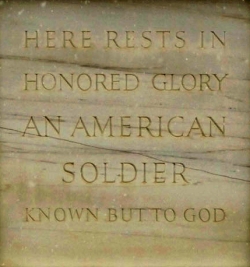
Inscription on the Tomb of the Unknown Soldier

1921 – Exactly three years after the end of World War I, the Tomb of the Unknowns is dedicated at Arlington Cemetery in Virginia during an Armistice Day ceremony presided over by President Warren G. Harding.

1942 – Congress approves lowering the draft age to 18 and raising the upper limit to age 37. In September 1940, Congress, by wide margins in both houses, passed the Burke-Wadsworth Act, and the first peacetime draft was imposed in the history of the United States. The registration of men between the ages of 21 and 36 began exactly one month later. There were some 20 million eligible young men-50 percent were rejected the very first year, either for health reasons or because 20 percent of those who registered were illiterate. But by November 1942, with the United States now a participant in the war, and not merely a neutral bystander, the draft ages had to be expanded; men 18 to 37 were now eligible. Blacks were passed over for the draft because of racist assumptions about their abilities and the viability of a mixed-race military.

1992 – By letter, Russian President Boris Yeltsin told U.S. senators that Americans had been held in prison camps after World War II and some were “summarily executed”.

2000 – President Bill Clinton led groundbreaking ceremonies in Washington DC for the National WW II Memorial.

(The above information extracted from This Day in U.S. Military History.)

A Tuesday like No Other

Last year, the ten-year anniversary of the 9/11 attacks didn’t seem to elicit much of a reaction in me.  I wrote one blog post that dealt with the physical, personal, and economic toll of America’s response to the attacks via the War on Terror … the war in Afghanistan, the number of wounded and killed American soldiers, the casualties suffered by the Afghan people, etc.  But the decade commemoration itself was not as noteworthy for me, troubling though that may be to some people.

I think it was the higher level of attention the ten-year mark received from the media, the Government, the City of New York and all those smaller communities that the tragedy touched that might have muted my own personal reaction.  These were people who were more directly and personally affected that rightfully deserved and received the attention of a country still mourning in many ways that tragic September day.

So I was a bit surprised to feel a bit more connected to this year’s anniversary – the 11th.  Not uneasy exactly … pensive might be the better word.  Why was a bit of a mystery to me.

Then I realized that this year’s anniversary would fall on a Tuesday.  And that’s when it clicked.  Due to that quirky 11-year Roman calendar cycle, September 11 this year would fall on the very day of the week it occurred in September 2001.  Tuesday … a bright, clear sunny day … cloudless sky, Indian summer temps … a Tuesday in Manhattan.

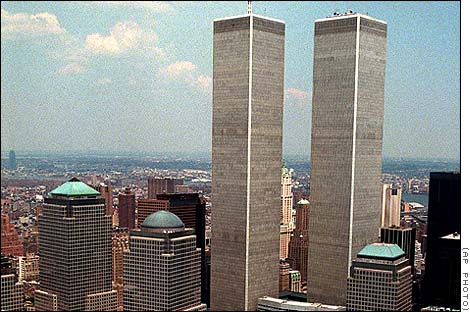
I was at work that day.  Had just gotten to my desk at the Naval Inventory Control Point (now NAVSUP Weapon Systems Support)  at 8:30 that morning, and almost immediately heard about a private plane that had crashed into The World Trade Center in New York City.  I remember thinking what stupid pilot could crash into such a huge building on a cloudless, crystal clear day.  When I found one of the randomly placed TV monitors located throughout the work spaces, I was struck by the size of the hole punctured in the side of the North Tower, almost like an aluminum can pierced by a bullet.  The hole didn’t look right.  It was too big for a private plane.  So when I heard it was a larger airliner, I wasn’t surprised … just more confused by the apparent ineptitude required to cause such a tragedy.

Then I saw the second plane hit, and the horror took on a totally different meaning.

I won’t bore you with my reactions to all the horrors that unfolded that day or the painful images we were to view over the following days and weeks.  What I will share were two reactions that for some reason have stayed with me through this decade-plus-one since that Tuesday in September.

The first was related to a local event that occurred just the weekend before … the semi-regular airshow at the now shuttered JRB Willow Grove had just concluded the Sunday before the attacks.  I can remember thinking that many of those pilots and ground troops that showed off their skills for the tax-paying public over those three days would soon be heading into harm’s way, actual combat, and the very real possibility of not coming home.

My second reaction was that Tuesday evening, taking a walk with the dog, and looking up into what’s normally a very active Northeastern sky.  I was struck by the absolute absence of any moving lights in that dark, star-filled sky … no air traffic at all … The realization that “they” could hit us here and could disrupt our normal everyday lives.  The thought gave me an empty, chilled feeling.

I just know if Tuesday morning opens with clear blue skies and Indian summer temperatures that empty chill will be back cold and hard in the pit of my stomach.

As you enjoy your 4th of July holiday …

… Remember the sacrifices paid to keep this country, its citizens, its future citizens, its traditions free from tyranny and oppression.

Of course the reason we will all be enjoying the Jersey shore, our National Parks, picnics, fireworks and apple pie is the anniversary of another year of The Grand Experiment, where a collection of 13 former British colonies took the first step towards forming a government “… by the people , for the people…”.

“The preservation of the sacred fire of liberty . . is finally staked, on the experiment entrusted to the hands of the American People.”  – George Washington

Thirteen years before Washington spoke those words in his first inaugural speech, fifty-six brave men put their names to a document – The Declaration of Independence – that gave birth to a new country at the risk of their own lives and the success of a rebellion against a powerful European ruler.  In 1776, these men dared Great Britain to defy their pledge to pursue life, liberty and happiness.

And on that very same date – exactly 50 years later – in 1826 both John Adams and Thomas Jefferson, the second and third elected Presidents to serve and protect this Grand Experiment succumbed to age and died within hours of each other.  In 1831 James Monroe, the 5th U.S. President also passed away.

Today, July 3 marks the anniversary of the high-water mark of the Southern Confederacy’s failed efforts to secede from the Union and enslave African people on plantations and in commerce throughout the South.  On this day in 1863, General James Longstreet’s corps, under the command of General Robert E. Lee and led into battle by General George Pickett reached the zenith of the Confederacy’s attack on Northern soil on the final day of the Battle of Gettysburg.  At a place known as The Angle Pickett’s Charge marked the ebb of the South’s attempt to force an end to The Civil War by threatening Northern cities and eventually the capital, Washington, D.C..

During the charge approximately 4000 Americans were killed or wounded.  The Battle of Gettysburg claimed roughly 35,000 killed and wounded.

The following day, the 87th anniversary of the signing of The Declaration of Independence, the Confederate garrison at Vicksburg, Mississippi under the command of Lt. General John C. Pemberton surrendered to General Ulysses S. Grant’s Army of Tennessee after a six-week siege of the city.  3200 Americans were killed or wounded during the siege.

The one-two punch of Gettysburg and Vicksburg formed a recognizable turning point in the American Civil War as Northern industrial might and an overwhelming population advantage formed an insurmountable barrier to future attempts by the South to force a political capitulation from the North.  And although the war dragged on for almost two more years, the South never really threatened the North again.

And finally on July 4, 1944 ….

Private First Class William K. Nakamura distinguished himself by extraordinary heroism in action on 4 July 1944, near Castellina, Italy. During a fierce firefight, Private First Class Nakamura’s platoon became pinned down by enemy machine gun fire from a concealed position. On his own initiative, Private First Class Nakamura crawled 20 yards toward the hostile nest with fire from the enemy machine gun barely missing him. Reaching a point 15 yards from the position, he quickly raised himself to a kneeling position and threw four hand grenades, killing or wounding at least three of the enemy soldiers. The enemy weapon silenced, Private First Class Nakamura crawled back to his platoon, which was able to continue its advance as a result of his courageous action.

Later, his company was ordered to withdraw from the crest of a hill so that a mortar barrage could be placed on the ridge. On his own initiative, Private First Class Nakamura remained in position to cover his comrades’ withdrawal. While moving toward the safety of a wooded draw, his platoon became pinned down by deadly machine gun fire. Crawling to a point from which he could fire on the enemy position, Private First Class Nakamura quickly and accurately fired his weapon to pin down the enemy machine gunners. His platoon was then able to withdraw to safety without further casualties. Private First Class Nakamura was killed during this heroic stand. Private First Class Nakamura’s extraordinary heroism and devotion to duty are in keeping with the highest traditions of military service and reflect great credit on him, his unit, and the United States Army.

Private First Class Nakamura was posthumously awarded the Congressional Medal of Honor.

And so, as you enjoy your holiday, your friends, your family … REMEMBER what it has meant to those who have sacrificed for all of us!

70 years ago this week: Battle of Midway Island (June 4-7, 1942)

(Today our Navy command observed the 70th anniversary of the Battle of Midway as in commemoration of the recent Memorial Day holiday.  This was a different take on Memorial Day observations as it took a look at a specific, historical battle.) 

Japanese Admiral Isoroku Yamamoto

As was mentioned in my previous Memorial Day post, the Japanese fleet set off for Midway Island on May 27, 1942.  Their intent was draw U.S. Navy carrier forces into a trap by attacking Midway Island, one of the few military installations U.S. forces occupied west of Pearl Harbor and the Hawaiian Islands.  Once U.S. carriers responded to the Midway attack by seeking out Japanese carrier force, the hammer of Japanese battleship forces would then attack and destroy the U.S. carrier fleet.  All the U.S. battleships assigned to the Pacific theatre had been destroyed or damaged just six months prior to the Battle of Midway when the Japanese attacked Pearl Harbor.

Several factors contributed to the eventual U.S. victory at Midway.

  • U.S. cryptologists had successfully figured out the Japanese code used for its operational forces.  The Japanese had been delayed in fielding their own more advanced code in the weeks leading up to Midway.  As a result, Allied forces in the Pacific were able to read Japanese message traffic, and knew both where and when – within a day or two – the Imperial Forces were expected to hit Midway Island.
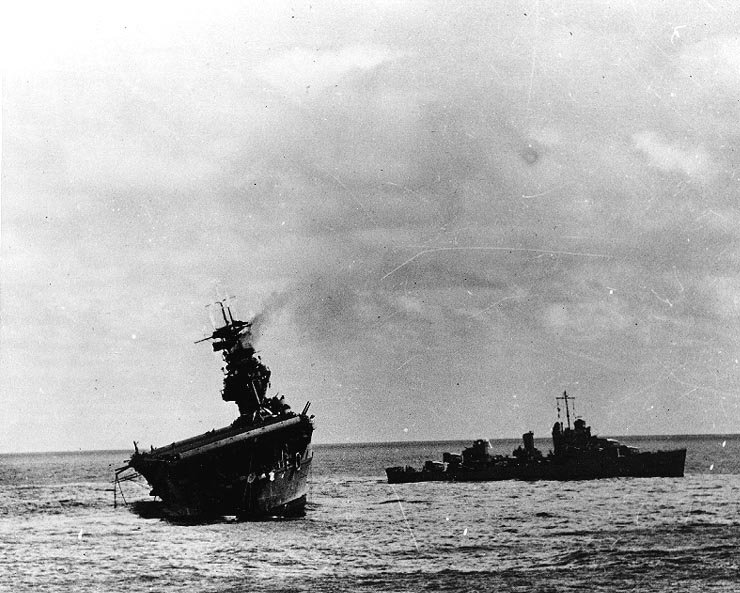
  • Aircraft carrier U.S.S. Yorktown (CV-5), heavily damaged and thought by the Japanese to have been sunk during the Battle of the Coral Sea (May 7-8), limped back to Pearl Harbor on May 27 and was turned around in sufficient fighting condition in just 3 days!  Yorktown was able to sail as the core of Task Force 17 on May 30.
  • On 29 May, seaplane tender (destroyer) USS Thornton (AVD-11) arrived at French Frigate Shoals to relieve light minelayer USS Preble (DM-20) on patrol station there. The presence of U.S. ships at French Frigate Shoals prevented the Japanese from refueling flying boats to reconnoiter Pearl Harbor.  As a result, the Japanese had no intelligence on the departure and makeup of Task Forces 16 (U.S.S. Enterprise and U.S.S. Hornet) and 17 (U.S.S. Yorktown). 
  • Radio silence insisted upon by Japanese Admiral Isoruku Yamamoto prevented what sporadic information Japanese intelligence could discern about Task Force departures from Pearl Harbor from reaching Vice Admiral Nagumo Chuichi‘s Carrier Strike Force.

Overview of the fighting during the Battle of Midway, as taken from the Naval History and Heritage Command, Battle of Midway link:  

U.S. Admiral Chester W. Nimitz

Just after midnight on 4 June, Admiral Chester W. Nimitz, based on patrol plane reports, advised Task Forces 16 and 17 of the course and speed of the Japanese “main body,” also noting their distance of 574 miles from Midway. Shortly after dawn, a patrol plane spotted two Japanese carriers and their escorts, reporting “Many planes heading Midway from 320 degrees distant 150 miles!”

The first attack on 4 June, however, took place when the four night-flying PBYs attacked the Japanese transports northwest of Midway with one PBY torpedoing fleet tanker Akebono Maru. Later that morning, at roughly 0630, Aichi D3A (“Val”) carrier bombers and Nakajima B5N (“Kate”) torpedo planes, supported by numerous fighters (“Zekes”), bombed Midway Island installations. Although defending U.S. Marine Corps Brewster F2A (“Buffalo”) and Grumman F4F (“Wildcat”) fighters suffered disastrous losses, losing 17 of 26 aloft, the Japanese only inflicted slight damage to the facilities on Midway. Motor Torpedo Boat PT-25 was also damaged by strafing in Midway lagoon.

Over the next two hours, Japanese “Zekes” on Combat Air Patrol (CAP) and antiaircraft fire from the Japanese fleet annihilated the repeated attacks by the American aircraft from Marine Corps Douglas SBD (“Dauntless”) and Vought SB2U (“Vindicator”) scout bombers from VMSB-241, Navy Grumman TBF (“Avenger”) torpedo bombers from VT-8 detachment, and U. S. Army Air Force torpedo-carrying Martin B-26 (“Marauder”) bombers sent out to attack the Japanese carriers. Army Air Force “Flying Fortresses” likewise bombed the Japanese carrier force without success, although without losses to themselves.

Between 0930 and 1030, Douglas TBD (“Devastator”) torpedo bombers from VT 3, VT-6, and VT-8 on the three American carriers attacked the Japanese carriers. Although nearly wiped out by the defending Japanese fighters and antiaircraft fire, they drew off enemy fighters, leaving the skies open for dive bombers from U.S.S. Enterprise and U.S.S. Yorktown. VB-6 and VS-6 “Dauntlesses” from Enterprise bombed and fatally damaged carriers Kaga and Akagi, while VB-3 “Dauntlesses” from Yorktown bombed and wrecked carrier Soryu. American submarine Nautilus (SS-168) then fired torpedoes at the burning Kaga but her torpedoes did not explode.

USS Yorktown – June 4, 1942

At 1100, the one Japanese carrier that escaped destruction that morning, Hiryu, launched “Val” dive bombers that temporarily disabled Yorktown around noon. Three and a half hours later, Hiryu’s “Kate” torpedo planes struck a second blow, forcing Yorktown’s abandonment. In return, “Dauntlesses” from Enterprise mortally damaged Hiryu in a strike around 1700 that afternoon. The destruction of the Carrier Strike Force compelled Admiral Yamamoto to abandon his Midway invasion plans, and the Japanese Fleet began to retire westward.

On 5 June, TF 16 under command of Rear Admiral Spruance pursued the Japanese fleet westward, while work continued to salvage the damaged Yorktown. Both Akagi and Hiryu, damaged the previous day, were scuttled by Japanese destroyers early on the 5th.

The last air attacks of the battle took place on 6 June when dive bombers from Enterprise and Hornet bombed and sank heavy cruiser Mikuma, and damaged destroyers Asashio and Arashio,as well as the cruiser Mogami. At Admiral Spruance’s expressed orders, issued because of the destruction of three torpedo squadrons on 4 June, “Devastators” from VT-6 that accompanied the strike did not attack because of the threat to them from surface antiaircraft fire. After recovering these planes, TF 16 turned eastward and broke off contact with the enemy. COMINT intercepts over the following two days documented the withdrawal of Japanese forces toward Saipan and the Home Islands.

Meanwhile, on the 6th, Japanese submarine I-168 interrupted the U.S. salvage operations, torpedoing Yorktown and torpedoing and sinking destroyer USS Hammann (DD-412). Screening destroyers depth-charged I-168 but the Japanese submarine escaped destruction. Yorktown, suffering from numerous torpedo hits, finally rolled over and sank at dawn on 7 June.

Luck also turned out to be on the American side as well; but it was luck that was made possible through better intelligence gathering, cryptology breakthroughs, industrial capabilities (e.g. U.S.S. Yorktown’s quick shipyard turnaround), superior naval leadership and carrier tactics.  Not the least of any of the aforementioned factors, the fighting spirit, dedication, and bravery of U.S. military personnel determined the course of the Battle of Midway and by doing so, defined the high-water of Japanese designs for the Western Pacific.

Casualties were relatively light for American forces (300 dead, U.S.S. Yorktown sunk) compared to the over 3000 dead and four aircraft carriers lost by the Japanese.  The real measure of U.S. and Allied success was what the defeat did to Japanese designs to force the Allies out of the central Pacific so that Japanese forces could have their way in the western Pacific. 

From Midway forward, the World War II Pacific Theatre would slowly but decidedly turn to the Allies favor.  Due to the significant losses in aircraft carriers, airplanes, pilots, and even their trained aircraft mechanics, Japanese forces would suffer from the loss of air superiority.  And Japanese weaknesses in manufacturing capacity and the flow of raw materials made replacing lost ships extremely difficult and virtually impossible in the case of aircraft carriers.  As a result,  Japanese military operations would turn from offensive to defensive in nature as the Allies slowly closed the circle around the Japanese homeland.

The Battle of Midway, along with those at Coral Sea and the Doolittle Raid over Japanese home islands, marked the beginning of the Age of the Aircraft Carrier, which after 70 years still serves as the backbone of any prolonged American military presence in oceans around the world.

So despite that our Memorial Day has already passed, take a few moments to reflect on what these men and their machines accomplished in interests of freedom and American interests 70 years ago this week.

On Bravery, Honor and Commitment at Gettysburg

My eldest son and I just spent a day-and-a-half exploring the Battlefield at Gettysburg, PA.  This was a very typical Guys Weekend, doing the things we enjoy or simply find interesting and provocative.  We spent Saturday in Washington, D.C. witnessing the Phillies lose to the Nationals on our first visit to Nationals Park.  On Sunday we drove out to Gettysburg.

Historic-type excursions were not something we did much when the kids were young.  It’s difficult to justify dragging three children through an age-old battlefield when you’re the only one who finds it “interesting and provocative”.  The kids and the wife get bored; you feel rushed and more than a tad selfish; and it ends up not being a very enjoyable time for anyone.  Yet I was embarrassed by the fact that I had never visited Gettysburg, despite living in Pennsylvania my entire life.

Recently Mike Jr. started reading up on Civil War history; something I did somewhat intensely around 10 years ago.  Suddenly we had a new and fascinating subject on which we could talk and share opinions, insights, and information.  A few months ago, we agreed to visit the Gettysburg National Military Park together.

George Gordon Meade

The Battle of Gettysburg was the largest land battle ever fought on the North American continent.  Fought during the Civil War, it was a major turning point in Abraham Lincoln’s heroic efforts to preserve the Union of the United States.  Over 165,000 men converged on Gettysburg in late June 1863 in a dance of movement and counter-movement with which both armies were well acquainted.

Although there were no plans to engage at Gettysburg (Jubal Early‘s Confederates had raided and left Gettysburg days earlier.), the vagaries of war, where many men under different commands spread out over a wide area, resulted in a dramatic confrontation that lasted three days.  All that was needed to set off the conflagration was the rumor that Gettysburg had a supply of shoes, a cherished commodity for the often shoeless men of the Southern Armies.

General George Gordon Meade led the Union’s Army of the Potomac despite having been promoted from his Corps command to replace General Joe Hooker just three days before the battle.

The combined engagements were the bloodiest of the Civil War.  Over 7000 men were killed, over 33,000 wounded.  And almost 11,000 were listed as missing or captured.  Yet despite fighting that surrounded a well established town of 2400 people, only one civilian was killed.  Mary Virginia Wade died when a stray shot ripped through the door of her sister’s house.

When we arrived at the National Park, we headed out to visit the sites of the first day’s battles, all the while reliving scenes from the well-known historically based movie Gettysburg.  When you begin to get an overview of the battleground, you begin to realize the size and scope of the event.  Those of us without military experience fail to appreciate how much ground is involved in a major military engagement.  The depth and breadth of space required to accommodate major armies is truly impressive.

George E. Pickett

But the true magnitude of what occurred in Gettysburg in that hot, humid July in 1863 does not hit home until you visit the sites of fighting that occurred on Day 2 and Day 3.

Since we were saving the bulk of the Day 2 fighting (particularly Little Round Top and Devils’ Den) for our second day, we decided to take the walking tour of Pickett’s Charge (also known as Longstreet’s Charge), as provided by a National Parks Ranger.  If you ever have the opportunity, this is a great way to get both an overview of events as well as insights into the small individual feats and personal stories that underscore the drama.

As we stood on Cemetery Ridge looking west towards Seminary Ridge you suddenly realize the difficulty of that final charge made by elements of Longstreet‘s First Corps (Pickett in charge with Andrews’ and Pettigrew’s Divisions).  Across roughly a mile of wide open ground, exposed to artillery and then musket fire along the entire route.

Nowhere to hide, few places to take cover, against Union forces behind low reinforced battlements on high ground with undisputed command of the field and unobstructed fields of fire.  The dedication, courage and sense of honor necessary to march into that Field of Death is – simply put – unimaginable!

James Longstreet

Regardless of your views on the Confederate struggle, you cannot help but be awestruck by the bravery demonstrated that day by those wearing the ragtag uniforms of the Army of Northern Virginia under the command of Robert E. Lee.

At times I have found myself embroiled in heated discussion about the legitimacy of the South’s struggle. Not from the viewpoint of defending slavery, but in trying to place into perspective the role of everyday Southern farmers, artisans, college students, and back woods folk who did not own slaves themselves, but believed they were fighting to define their Right to Self-Determination.  Their allegiance was to their State as their Country at a time when the U.S. of A. was still trying to define itself as a Country of States.

Too many people want to boil it down to the preservation of slavery as the only motive behind The Civil War.  But that’s an over-simplification.  There were other issues at stake …  a strong centralized government vs. a weaker national presence in favor of strong, independent States; the economic interests of the agrarian South (slavery) in the face of a more populous, industrialized North; the Right of individual States to come and go as they chose, depending on their agreement with National policies and actions; and the State Nullification of Federal Laws when States disagreed or were disadvantaged by said laws.

Both sides in the conflict were pushed to war by fiery speeches and political posturing that portrayed “the other side” as threats to the existence of the other.  In the end, it was mostly the common man who paid the price on blood-soaked fields defending their homelands or in not-so-distant sister States.

Our second day was spent on a paid two-hour car tour led by an elderly gentleman named John Everude.  For a reasonable $65 (not including tip) we received an interesting and enthusiastic overview of the entire three-day battle as well as events leading up to the largest land battle on American soil.  This is well worth the price should you ever decide to visit Gettysburg.  (Reservations must be made at least three days prior to your visit.)

We spent the rest of the day exploring the sites of the Day 2 battles at Little Round Top, Devil’s Den, the Wheat Field and Peach Orchard.  We visited the site of the 20th Maine‘s heroic stand and bayonet charge down Little Round Top as made famous in the aforementioned movie, Gettysburg.

Joshua Chamberlain

When you walk and gaze upon a terrain broken by boulders the size of cars piled atop and massed together in the low-lying Slaughter Pen and along the heights of Devil’s Den, you acquire an appreciation for the hardships both sides faced as they struggled to control the far left segment of the Union line, as it was attacked by Longstreet’s Corps.

Mike and I marveled at the terrain held by the Joshua Chamberlain‘s 20th Maine and over which it executed its bayonet charge against John Bell Hood‘s 15th Alabama Regiment.  You cannot imagine how the 15th charged up that rugged hill, let alone how the 20th Maine could possibly have charged down it!

It’s only when you walk this ground that you realize it’s impossible to comprehend the Bravery needed to Honor one’s Commitment to Country and to comrades.  Yet these men did it to the ultimate betterment of us as a People and as a Country.