On this date in 1945 …

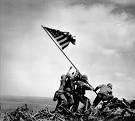
… One of the most iconic events in American history occurred with the raising of the Stars and Stripes by U.S. Marines on the Pacific island of Iwo Jima (now known as Ioto). 

Raising the flag on Mount Suribachi

It is important to keep these incredible feats of bravery in the collective field of vision.  Generations of Americans to follow will become – very naturally – more removed from and less aware of these proud military accomplishments.

I readily admit, I have very little knowledge on the heroics of those who served in World War I.  This due to the fact that fewer and fewer of those veterans were around, and their exploits were in many ways overshadowed by other events – like WWII – that followed.

Whenever I take the time to sit and watch a favorite WWII flick (Saving Private Ryan and In Harm’s Way are two of my favs) or docudrama (Band of Brothers), I always have to remind myself that these were kids doing incredibly difficult and mortally dangerous acts. 

So simply take a moment from time to time to consider the immense sacrifices made in the past to the benefit of the nation and its people, from the American Revolution to present day Afghanistan and Iraq. 

An overwhelming majority of the real heroes never make it home again.  So if the opportunity presents, thank a veteran for their service and sacrifice.  Appreciate the fact that for so many that opportunity was lost long ago.     

———————————————————————————————————–

Other events from this date:

1836 – Alamo besieged by Santa Anna; entire garrison eventually killed .

1847 – 5000 U.S. troops under General Zachary Taylor defeats 15,000 Mexican soldiers under General Santa Ana near Buena Vista, Mexico.

1861 – With assassination threats rampant, President-elect Lincoln arrives secretly in Washington DC to take office.

1896 – Tootsie Roll introduced by Leo Hirshfield

1903 – Cuban state of Guantanamo leased to USA.

1904 – Control of Panamá Canal Zone acquired by US for $10 million.

1960 – Demolition begins on Brooklyn’s Ebbets Field.

1967 – 25th amendment (Presidential succession) declared ratified.

Birthdays:

George Handel, German-born composer (1685)

W. E. B. Du Bois, black American historian and sociologist (1868)

Peter Fonda, actor (1940)

Deaths:

John Keats, Romantic poet (1821)

John Quincy Adams, 6th POTUS (1848)

Thomas Woodrow Wilson, 28th POTUS (1924)

Aleksei Tolstoi, Russian poet/writer (1945)

Belated Happy Birthday, Mr. Reagan!

To commemorate Ronald Reagan’s 100th birthday this past Sunday, it seems appropriate to devote a blog entry to his significance for me, given the effect his two-term presidency had on my political views. 

An American Hero

For much of my post-college years I proved to be much more liberal in my political and social views than many of my life-long friends.  I can recall – with general fondness – the abuse I used to take at the hand of life-long friends during discussions that tended to spring up when young working-class guys get together over beers or maybe a card game.  Looking back at it now, it seems odd that so many of them held such conservative views, when all of us grew up in a blue-collar, urban environment that would normally be viewed as traditionally more liberal than conservative.    

But I learned to live with it. 

Then Jimmy Carter was elected President.  When Carter made his “crises of confidence” speech, which later morphed in the country’s “malaise”, I had enough of his weak – bordering on whiny – presidential leadership.  There had been an intolerable lack of presidential leadership in this country, as was clearly the case with Lyndon Johnson (Vietnam), Richard Nixon (Watergate) and Gerald Ford (being Gerald Ford).  Carter seemed like the latest in an undistinguished line of presidents.

Ronald Reagan was not what I was looking for in 1980.  I can remember watching Reagan in a televised debate, and quickly turning it off because my impression of him was one of a guy clearly in over his head.  I must have missed a helluva comeback performance, because Reagan went on to beat the stuffing out of Carter in November.  I’ve always wondered what chances Reagan would have had if there had been a stronger incumbent than Carter in The Oval Office.

In the end, I think I actually sat out the 1980 presidential election.

But what I learned in those early Reagan years was that he was the consummate manager.  He knew how to pull in the most qualified people to execute his strategies, then he got out-of-the-way and let them do their jobs.  Mr. Reagan eventually proved to demonstrate values, policies and initiatives that I came to appreciate. 

His administration’s efforts to build a 600 ship navy placed unmanageable pressure on the Soviet military and economy.  It was just one more factor adding cracks to the facade of the soon-to-fail Soviet bloc.  Reagan’s foreign policy initiatives included added emphasis on reducing the nuclear arsenals of both the USA and USSR in the Intermediate-Range Nuclear Forces (INF) treaty that laid the framework for the Strategic Arms Reduction Talks (START) treaty.  In fact, Reagan became such a popular icon in the Soviet Union that Mikhail Gorbachev asked Reagan to give a speech on free-market philosophy at Moscow State University.

But what struck me most was the way Reagan restored a sense of strength and leadership in The Oval Office.  Reagan’s performance, whether one agrees with his pragmatic approach to governance and belief in American exceptionalism (the shining city on the hill),  turned the attitude of country around from the aimlessness of the Carter years. 

By the end of Reagan’s first term I was a convert, not only to the Reagan philosophy but to more conservative views on social and economic matters.  I voted for Reagan in his re-election campaign against Walter Mondale.  And by the end of his presidency in 1988, I viewed Ronald Reagan as an American hero.

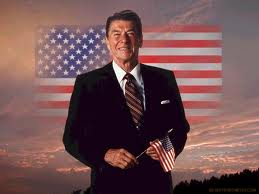
The above is one of my favorite pictures of Reagan.  I had it taped on my desk at work for years; and on more than one occasion it was suggested that the picture was disrespectful.  When confronted with this observation, I would explain that the picture was a favorite because it portrayed a side of Reagan no other President in recent memory would allow to peek through.  (When asked why he allowed himself this lapse in presidential decorum, the President simply said he had always wanted to do that to the press.) 

Ronald Reagan was unafraid to appear human, even self-deprecating.  I loved the picture because it showed President Reagan as a human being who cared more for that “shining city on the hill” than he did for the pretense of invulnerability.

Happy Birthday, Mr. President!

We miss you!

Happy Fred Korematsu Day!

(In a shout out to Jon, a debate counterpart on another website, the following was posted in response to his request for comments on California’s observation of Fred Korematsu Day on January 30.)

It (internment) was a travesty perpetrated on Japanese-Americans during WWII.  And it reflects – to a point – the mindset from the 1940s that Orientals were a lesser race of people.  It’s especially appalling given the experience of German and Italian-Americans during the same period.  But it’s not that easy – in my opinon – to fully comprehend or to condemn.

On one hand, you can rationalize to an extent the treatment of the Japanese in the immediate aftermath of Pearl Harbor.  Their race was viewed as being sneaky and ruthless, due to the nature of the Pearl Harbor attack contrasted with the false negotiations Tokyo held with Washington in the weeks leading up to the attack.

It’s also somewhat easier to comprehend when you read what the Japanese were doing in areas they had already conquered, like China.  If you get the chance, pick up the book The Rape of Nanking: The Forgotten Holocaust of World War II.  The Japanese were doing some nasty, nasty stuff in their own belief that THEY were the race superior to all others.

So I don’t think it’s as easy to dismiss the fear, distrust, and ethnic animosity that was present especially after thousands of Americans died in a surprise military attack.

Don’t get me wrong.  It was reprehensible treatment of fellow Americans, many of whom either fought or sent sons to fight in defense of their U.S. homeland despite – in some cases – family still living on the Japanese islands.

It was a horrible event during horrible times.

For Anglo veterans of the Pacific in World War II, many never got over what they experienced fighting the Japanese.  I recall a day out golfing with a good friend in the late ’80s/early ’90s, when we pulled up the 10th tee after the turn.  A group of older Anglo gentlemen were already on the tee, waiting for a group in the fairway to clear out.  One of the gents came up and – by way of apology – stated that they were waiting for “the gooks” to move on.  Being the smartass, I replied, “”You mean those Oriental gentlemen?”  And despite the fact that you could not determine from where we stood whether they were Japanese, Korean, Chinese or whatever, he dismissively snorted, “Not if you were in the Pacific during WW2!” 

For another perspective – though fictional – read Snow Falling on Cedars by David Guterson.  It deals with the real discrimination that Japanese- American World War II veterans faced in the years after the war ended.  A national award winner, it’s also an enjoyable read!

Reading List: “Game Change” – Heilemann & Halperin

(I’m sure many blogs are delving deeply into the recent SOTU Address and the analysis thereof.  But the SOTU has become such partisan political demonstration, I have a hard time even reading the media analyses, let alone actually watching the speeches themselves.  So today I’ll stick to a less aggravating topic, political history.)

Game Change was written by two political journalists, John Heilemann (New York) and Mark Halperin (Time). Both are regular contributors on Joe Scarborough’s morning MSNBC offering, Morning Joe.

Game Change takes a look at the 2008 U.S. Presidential race, including the critical Democratic primary run-up that saw the rise of Barack Obama to national prominence.

By far the most interesting aspect of the book is the meteoric rise of Obama, and the unseating of Hillary Clinton as heir to the throne.  John Kerry’s decision to invite a little known State Senator from Illinois to give a keynote address at the 2004 Democratic Convention resulted in recognition on a national level of Obama as a charismatic leader with the potential to unite and excite the various factions with in the Democratic Party.

But the depth and breadth of his appeal with little experience at the national level and absolutely no executive background puzzled many.

In one scene (p. 65) – to which many of us who watched this drama from the Republican side can relate –  a white woman in an Iowa focus group leading up to the caucuses there states, “There’s something about that guy; that’s the guy I want. I can’t even put it in words.”  The occurrence nicely summarizes the phenomena that launched his successful quest for The Oval Office.  Who is this guy?  How did he get here?  What’s the appeal?

For me, it’s a fascinating story. 

The play between the Obama and Clinton camps is the best part of the story.  Hillary actually coaches the newly elected Senator Obama during his very short stint in The Senate (141 days).  Yet the animosity for the Clintons within the Democratic Party, which lies just beneath the facade of support demonstrated by party leaders becomes all too easy for Obama to tap.  Just goes to show that if you’re considered the playground bully – as the Clintons were, it doesn’t take much to instigate a palace revolt!

Obama slowly starts to pull in party support and endorsements, including the defection of Bill Richardson, former New Mexico governor who served as Secretary of Energy and Ambassador to the U.N. in Bill Clinton’s administration.  And the theme of the book quickly becomes the befuddlement of the Clintons as political rugs are pulled out from beneath them time and again. 

Of course my first reaction to all this, as it peaked during the caucus and primary season in the summer of ’08, was not particularly flattering.  I kept recalling the campaign and election of James Earl (Jimmy) Carter.  I would shudder when I recalled all the excitement and media frenzy surrounding the peanut farmer with the big toothy smile.  Ever since, I can’t look at Planter’s Peanuts commercials featuring Mr. Peanut without getting nauseous.  Afterall, Carter has to go down as one of the worst Presidents in U.S. history.  I can still see the cardigan sweater-clad Carter sitting leisurely by a fireplace as he chided America about its defeatist attitude, which would later be described by Carter staffers as a national “malaise”.  Just a complete lack of leadership …

On the other hand, John Edwards and his late wife, Elizabeth, do not fare well in Game Change.  From John’s $400-1200 haircuts, his Rielle Hunter affair, and the knock-down drag-out fights it produces between them to Elizabeth’s unfortunate bout with cancer, her high maintenance needs and general surliness towards everyone, it’s an ugly picture.  How exactly Edwards thought he could pull off an affair with the attention-whore Hunter and still think he could be a good president is simply mind-boggling.  It’s the height of self-absorbed elitism.

Once Obama seals the Democratic nomination, the story turns to John McCain and Sarah Palin.  They come out looking better than the Edwards’, but not by much.  McCain comes off as an aloof candidate, prone to angry outbursts sprinkled with expletives; more concerned about dinner plans with his much younger wife, Cindi, than he is about campaign issues.  This includes a White House strategy session McCain instigates to offer his plans to right the economy during the banking crises.  McCain arrives at the meeting completely unprepared.  Obama end up doing a much better job of presenting his views and call to action.  As a result, even Bush43 wonders what the heck McCain’s point was in betting his political life by proposing the crises meeting.  

Sarah Palin shows her ability to wow a crowd, but becomes more of a drag on a sinking McCain candidacy.  Her obliviousness to even the most rudimentary political and foreign policy issues is alarming for anyone who was concerned about her readiness for the international spotlight.  I’m not a fan of hers, so some might conclude I’m letting the media influence me.  But there’s an awful lot of baggage there.  In the end though, it was the McCain campaign that did her in by shoving her into the national spotlight when she wasn’t ready for the national stage.

As you can see there’s a lot of meaty political nastiness and intrigue in Game Change.  Even as an avid reader, I NEVER read books on politics.  Political history, biographies?  Absolutely!  (Pick up some of Edmund Morris’ works on Theodore Roosevelt and Ronald Reagan!)  But never political tomes. 

But I was fascinated by the 2008 campaigns …  the changing fortunes of the Clintons, the meteoric rise of Obama, the RNC settling for an indifferent and low-energy McCain, Palin, the Edwardses …  It was a political soap opera.  If you feel – like I do – that the 2008 election cycle was so atypical for what we have grown used to over the past 20 years or so, you should definitely pick this book up! 

4 stars out of 5

(Hope you enjoyed this.  It’s been DECADES since I did a book report!)
Was slavery the only issue in U.S. Civil War?

The following was written as a letter to the editors at The Philadelphia Inquirer in response to several letters (See fifth letter down.) in the past week or so protesting commemorations of The Civil War as “glorifications” of slavery (i.e. commemorations in the southern U.S.).

I really do not understand all the sudden angst over observances related to the American Civil War.  I do not understand the insistence on framing the war totally within the context of slavery.  Anyone, who has taken the time to study the development of the American experiment through the 18th and 19th centuries and the origins of the hostilities that broke out in 1861, recognizes that slavery was not the only issue that defined the war.   

The American republic had many more issues before it than the horrors of slavery.  The questions of states rights, the strength of a centralized federal government, the interests of agrarian vs. industrialized economies, even the success of a Lincoln-led administration were all factors of immense national interest at stake.  As such, both the North and the South had legitimate vital interests in the conflict that went beyond the insidious practice of slavery. 

Slavery as the only issue related to the war does not explain Lincoln’s own admission that he would have resolved the conflict – if he could – without freeing a single slave.  It also does not account for the fact that hundreds of thousands of poor, non-slave owning Southerners fought willingly against the overwhelming advantages of the North.  The fact is that hundreds of thousands died in that war with no stake on the issue of slavery.  Many of them unemployed immigrants fighting for the North just for money to survive in a new world. 

There is no reason to restrict “glorification” of a preeminent event in American history solely to the issue of slavery.  To do so dismisses so much more that can be learned about how the United States stayed a united nation and the experiment continued on its epic journey.  

Mike —-

 All the angst seems motivated by the fact that the wrong people – Southerners – might want to commemorate an event that was also crucial to the history and development of that region.  Not to mention the fact that hundreds of thousands died there also, many of them dirt-poor farmers who did not own and could not afford slaves.

This is so much more about Liberal guilt over American history than it is any attempt to put that event into its proper historical context.