CML Idiot’s Guide to Lawn Care: Summer Recovery & Winter Preparations

(As stated in previous lawn posts here, these tips are based on my experience alone.  I offer no illusions of formal turf training or professional experience.  This is solely what seems to work for me and my Southeast Pennsylvania lawn.  Always proceed with caution and be mindful of conditions in your specific region.)

Few lawns in the mid-Atlantic region of the good ol’ US of A survive the summer unscathed, unless they are blessed with an in-ground irrigation system or a bountiful canopy of shady trees.  Mine has neither.  So every September consists of efforts at lawn recovery from another long, hot summer. 

Even with adequate rain, exposure to the summer sun and heat will cause brown and dead spots, usually in the same areas of the lawn year-after-year.  My trouble spots are concentrated along the eastern and southern exposures where the sun stays high in the summer sky for most of the day.  Each year I try to mitigate the damage; but regardless of what tricks I use, I have to repair sun and heat damage to the usual areas every September.

This is the best time of the Summer/Fall season to fix what the sun has wrought.  Any repairs taken now will give your lawn 8-10 weeks of Fall growing season, and a head start in the Spring.  I normally begin this effort over the Labor Day weekend.  Warm temperatures in the day and cool, dewy nights during September makes this an ideal time to regenerate growth.       

Remove browned dead grass:  An obvious problem is how to grow new grass with all that dead, matted grass in the way.  There are two ways of approaching this problem, depending on the size of the affected areas.  In my case I usually end up with one or two manageable patches of dead grass with other small patches spread throughout the lawn.  For me, the more practical solution is a good dethatching rake.    

Dethatching rake

  No human looks forward to raking in any way, shape or form; and as a warning, dethatching is probably the most physically demanding raking activity known to man!  So take your time and take care to rake lightly along the top of the lawn to minimize damage to healthy lawn plants and to the roots that remain from the dead grass you are removing.  Even roots from dead growth can regenerate if deep enough to escape the worst effects of sun and heat.  (For this reason, I suggest leaving dead, brown grass in place during the hottest summer weather.  I believe it provides some cover from excessive heat for salvageable grass roots.) 

Concentrate on small areas; pulls towards yourself, then rake forward to remove the dead growth from the rake tines. Work “up” the dead spot as dead growth will be dumped closer to your feet as you move along.   

Do not fret the removal of some green growth.  It’s inevitable given the technique and tools.  As long as you’re not pulling up healthy roots, any green growth removed will grow back.
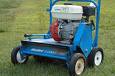
Lawn comber

Now if you have large areas or – Heaven forbid – an entire lawn in summer shock, you can rent a dethatching machine (a.k.a. lawn comb) from an equipment rental store.  The lawn comb makes much easier work of dethatching; and it’s not a bad idea to dethatch your entire lawn every couple of years.  Dethatching will not only remove topside dead growth, but also that underlying layer of dead growth from seasons past as well as any accumulation of dead leaves, twigs and other debris.  (I dethatched my entire lawn with a machine last September, and the results this Spring were impressive!)

 The combing action of the machine version also does a nice job of disturbing the top layer of soil that makes over-seeding a bit more effective.  Save yourself unnecessary clean-up raking by using your lawn mower with bagging attachment to remove the dead growth pulled up by either the dethatching rake or the lawn comber.

To seed or not to seed, that is the question!  Generally, I do not over-seed, unless I’m doing the entire lawn every few years as mentioned above.  Instead I prefer to let nature take its course, since I consider my lawn’s root system to be healthy enough to regenerate growth on its own. 

Weaker lawns should definitely be over-seeded.  If you decide to seed and live near me (southeastern Pennsylvania), try to avoid Kentucky blue grass and Bermuda seed in favor of a rye and fescue mix.  In my experience, neither blue grasses nor Bermudas tolerate the mid-Atlantic summers very well.   

If you apply seed, I suggest an application of starter fertilizer which will give the entire lawn a more concentrated boost that a weed ‘n feed.  REMEMBER: Never apply a weed ‘n feed to freshly seeded grass.  The “weed” component of a weed ‘n feed will inhibit the germination of any new seed.  Generally, you must wait six weeks after a seeding to apply a weed ‘n feed product. 

Fertilize:  Covered fairly well above.  Just let me reiterate … Starter fertilizer for either seeded or unseeded lawns.  A starter fertilizer will work regardless of whether you are seeding or not.  Weed ‘n feed not only fertilizes but also gives you a leg up on maintaining momentum against weed incursions the following Spring/Summer.  (I prefer to apply an extra weed ‘n feed application in September.  It will give my lawn a nice jolt going into Indian Summer, and it maintains the momentum of anti-weed efforts taken in the Spring.)  

One side effect of any fertilization at this time of the year is that you should plan to be mowing well into November.  But a thick, healthy lawn is worth it, right?!?   

Watering:  Don’t forget to water!  Keep an eye on your forecast; and make sure your lawn gets a sufficient watering, especially if you face a hot September and little rain.  An astute observer will also pay attention to the presence of dew on the lawn in the morning during late summer and early fall.  Warm daytime temperatures, followed by cool evenings can provide heavy dews that act to essentially self-water the lawn.  If you pay attention to these condition, you can better gauge whether watering the lawn is really necessary.  When in doubt, get the hose out!

Aeration:  If you did not aerate in the Spring, doing so in the Fall is a good alternative.  Some lawn aficionados will aerate in both the Spring and Fall!  I don’t.  But if you are faced with hard-packed soil, or your lawn gets a lot of foot traffic, aerating twice a year could be beneficial. 

Leaves:  Once the leaves fall from the trees, make sure you get them off your lawn as best you can.  Allowing leaves to cover your lawn over the Winter will exacerbate a number of problems, and can block early Spring growth.  (I have but one small cherry tree on my property, yet I get a thick covering of leaves from HUGE trees in neighboring yards.  I love the trees and the shade they provide our backyard in the summer, so I deal with the fallout begrudgingly.  My sole concession to my inherent desire to avoid unnecessary work is my refusal to undertake my final leaf roundup until every tree around my property has lost every single leaf, hoping in the meantime for windy weather favorable to blowing said leave into someone else’s yard!)       

Winterize:  Yes, this is another form of fertilization.  But since it’s done separately from your lawn recovery efforts, I treat it separately here.  Winterizing fertilizers are applied in the Fall, usually between Halloween and Thanksgiving.  The nutrients delivered by a winter fertilizer are stored in the grass’ root system, and provides a nourishment to your lawn in the early Spring.  It should be applied before the lawn goes dormant for the Winter.

CML Idiot’s Lawn Guide: Chapter 5 – Out, damn spots!

Well, it’s July and Cranky’s front lawn is showing signs that summer’s heat is taking its toll!  It’s an inevitable annual development.  No matter how much rain we get in April, May, June, it’s never enough to get the home turf through the summer unscathed.  And besides the heat, there are other dangers afoot …

Brown spots in your lawn can be caused by any number of things.  At this time of the year the culprits are innocuous occurrences that are simply magnified by the sun and heat.  For instance, I have noticed a good deal of spotting along the sidewalk in front of Cranky Man’s palatial estate.  At first I ran through the more dangerous threats, like over-fertilizing and grub damage; but after reviewing the overall condition of the East Lawn, I was able to eliminate both potential causes. 

There were three keys to my conclusion with a Confidence Factor of 90%:

  1. Spotting on the rest of the lawn was minimal (some from high-activity landscaping/gardening near the East Garden that fronts the East Lawn);
  2. There was scant evidence of grub-type insects in the soil and grass; and
  3. I caught the big golden retriever from down the block peeing along the spotted section of grass!

Often it’s the simplest explanation that causes discoloring to a lawn.  That’s why it’s important to look at the overall condition of your lawn before drawing conclusions about what the problem is and what the treatment should be. 

 The first conclusion MOST lawn overseers will make to brown spots at this time of year is grub infestation.  Late June – early July (Southeast Pennsylvania) is normally when you will begin to see the insects that develop from the white grubs that have the greatest potential to do damage to your lawn.  But that damage will actually be evident as early as April, when white grubs roust from their winter slumber to feed and mature into beetles (i.e. Those brown spots will appear well before the insects appear.)

In my case, it was dogs not slugs that were responsible for the brown spots.  As a dog owner, I can appreciate and make allowances for doggies doing a #1 on the lawn (just don’t leave its #2 lying about, please).  That kind of damage you can live tolerate, since its not permanent or pervasive.

And since grub treatments tend to be the MOST EXPENSIVE of traditional lawn treatments available at your local lawn supply store, it’s best not to jump to the conclusion that grubs are a threat to your lawn.  It’s important to know thy enemy! 

Personally, I haven’t applied a grub treatment for several seasons now, due to the relative scarcity of Japanese beetles (white grub=larvae stage) in late June-early July.  As has been the constant theme at Cranky Man’s Lawn, common sense, education and observation are important keys to sensible lawn care. 

Here are several good websites that will help you learn how to recognize, evaluate and treat a grub infestation:

Penn State University, College of Agricultural Sciences – PSU is a leading authority on turf management.

New York State Integrated Pest Management Program – Out of Cornell University   

University of Illinois – Pegged to lawn conditions in Northern Illinois, but good info!

Cranky Man’s twist on the above information, carefully fine-tuned from years of haphazard observation and other serendipitous methodologies:

  • NEVER use Japanese beetle traps during the height of an infestation.  I made this mistake a few years ago, until I realized these pheromone-baited traps (Some use a floral lure.) attracted THOUSANDS of randy beetles from MILES around (or so it seemed).  And since only a percentage of the attracted beetles actually get caught in the trap, you may just turn your lawn into a Best-Of-Beetle dating site, nursery and smorgasbord!
  • Small numbers of beetle larvae (See the PSU and Illini site for how to “survey” your lawn for unwanted guests.) are not a threat to overall lawn health.  Finding a dozen grubs in one square foot of lawn would indicate a significant pest problem.  If it’s less than that, you MAY NOT have a grub problem!
  • Look for damage from moles, raccoons, and skunks, or a number of birds doing a high level of foraging in your lawn.  They LOVE grubs.  If they like your lawn, chances are the grubs are there enjoying your lawn too!      

What to do about those ugly brown spots once either the heat, the dogs, or the grubs have done their dirty work:

  • Don’t overreact and rip up the brown grass.  No lawn grows much in the heat of summer.  Minimize the damage and protect the roots by leaving the unsightly – but useful – brown grass in place. 
  • Make sure you KNOW what the problem is before you treat it!  You can do MORE DAMAGE to your lawn applying fertilizer to a hot, dry lawn!
  • Wait until early to mid September, then remove the brown grass and spread seed and fertilizer over the affected area.  (This is always a good time to over-seed and fertilize your entire lawn.  More on that in a later posting.)  With good weather, you could easily get 6-8 weeks of autumn growth to give you a head start on Spring!  
  • Remember that it’s the  lawn’s overall health that’s MOST important.  Few lawns are free of bad spots, so temper your expectations during the hot summer.  Understand the problem; minimize the damage; repair it when conditions for growth are most favorable!

Good luck!

CML’s Idiot’s Guide for Lawns; Chapter 4 – Summer lawn survival

I have few prejudices in life; but the ones I have are deeply rooted and attended to as lavishly as my lawn care obsession!  They are in rough order of magnitude:

  • crabgrass
  • large dogs with inconsiderate owners
  • all other weeds
  • lawn mowing contractors
  • small dogs with inconsiderate owners

As you can see, I consider lawn mowing contractors roughly equivalent to “medium-sized dogs with inconsiderate owners”.  It’s not that I “hate” them per se; and I do not begrudge their need to earn a living or the demand for their services by home owners who simply don’t want to be bothered.

The truth is lawn mowing services rarely care about your lawn.  They cut your grass way too short – no matter how hot it is – in order to make it easier on themselves should rainy weather prevent them from making a weekly cutting.  And they tend to be sloppy and inconsiderate.  Case-in-point was watching my neighbor’s contractor – on Memorial Day morning no less – doing a sloppy job of mowing their lawn.  Had I known how sloppy the mess left on my side of the lawn was, I would have confronted them at the time.  But if you like large clumps of long, dried out clippings all over your lawn, then you’re in good hands!

But I digress …

The point of this post is to provide some uneducated, experience-related tips on how to help your lawn survive the long, hot, dry summer and then thrive once cooler temps return. 

My front lawn absolutely BAKES during the summer.  An east-by-southeast exposure, and the absence of shade or an irrigation system, guarantees that by late August it looks more like a lawn in Afghanistan than it does one in southeast Pennsylvania.  My back yard is exactly the opposite … plenty of shade provided by the house and large neighboring trees.  It still gets dry; but it doesn’t sun-bake nearly as much as the front. 

Differing conditions should influence how much time and care you dedicate to your lawn’s summer survival.  I will water the front yard every other day during hot, dry weather; but NEVER bother watering the back yard.

Common sense is the recurring theme in my suggestions for helping your lawn beat the heat and survive the summer:

  1. Make sure you fertilize regularly, especially in the spring and fall.
    • Search the tag cloud on the menu bar for Lawn Care to read these posts
  2. Don’t be afraid to let your lawn grow LONGERonce it starts getting HOT. (This is where the aforementioned lawn-mowing contractors are so often no friend to your lawn!) 
    • A well-maintained lawn will look fuller and more lush when allowed to grow longer.
    • Longer grass will collect and retain more moisture, even just from morning dew.
    • Longer grass also helps shade underlying soil, helps it retain moisture, and protects the plants’ roots
  3. When it starts getting hot, water regularly those sections of your lawn that tend to dry out first and turn brown.
    • It’s never to late to water; but do not wait until the lawn is already starting to brown to start watering.
    • Pay attention to weather forecasts for anticipated rains and plan accordingly.
    • Water in the evening when moisture has longer to soak the soil and reach plant roots.
  4. Use common sense when it comes to fertilizing during heat waves and dry conditions.  Don’t fertilize a severely dry or burnt lawn.  You’re likely to do more harm than good.
    • This is generally an issue only with anti-grub applications, normally applied around the 4th of July.  In my opinion, you could do more harm than any lawn pest by applying a grub treatment when your lawn is water-starved.
  5. When worse comes to worse and the lawn turns to straw, watering can still help to keep the roots from completely drying out. 

None of these suggestions will guarantee your lawn won’t turn brown.  If Mother Nature doesn’t cooperate with an occasional rain, only an irrigation system will keep your lawn green for any extended period of time during hot, dry weather.  

My lawn does not have an irrigation system.  So I TRY to water every other day (which is a practical compromise between wanting to water every day and the cost of doing so).  But even when I am conscientious about watering, without help from Above, my front lawn will stay green only for so long.  There is NEVER a summer where patches – usually the same spots each year – don’t thin out, turn brown, and resemble more closely straw than grass.  These areas get early special attention in an attempt to mitigate the damage.

The MOST IMPORTANT result is that my lawn usually bounces back pretty quickly because – I like to think – I’m sensible about keeping it in as good a shape as I can BEFORE the long, hot, dry summer starts taking its toll!  The secret is to pay attention to your lawn’s condition when Mother Nature turns on the oven, and to anticipate what needs to be done to protect it!  

Good luck out there!

Operation Digitaria

UPDATE/MISSION DEBRIEF:  Friendly forces successfully applied anti-crabgrass treatment (preemergent) along the contested northern border and behind enemy lines to a distance of 3-4 feet.

Operation Digitaria commenced at 1745 EDT on May 10 with a diversionary mowing operation.  Followed immediately by a lightening-fast (Well, for me anyway.), stealth application of said preemergent.

Mission success was threatened by temporary loss of rotary spreader capability caused by ingestion of foreign material related to spousal unit failure to properly clean hand trowel used for recent cemetary plantings. (SURPRISE! … I tend to store small garden tools in the spreader housing when not in use.)  Corrective maintenance returned spreader to full mission capability.  Operation completed without losses to personnel or equipment.  Initial observations indicate bordering forces did not observe and remain unaware of interdiction operation.     

END

Chapter 3 – Everyone’s lawn looks great in April

One early Spring evening while attending a soiree at my friend Bob’s house, he took me on a tour of his spread and pronounced how great his lawn looked.  I couldn’t help but level my candid Unofficial Lawn Guru assessment.

“Bob, everyone’s lawn looks great in April.”    

He was not pleased.  But the fact is, you could grow grass on your uncle’s bald head in April.  Between the wealth of wet Spring weather and the normal spurt of growth all plants enjoy as Spring breaks upon the land, it ain’t hard to grow anything in April.  The trick to developing and maintaining a full, healthy lawn is how it looks in July and August.  And how it looks in July and August has a lot to do with what you do with your lawn in April and May.  Admiring God’s Spring handiwork only gets you so far!

Of course the converse of my ULG assessment is also certainly true … that everyone’s lawn looks significantly worse in July and August (at least in this region of the country).  And yes, this includes Cranky Man’s home turf!  The real test of lawn health then is how well your grass rebounds in the following cooler months of September and October, as well as how it looks the following April when we start the cycle all over again.

And what you do in April and May is clean-up, fertilize, mow and aerate.  We have covered clean-up and aerating.  Today I’ll tell you what little I know about fertilizing.

DISCLAIMER:  These casual lawn tips are the product of trial-and-error experiences in the Philadelphia region of the Mid-Atlantic; and in no way reflect any formal training or pretentious claims to know what-the-hell I’m talking about .  Results may vary – and vary wildly – given your region, conditions, and level of common sense.  The lawyers made me do this.  Reader beware!

Fertilizing:  Generally I fertilize five times a year, running from crabgrass (early Spring), weed ‘n feed (late Spring), insect (mid-Summer), weed n’ feed II (early Fall), and winterizing (late Fall) treatments.  I rely on two types of Spring lawn fertilizing, crabgrass pre-emergent and weed n’ feeds.    

I concern myself only with a crabgrass pre-emergent (apparently there are several kinds).  The most important aspect to consider is timing when using a crabgrass pre-emergent.  If applied too late, it will not prevent crabgrass seed from germinating.  If applied too early, it will wash away or be absorbed too deeply in the soil to be effective.  Since crabgrass seeds germinate in the Spring when ground temperatures reach 55-60 degrees and stay there for several days, I recommend waiting until temperatures warm a bit to apply a crabgrass pre-emergent.  Since crabgrass treatments last for about three months, this should cover your lawn for most of the prime crabgrass season.

On the other hand, regular weed ‘n feeds can be applied as soon as the first weeds pop up.  Hopefully, these are popping up on your neighbor’s lawn, not yours.  But either way, a properly applied weed ‘n feed will not only kill whatever weeds you get, it will also give your lawn a nice growth jolt.

If you don’t have a “weed problem”, then you can apply a weed ‘n feed at any time.  However, if you have active weeds on your lawn, it is best to apply a weed ‘n feed after a rain heavy enough to thoroughly wet the grass, or very early in the morning when the lawn is dew-soaked.  Weed ‘n feeds are active weed killers that work by clinging to weed leaves and blooms.  Wet grass helps the fertilizer cling to visible weed plants.  So it is also critical that there be a 48-hour rainless period AFTER you apply the weed ‘n feed which allows the active ingredients plenty of time to do their dirty work.  So pay attention to rain forecasts before applying!

In years past, I would usually apply the weed ‘n feed now to give the lawn a growth spurt; then apply the crabgrass pre-emergent later, since I needed it only as a preventative measure.  However, I noticed last summer that crabgrass was popping up in places I had not seen it in a while.  The culprit turns out to be my non-compliant next-door neighbor, who has not as yet subscribed to the Unofficial Lawn Guru Code.  It’s a veritable weed and crabgrass farm over there!

So this year I will be in full weed-combat mode, with primary battle lines drawn along the northern frontier.  And this week – assuming continued warming – I will be applying a crabgrass pre-emergent in an attempt to lay down an effective defensive perimeter. 

This means I will push weed ‘n feed back until late May, which is fine considering the near weed-less condition of my thick green spread of lawn lushness. 

If you face a situation like mine, with non-compliant or semi-compliant neighbors causing unwanted weeds on your lawn, do what I do.  Buy a bit more fertilizer than you need to cover your spread, and apply it liberally to the offending lawn along the contested border.  You’ll be laying down an effective perimeter defense.  And if your neighbor sees you violating his airspace, he’ll think you’re just being Good Neighbor Guy.  He will never suspect your undercover guerrilla weed-warfare strategy!  So it’s …

Damn the dandelions!  Full speed ahead!!           

Good luck, and be careful out there!

Cranky Man’s Lawn Care: An Idiots Guide; Chapter 2 – Aerating

Pre-Brief:  Really, really wanted to aerate this weekend, but without snorkeling gear it would prove difficult.  (Had tix for tonight’s Phils game, also a washout.) Since you need to plan an aerating operation (i.e. equipment rental/reservation), here is Cranky Man’s Lawn Care chapter on lawn aeration to get you off your rider.  Good news is that wet weather makes for favorable aerating conditions.

Aerating:  Spring is  the best time of the year for aerating your lawn.  Aeration helps to loosen the top most layer of soil, which allows for fuller lawn growth.  Aerating – especially for high-traffic lawns – allows much-needed oxygen, nutrients and water to reach grass roots.

Soil compaction can prevent adequate root growth and development.  Since compaction is the problem you’re trying to treat by aerating, it’s important that you use hollow-core aeration equipment as opposed to a machine using solid spikes that actually compact the soil further.  A core aerator will deposit many, many little plugs of soil and grass on top of your lawn.  These plugs will deteriorate quickly and will not harm the grass.

Many lawn devotees will aerate TWICE a year – in Spring and in Fall.  I’m not that ambitious or obsessive so once a year in the spring suffices; sometimes even skipping a year with no concerns.  But my lawn does not have a high level of traffic in most areas.  The higher the traffic, the greater benefit aerating will have.  Aerating in the Spring – after melting snows and typical Spring rains – ensures deep core penetration and maximum benefit.  Too often aerating in Fall follows hot, dry summers and results in harder soil that will resist adequate penetration.

I would suggest going over very high traffic areas several times, overlapping as you go.

Many lawn owners will accompany aerating with overseeding.  I’m not a big believer in overseeding (assuming you are observing other Healthy Lawn Behaviors), but overseeding can benefit struggling lawns.

Next segment:  Fertilizing

Cranky’s Lawn Care: An Idiot’s Guide, Chapter 1: Clean & Green

When I decided to create this blog, for some reason working “lawn” into the title seemed to be a natural choice.  I take much pride, a few compliments, and much abuse for my Obsessive-Compulsive lawn tendencies.  Many a friend and neighbor, upon marveling at the fluffy greenness of my 1/4 acre “spread” say to me, “Mike, what do I need to do to get my lawn looking so incredible?!?”  But after listening to me yammering on and on about fertilizers, aerating, mowing, dethatching, edging, raking, etc., they usually pick up the phone and call a landscaper.    

So, in keeping with my nature, I will blog a bit about lawn care.  But as to not overwhelm the uninitiated; scare off the slackers; or offend the laissez faire “What lawn?!?” set, I will present my completely untrained, common sensical approach in a series of posts as I go about performing my own lawn care activities!

So without further ado …

 Clean & Green: (Yes, I am well aware this is backward from the blog title subtext of Green & Clean, Venting My Spleen; but you cannot get “green” unless you “clean” first!)

I love Spring.  I hate Spring.  I love the warming weather.  I hate the Winter cleanup.  It’s a love-hate Spring thing.

But cleanup is the first task we face when it comes time to prepare the lawn for the approaching growing season.  I despise the annual spring lawn clean-up.  I’m a minimal effort for maximum effect kind of guy. It’s my personal house & home mantra.  

I like a nice green lawn; but I hate the first step in getting there … Cleaning up the debris left over from Winter.  I consider this a necessary evil, from the minimal effort/maximum effect point of view.  There is nothing minimal about this effort.  And I absolutely hate to rake.

It’s important to get up all of Winter’s debris – mostly in the form of dead leaves – off the lawn.  Leaves tend to accumulate anywhere the lawn or soil is depressed (physically, not emotionally).  It’s important to give your lawn every opportunity to awaken from its slumber, and reach its tiny, groggy awakening blades towards the warming sun and nourishing spring rains.

Yeah, I know … That was a bit weird.

But dead leaves will suffocate existing grass, and will prevent new growth from developing under those wet, spongy remnants from last fall. 

I recommend using a good mower with a bagging attachment to keep raking to an absolute minimum.  (I hate to rake.)  Given that however, you simply can’t avoid doing SOME raking if you intend to properly clean it up.  To make it easier to handle, I suggest mowing in small sections; raking up whatever debris the mower misses; then picking up the dead rakings with the mower.  (Did I mention that I hate to rake?)

In the end, you’ll have the cleanest lawn in the ‘hood, and one that will be ready to take full advantage of the growing cycle.  And if you’re lucky, no more raking until Fall!

Next episode:  Aerating