Cranky Man’s Lawn Epistles ’12 – Help your lawn beat the heat

When it comes to my little 1/4 acre of turf, I have a few lawn care prejudices.  They are in descending order of irritation:

  • crabgrass
  • large dogs with inconsiderate owners
  • all other weeds
  • lawn mowing contractors
  • small dogs with inconsiderate owners

As you can see, I consider lawn mowing contractors roughly equivalent to “medium-sized dogs with inconsiderate owners”.  It’s not that I “hate” them per se; and I do not begrudge their need to earn a living or the demand for their services by home owners who simply don’t want to be bothered.  The truth is lawn mowing services rarely care about your lawn.  They cut your grass way too short – no matter how hot it is – in order to make it easier on themselves should rainy weather prevent them from making a weekly cutting. 

But I digress …

The point of this post is to provide some uneducated, experience-related tips on how to help your lawn survive the long, hot, dry summer and then thrive once cooler temps return. 

My front lawn absolutely BAKES during the summer.  An east-by-southeast exposure, and the absence of shade or an irrigation system, guarantees that by late August it looks more like a lawn in Afghanistan than it does one in southeast Pennsylvania.  My back yard is exactly the opposite … plenty of shade provided by the house and large neighboring trees.  It still gets dry; but it doesn’t sun-bake nearly as much as the front. 

Differing conditions should influence how much time and care you dedicate to your lawn’s summer survival.  I will water the front yard every other day during hot, dry weather; but I NEVER bother watering the back yard.

Common sense is the recurring theme in my suggestions for helping your lawn beat the heat and survive the summer:

  1. Make sure you fertilize regularly, especially in the spring and fall.
    • Search the Tag cloud or Categories on the menu bar for Lawn Care to read these posts.
  2. Don’t be afraid to let your lawn grow LONGER once it starts getting HOT. (This is where the aforementioned lawn-mowing contractors are so often no friend to your lawn!) 
    • A well-maintained lawn will look fuller and more lush when allowed to grow longer.
    • Longer grass will collect and retain more moisture, even just from morning dew.
    • Long grass also helps shade underlying soil, helps it retain moisture, and protects the plants’ roots.
  3. When it starts getting hot, water regularly those sections of your lawn that tend to dry out first and turn brown.
    • It’s never to late to water; but do not wait until the lawn is already starting to brown to start watering.
    • Pay attention to weather forecasts for anticipated rains and plan accordingly.
    • Water in the evening when moisture has longer to soak the soil and reach plant roots.
  4. Use common sense when it comes to fertilizing during heat waves and dry conditions.  Don’t fertilize a severely dry or burnt lawn.  You’re likely to do more harm than good.
    • This is generally an issue only with anti-grub applications, normally applied around the 4th of July.  In my opinion, you could do more harm than any lawn pest by applying a grub treatment when your lawn is water-starved.
  5. If worse comes to worse and the lawn turns to straw, watering can still help to keep the roots from drying out completely. 

The most important take-away here was best addressed by my Great Grandpappy* who used to say …

If you cut your lawn like a golf course fairway in May, it will look as lush an airport runway in July! *

(* OK, I never really knew my great-grandfather and barely remember one grandfather, but folksy wisdom always sounds more believable when attributed to someone older, wiser and near death.)

None of these suggestions will guarantee your lawn won’t turn brown.  If Mother Nature doesn’t cooperate with an occasional rain, only an irrigation system will keep your lawn green for any extended period of time during hot, dry weather.  So far this year, Mom Nature has been kind.  But like all women, that could change in the time it takes to narfle the garthok

My lawn does not have an irrigation system.  So I TRY to water every other day (which is a practical compromise between wanting to water every day and the cost of doing so).  But even when I am conscientious about watering, without help from Above, my front lawn will stay green only for so long.  There is NEVER a summer where patches – usually the same spots each year – don’t thin out, turn brown, and resemble more closely straw than grass.  These areas get early special attention in an attempt to mitigate the damage.

The MOST IMPORTANT result is that my lawn usually bounces back pretty quickly because – I like to think – I’m sensible about keeping it in as good a shape as I can BEFORE the long, hot, dry summer starts taking its toll!  The secret is to pay attention to your lawn’s condition BEFORE Mother Nature turns on the oven, and to anticipate what needs to be done to protect it!  

Good luck out there!

The missing Political Middle; the loss of American governance

Thank you, Jeb Bush for putting into words what I have been thinking for quite some time!  How exactly to express my frustration with a National Leadership that is getting absolutely nothing done.  Nothing fair, nothing honest … simply nothing at all.

Washington, D.C. is broken.  And while Jeb Bush touched on one aspect of the problem – the severe hyper-partisan divide, my frustration is centered on another cause of this political stagnation.

What has happened to the Moderate Middle in American politics?!?

First off, allow me to lay the basis of my beliefs for this post:

  • Hyper-partisanism is a problem with BOTH political parties.  The Democrats in Washington are just as hyper-partisan as the Republicans.  A point which former Florida Governor Jeb Bush acknowledged in his e-mail to The Associated Press this week. 
  • There is no such thing as RINOs (Republican In Name Only) or DINOs (Democrat-INO).   

I have a HUGE issue with this blatant misrepresentation, intended to do nothing more than silence all but those on the extreme Right or Left of the political parties.  This is also problem relevant to BOTH parties, although RINO seems to get much more play than DINO.  In my opinion, Liberal Dems are simply more subtle in their efforts to trample over The Middle.

There was a time when the Democrats included conservative elements, such as those in The South known as Dixie Democrats.  There was also a time when there were Liberal Republicans, those who were more liberal on social issues while sticking to the economic virtues extolled by established GOP Conservatives. 

Barry Goldwater, a stalwart Conservative Republican in the ’60s and ’70s was more tolerant in his views on social issues.  Goldwater even appreciated the need for Liberal viewpoints as a counterweight to conservatism.  Anticipating that Somewhere in the Middle the two would meet!

Well, that’s simply not happening anymore …

  • The true and proper context for these misleading labels – assuming we even need them – is CINO (Conservative In Name Only) or LINO (Liberal-INO)
  • The Political Middle is the real issue here.  Moderate political viewpoints and participation serves as a buffer to the far edges of the political spectrum.  And it offers a middle ground for the germination of political compromise. 
  • The problem?  The Political Middle has all but disappeared in this country!

I consider myself a Moderate Republican with conservative leanings.  I believe in Smaller Government, reduced Government spending, and a strong National Defense.  But I also hold more moderate views on Social Issues (e.g. poverty, illegal immigration, LGBT lifestyles, education, and women’s rights).  I believe there are times when increased Government spending is both necessary and unavoidable (e.g. economic crises, natural disaster, military conflict, international leadership). 

I have a pragmatic view about taxes.  I hate like hell paying them.  I despise paying more of them.  But at times you simply have to cringe and bear it.  And yes, some people should pay more if their financial means allow for it, especially when the condition of the fiscal house rivals an EPA Superfund site.

The spread of views I possess apparently classifies me for the title RINO.  Not that I care …

Yet this explains exactly how we have gotten to the point in this country where no National Leader will dare make compromise or reach “across the aisle” to work towards solutions to our very real problems. 

  • It led to President Obama’s decision to throw his own debt reduction plan – Simpson-Bowles Commission – under the bus, because – God forbid – we can’t deal with the specter of social benefit reductions at a time when the federal deficit is roiling out of control!  Don’t want to get on the wrong side of the Liberal political base!
  • It led to the recent attempt to recall Wisconsin Governor Scott Walker for nothing more than his desire to reign in state spending and break the cycle of union-politician cronyism.    
  • It led to the rejection by every single Republican Presidential candidate of the very pragmatic suggestion of increasing tax revenues by $1 for every $10 reduction in government expenditures.  Because – ya know – you don’t want to piss off the Tea Party or Grover Norquist …  

I wholeheartedly agree with Jeb Bush’s statement, “If you could bring to me a majority of people to say that we’re going to have $10 in spending cuts for $1 of revenue enhancement — put me in, coach.” 

Dealing in absolutes in politics is a recipe for stagnation.  Stagnation in Leadership, stagnation in developing solutions to real problems, stagnation in progress, stagnation in a much-needed, too long developing economic recovery.  What you get – what we have now – are both the Left and the Right burrowing down and digging in behind jingoism and intransigence. 

So how did we get here? 

In essence, the Political Middle has abandoned the political field of play to both political extremes.  It’s simple really to understand.  Most people disdain or – perhaps more accurately – are apathetic towards politics, especially given its hateful tone in recent years.  For those with no hard and fast anchors on the more edgy political and social questions of the day, politics are just nasty, dirty, aggravating … a waste of time better spent elsewhere.  In some ways, it’s hard to blame The Middle for its retreat.

On the other hand, those individuals who possess solid political and social issues anchors, see politics as a Means to their Ends.  And this is magnified in those who willingly describe themselves as Ultra-Liberals or Right Wing Conservatives.  For instance, they recognize the importance of the primary vetting process for weeding out Presidential candidates they perceive as weak on their respective anchor issues.  This is why the early primaries in Iowa, South Carolina, New Hampshire receive such out-of-proportion attention.  By the time those of us in Pennsylvania get the chance to cast a primary vote, the candidate list has been pared down to one or two candidates.  Indeed they will simply be the candidates who could repeat their talking points without making the Left or the Right throw up in their mouths.  

This explains how we so often find our National political choices limited to Evil and The Lesser of Two.  It explains why many well-qualified individuals will forego involvement in politics and the responsibility of civic leadership.  They simply won’t subject themselves to cannibalization by those on the edges of the political spectrum.   

 Yet few of those who survive this vetting ordeal can be elected without the votes of the Political Middle.  And so we see, as soon as the primary process ends, the rush by the annointed candidates to appeal to The Moderate Middle.  Their sole objective: to win a general election so they can continue to pander to the only segments who will pay attention to what they do and say afterwards – The Left and The Right.

And so the cycle repeats.    

What has happened to the Political Middle? 

I guess they think they have better, more important things to do.  They do not appreciate that crucial decisions on issues and problems that could potentially affect them for years are being made without their input, long before they – The Middle – even realizes another Election Day is coming.  And these decisions are not limited to the social issues that drive stalwart Liberals and Conservatives to action.  They include decisions critical to the economy, to education, to fuel and energy prices, the environment, the deficit, and ultimately their futures and the futures of their children. 

The Middle’s political apathy is – mildly put – mind-boggling! 

So while we wait for America’s Political Middle to wake up to today’s reality, the partisans dig in and refuse to budge, refuse to solve, refuse to govern.  The economy continues to falter; the federal deficit continues to grow.  We wait for yet another Presidential election where our choices are weak and uninspiring; all the while knowing, nothing’s going to change regardless of the outcome.

Jeb Bush recognizes part of the problem.  When will we recognize the solution is a formidable, continuous presence of Moderate political voices?

Find a wallet; make a friend … kinda

Saturday night Mrs. Cranky and I attended the wedding of a close friend’s daughter.  The events were held in two of the area’s nicer venues … the wedding ceremony atop The Water Works facility on the Schuylkill River; the reception across the Delaware River at the Camden’s Adventure Aquarium

Both venues were new experiences for me, which made both memorable.  The reception at the aquarium was very well done for the most part, especially if you like the idea of cocktails in the shark tunnel.  Eating with the carnivores – even if it’s only appetizers and hors’ devours – was a trip!

Unfortunately, the Camden waterfront was alive with another kind of species that night … teens and young adults attending hip-hop artist, Drake‘s concert at the Susquehanna Center.  I only say “unfortunately” because the Drake event was letting out just as the wedding was concluding.  There’s nothing like waiting in traffic for an hour, then taking a midnight tour of Camden after leaving a wedding reception! 

As we reached our car for the hour-and-a-half trip that normally takes 40 minutes, I spied a recognizable shape laying on the ground near the rear wheel.  Someone had lost their wallet.  Immediately – as only a parent of several young adults could – I made a mental bet with myself that this was not the wallet of one of the wedding attendees.

Bullseye!

The wayward billfold revealed the owner to be a 19-year-old Philadelphia resident and student at St. John’s University.  After rifling through it looking for identification (wink, wink), contact information (none), and worthy plunder ($30 in cash including a $2 bill and two Dunkin Donuts gift cards were not worth sullying my impeccable reputation over.), I tossed it in the car and resolved to leave it go until the next day when I wouldn’t be cussing up a storm at bottlenecked traffic, GPS confusion, and ineffective spousal efforts to get me calmed down.  Damn you, Drake!!

After a Sunday morning perusing the paper and intaking copious amounts of coffee, I turned to contacting the now walletless owner.  After a shocking inability to find St. John on Facebook (Isn’t EVERYONE under the age of 40 on Facebook?!?), I turned to the on-line version of the Philadelphia White Pages.  Ten minutes later, I had found my quarry.

After a quick noontime phone call, where I smiled to myself as St. John’s dad asked the age-old question, “Where the HELL is your wallet?!?”, St. John’s sheepishly thanked me, had my cell number and address (I had to trust him, right?), and a plan to head to my house immediately to recapture his lost identity and Dunkin coffee credits.

That was until he called me 45 minutes later to let me know they were stopping for BRUNCH on the way!  St. John’s swore it “just came up”.  I sensed a female – or two – might have been involved, but I let it go.  I had no big plans, aside from another trip to the cell phone store to becalm my electronic-annoyed spou … (Nah, that would just get me in trouble.)

 My lone condition in a situation like this is that The Losee has to expend the overwhelming bulk of effort to regain his lost and found property.  It was fortunate – for St. John – that I had no other plans that day, or he would have been tracking me all week-long throughout the Mont-Phil region, playing catchup to my active, vivacious lifestyle. 

OK … It wouldn’t have been all THAT difficult … or vivacious.  Sad, but true …

Anyways around 3:00 PM (about three hours after our phone conversation) St. John’s knocked at the door, funky-colored baseball cap on backwards.  He was an amiable kid, respectful and truly relieved to have reclaimed his personal stuff (and not for the first time, he intimated).  He made no offer of reward, which was OK by me (but not so much my father-in-law).  Afterall, he’s a college kid; and I would have refused it anyway, given his young stature.

No, we won’t be hangin’ out anytime.  And there certainly won’t be any Drake concerts together in our future.  But hopefully he learned a few things about personal responsibility (Who am I kidding, really?) and maybe – someday – he’ll pay the good deed forward.

Ya never know …

Tips for surviving a Type A Vacation

Now that another summer is upon us, I offer observations and advice for those Type B personalities preparing for another “vacation” with their Type A spouses.

Many of us have one.  That Type A spouse upon whom we rely for all the high-intensity, detail-filled tasks that are essential to family health and harmony.  The Type A in the family is the go-getter, the organizer, the protagonist for family involvement, the anti-couch potato … all good things … most times.

Unfortunately, some Type As tend to transform into General Patton when it comes to the family vacation.  They plan and execute summer get-aways like the D-Day invasion of Fortress Europe.  There are Objectives, Operational Plans, and Time Tables.  The pace of operations can be intense and unforgiving.  And if you tire, get wounded, or fall off the pace, you’re likely to be left by the side of the road like a piece of carrion for the buzzards.

OK … Just a bit of hyperbole there.  And maybe there’s nothing amiss with some high-intensity activity on a vacation.  Many people seem not to mind.

But, if YOU are the family couch potato – like me – and come ill-prepared for the duration and intensity of this Theatre of Operations, a much-anticipated vacation could end up as your own personal version of The Donner Party.  So with my years of experience at being driven by my more energetic, motivated, hyper-vacationated spousal unit, allow me to offer some timely advice.

Keep in mind that each trial, hurdle, ache, and injury will be multiplied by the number of children you will carrying on your back or pushing in a stroller!

Get in touch with Type A reality:  Some people – or so I’m told – go on vacations to unwind, to regroup, to blow off steam, to reflect and to recharge the batteries.  In other words … To RELAX!  But as any Type A Vacation Survivor will tell you, you cannot spell R-E-L-A-X from V-A-C-A-T-I-O-N!  And that all you will get from your Type A protagonist is the “A” … and that “A” stands for Apathy!  Once rid of your Type B Vacation misapprehensions, you will understand and – more importantly – SURVIVE what is in store for you.

Cardiovascular health:  Make sure you are physically fit and ready for a grind.  Type A Vacations can include hand-to-hand combat, tests of agility, decision-making under extreme stress, and plenty of windsprints; and that’s just getting to breakfast!

So lose the excess weight.  Hit the elliptical trainer and the Stairmaster.  Work on BOTH speed and endurance.  You’re going to need it!

I learned – a bit too late to save my naive impressions of what vacations are – that the two of us were raised in families that lived at Polar Extremes of the Vacation Continuum.  My family – when we went on vacations – tended to gravitate towards the South Jersey shore points, where Leisure is spelled with a capital “L”.  The most stress usually involved deciding where to eat; the too long/too late obligatory excursions on the boardwalk; and the occasional case of sunburn.

Not so my better-half’s family vacation experiences.  Whereas my family’s vacations seemed geared towards resting and refreshing hard-working adults, her family’s vacations were about The Experience … Getting as much as one can from the trip … Trying not to miss a single offering or opportunity presented by whatever venue they visited … Hit the ground running and don’t stop until the money is exhausted or the hotel insists that your stay has ended!

She’ll claim it is not so; but I have the scars to prove otherwise!

Strength training:  You’ll want to bulk up normally for any vacation … all that baggage rustling, equipment stowage and deployment can test your back, arms and legs.

Pre-hotel-check-in on Day One, Disneyworld 2004

Many Type A’s look upon hotel check-in as an unnecessary hindrance to getting all the fun started.  If given their way, they would forego completely any initial hotel interaction until very late the first night of a trip.  They would prefer to jump, tuck ‘n roll from the still-moving car and commence immediately with the festivities.  This is why so many Type A’s will wear their bathing suits on the way to the shore.

However this becomes a real problem when visiting high-activity, high-intensity vacation sites like Disney World.  Dragging all those unchecked suitcases through The Magic Kingdom on Day One for hours before your Type A decides to waste time checking-in can be exhausting.  So make sure you pay extra attention to strengthening your large muscle groups of the legs and back!

It’s hard not to reflect on our earlier vacations when the boys were but wee lads.  The amount of equipment … strollers, porta-cribs, high chairs, toys … we had to drag along with us was mind-boggling. 

I can remember staring at the back of our Dodge Grand Caravan thinking, “I’ll never get all this crap in or onto the roof.” 

Of course just about then, General Patton would stick her head out the door and ask me why I was relaxing!!             

Get your rest before you go:  Yeah, I know … Get my rest BEFORE vacation?!?  Trust me!  As stated above, you cannot spell R-E-L-A-X …  Anyway, simply be prepared to GO GO GO from dawn to midnight!  You will get to relax when you sleep and if you’re lucky should you stop at a food source where you will be allowed – begrudgingly – to sit down and eat.

Know your rights!  This is the toughest part of being a Type B soul trapped in a Type A vacation.

It’s been four days of hard-driving, high intensity, calf-burning activity.  You look longingly at the hotel pool, the water of which you fear will never get the chance to wash over your cramping, stressed-out body.  You heard rumor that the tiki bar has been hopping the last two nights while you were pushing four-year-old Gertrude and six-year-old Jeffrey in a double dolphin stroller through 25 miles of SeaWorld until midnight.  You just want a few hours doing nothing more than reading a book, floating in the pool, or downing a few mai tais.  But you know that the Operations Plan does not allow for idle time.  Failure to adhere to The Schedule will throw the entire expedition into chaos and anarchy.

What’s a Type B to do?!?

STRIKE!

That’s right, exercise your God-given right to refuse to do anything more than sit around and contemplate your navel!  Why should teachers and Teamsters have all the fun?!?  Where’s the compassion?  Where’s the solidarity??  Where are the damn mai tais?!?

Now that being said, General Patton will be a bit more than slightly miffed at your insubordination and temerity.  They will huff and puff; threaten and cajole; plead in the name of the Operations Schedule.  DO NOT LISTEN!  The sole purpose is to wring another day’s worth of blood from a turnip.  And oddly enough, turnips is probably what your knotted, cramped legs will look like at this point of your Type A Vacation!

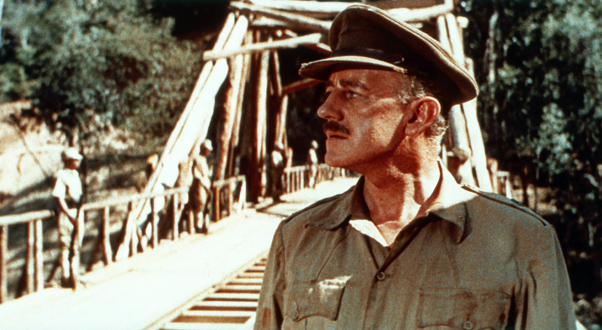
First off … NO TEARS!!  Crying is a sign of weakness to the Type A Patton.  They will roll over you like Hitler took the French!  If the Type A pressure persists, simply put on your Alec Guinness stiff upper lip; whistle the tune from The Bridge on the River Kwai; and stand your ground!

Simply state in your firmest, most reasonable voice that you will be taking a day off, and that you would be willing to watch the kids at the pool so that General Patton can dangle a foot off the dock for a few hours as well.  This strategy has worked for me in the past.  General Patton by this point accepts our labor standoffs with rolled eyes and an exasperated huff.  And one year she actually chose to forego the pool day and went solo into The Magic Kingdom just to reconnoiter the next day’s Mission.

But for the typical Type A Vacation Generalissimos, The Next Mission is what vacation is all about!

70 years ago this week: Battle of Midway Island (June 4-7, 1942)

(Today our Navy command observed the 70th anniversary of the Battle of Midway as in commemoration of the recent Memorial Day holiday.  This was a different take on Memorial Day observations as it took a look at a specific, historical battle.) 

Japanese Admiral Isoroku Yamamoto

As was mentioned in my previous Memorial Day post, the Japanese fleet set off for Midway Island on May 27, 1942.  Their intent was draw U.S. Navy carrier forces into a trap by attacking Midway Island, one of the few military installations U.S. forces occupied west of Pearl Harbor and the Hawaiian Islands.  Once U.S. carriers responded to the Midway attack by seeking out Japanese carrier force, the hammer of Japanese battleship forces would then attack and destroy the U.S. carrier fleet.  All the U.S. battleships assigned to the Pacific theatre had been destroyed or damaged just six months prior to the Battle of Midway when the Japanese attacked Pearl Harbor.

Several factors contributed to the eventual U.S. victory at Midway.

  • U.S. cryptologists had successfully figured out the Japanese code used for its operational forces.  The Japanese had been delayed in fielding their own more advanced code in the weeks leading up to Midway.  As a result, Allied forces in the Pacific were able to read Japanese message traffic, and knew both where and when – within a day or two – the Imperial Forces were expected to hit Midway Island.
  • Aircraft carrier U.S.S. Yorktown (CV-5), heavily damaged and thought by the Japanese to have been sunk during the Battle of the Coral Sea (May 7-8), limped back to Pearl Harbor on May 27 and was turned around in sufficient fighting condition in just 3 days!  Yorktown was able to sail as the core of Task Force 17 on May 30.
  • On 29 May, seaplane tender (destroyer) USS Thornton (AVD-11) arrived at French Frigate Shoals to relieve light minelayer USS Preble (DM-20) on patrol station there. The presence of U.S. ships at French Frigate Shoals prevented the Japanese from refueling flying boats to reconnoiter Pearl Harbor.  As a result, the Japanese had no intelligence on the departure and makeup of Task Forces 16 (U.S.S. Enterprise and U.S.S. Hornet) and 17 (U.S.S. Yorktown). 
  • Radio silence insisted upon by Japanese Admiral Isoruku Yamamoto prevented what sporadic information Japanese intelligence could discern about Task Force departures from Pearl Harbor from reaching Vice Admiral Nagumo Chuichi‘s Carrier Strike Force.

Overview of the fighting during the Battle of Midway, as taken from the Naval History and Heritage Command, Battle of Midway link:  

U.S. Admiral Chester W. Nimitz

Just after midnight on 4 June, Admiral Chester W. Nimitz, based on patrol plane reports, advised Task Forces 16 and 17 of the course and speed of the Japanese “main body,” also noting their distance of 574 miles from Midway. Shortly after dawn, a patrol plane spotted two Japanese carriers and their escorts, reporting “Many planes heading Midway from 320 degrees distant 150 miles!”

The first attack on 4 June, however, took place when the four night-flying PBYs attacked the Japanese transports northwest of Midway with one PBY torpedoing fleet tanker Akebono Maru. Later that morning, at roughly 0630, Aichi D3A (“Val”) carrier bombers and Nakajima B5N (“Kate”) torpedo planes, supported by numerous fighters (“Zekes”), bombed Midway Island installations. Although defending U.S. Marine Corps Brewster F2A (“Buffalo”) and Grumman F4F (“Wildcat”) fighters suffered disastrous losses, losing 17 of 26 aloft, the Japanese only inflicted slight damage to the facilities on Midway. Motor Torpedo Boat PT-25 was also damaged by strafing in Midway lagoon.

Over the next two hours, Japanese “Zekes” on Combat Air Patrol (CAP) and antiaircraft fire from the Japanese fleet annihilated the repeated attacks by the American aircraft from Marine Corps Douglas SBD (“Dauntless”) and Vought SB2U (“Vindicator”) scout bombers from VMSB-241, Navy Grumman TBF (“Avenger”) torpedo bombers from VT-8 detachment, and U. S. Army Air Force torpedo-carrying Martin B-26 (“Marauder”) bombers sent out to attack the Japanese carriers. Army Air Force “Flying Fortresses” likewise bombed the Japanese carrier force without success, although without losses to themselves.

Between 0930 and 1030, Douglas TBD (“Devastator”) torpedo bombers from VT 3, VT-6, and VT-8 on the three American carriers attacked the Japanese carriers. Although nearly wiped out by the defending Japanese fighters and antiaircraft fire, they drew off enemy fighters, leaving the skies open for dive bombers from U.S.S. Enterprise and U.S.S. Yorktown. VB-6 and VS-6 “Dauntlesses” from Enterprise bombed and fatally damaged carriers Kaga and Akagi, while VB-3 “Dauntlesses” from Yorktown bombed and wrecked carrier Soryu. American submarine Nautilus (SS-168) then fired torpedoes at the burning Kaga but her torpedoes did not explode.

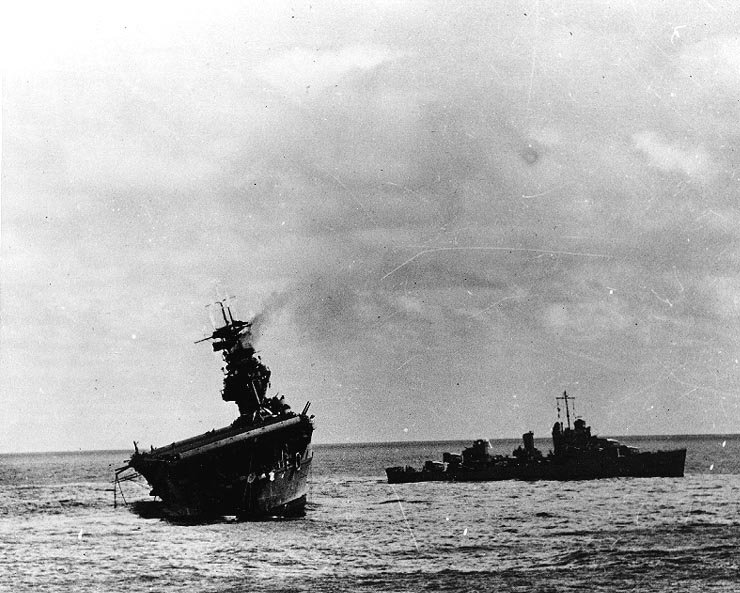
USS Yorktown – June 4, 1942

At 1100, the one Japanese carrier that escaped destruction that morning, Hiryu, launched “Val” dive bombers that temporarily disabled Yorktown around noon. Three and a half hours later, Hiryu’s “Kate” torpedo planes struck a second blow, forcing Yorktown’s abandonment. In return, “Dauntlesses” from Enterprise mortally damaged Hiryu in a strike around 1700 that afternoon. The destruction of the Carrier Strike Force compelled Admiral Yamamoto to abandon his Midway invasion plans, and the Japanese Fleet began to retire westward.

On 5 June, TF 16 under command of Rear Admiral Spruance pursued the Japanese fleet westward, while work continued to salvage the damaged Yorktown. Both Akagi and Hiryu, damaged the previous day, were scuttled by Japanese destroyers early on the 5th.

The last air attacks of the battle took place on 6 June when dive bombers from Enterprise and Hornet bombed and sank heavy cruiser Mikuma, and damaged destroyers Asashio and Arashio,as well as the cruiser Mogami. At Admiral Spruance’s expressed orders, issued because of the destruction of three torpedo squadrons on 4 June, “Devastators” from VT-6 that accompanied the strike did not attack because of the threat to them from surface antiaircraft fire. After recovering these planes, TF 16 turned eastward and broke off contact with the enemy. COMINT intercepts over the following two days documented the withdrawal of Japanese forces toward Saipan and the Home Islands.

Meanwhile, on the 6th, Japanese submarine I-168 interrupted the U.S. salvage operations, torpedoing Yorktown and torpedoing and sinking destroyer USS Hammann (DD-412). Screening destroyers depth-charged I-168 but the Japanese submarine escaped destruction. Yorktown, suffering from numerous torpedo hits, finally rolled over and sank at dawn on 7 June.

Luck also turned out to be on the American side as well; but it was luck that was made possible through better intelligence gathering, cryptology breakthroughs, industrial capabilities (e.g. U.S.S. Yorktown’s quick shipyard turnaround), superior naval leadership and carrier tactics.  Not the least of any of the aforementioned factors, the fighting spirit, dedication, and bravery of U.S. military personnel determined the course of the Battle of Midway and by doing so, defined the high-water of Japanese designs for the Western Pacific.

Casualties were relatively light for American forces (300 dead, U.S.S. Yorktown sunk) compared to the over 3000 dead and four aircraft carriers lost by the Japanese.  The real measure of U.S. and Allied success was what the defeat did to Japanese designs to force the Allies out of the central Pacific so that Japanese forces could have their way in the western Pacific. 

From Midway forward, the World War II Pacific Theatre would slowly but decidedly turn to the Allies favor.  Due to the significant losses in aircraft carriers, airplanes, pilots, and even their trained aircraft mechanics, Japanese forces would suffer from the loss of air superiority.  And Japanese weaknesses in manufacturing capacity and the flow of raw materials made replacing lost ships extremely difficult and virtually impossible in the case of aircraft carriers.  As a result,  Japanese military operations would turn from offensive to defensive in nature as the Allies slowly closed the circle around the Japanese homeland.

The Battle of Midway, along with those at Coral Sea and the Doolittle Raid over Japanese home islands, marked the beginning of the Age of the Aircraft Carrier, which after 70 years still serves as the backbone of any prolonged American military presence in oceans around the world.

So despite that our Memorial Day has already passed, take a few moments to reflect on what these men and their machines accomplished in interests of freedom and American interests 70 years ago this week.

Cranky Man’s Lawn Epistles ’12: Good crab – Bad crab

Ah yes … The Summer season is officially upon us!  And as we settle in for three months of hot temps, cool surf, outdoor parties and traditional Summer foods, it’s important that we not forsake the home turf when those hot temps hit.  I will assume that if you have gotten this far without closing your browser, that we are on the same wavelength!

Remember these summer lawn tips:

  • If you haven’t started already, now is a good time to raise your mower settings to allow your lawn to grow longer.  This will help to prevent some of the damage a hot, dry summer can cause by keeping your grass-roots shaded a bit from the searing sun.  And even though we have been getting plenty of rain in May, damaging heat is right around the corner.
  • Once temps start to rise, don’t forget to water your lawn!  Once these May rains end and the heat starts to build, it will not take long for your lawn to dry out.  Making sure your lawn gets water every 2-3 days is crucial.  Blah blah blah … You get the point.
  • DO NOT apply fertilizers to your lawn when it has been hot and dry for some time with no relief on the horizon.  Chemicals that sit on a lawn without water is a recipe for disaster!
  • And finally, enjoy your blue crab, your soft crab, your King crab this summer, but get the crabs out of your grass!

Vile weed, CRABGRASS!

Late May to the first week in June is the most important time for crabgrass treatment.  In previous posts, I put forth my objections to the long-held belief that crabgrass treatments are best applied in the early Spring.  Many lawn supply stores will recommend one treatment in the early Spring to prevent crabgrass from germinating.  But even if crabgrass plants successfully germinate in March or April, the plants will not grow until the heat of Summer hits.  Crabgrass likes it hot!

So there are two theories on crabgrass treatment … The preemergent treatment that attacks the germinating crabgrass plants, and the postemergent treatment that attacks crabgrass as it gets ready to bloom.  (Of course, your lawn supply store will say you need BOTH.  But that’s not always the case if your lawn is in very good condition.)  If your lawn is in poor shape or has a recent history of significant crabgrass, then treating BOTH ways is probably the safe choice.  However, if your lawn is healthy and full, without a significant crabgrass issue, then I recommend an active crabgrass treatment applied just before the heat of Summer activates the growing cycle.

These are the choices that have worked for me.  Your mileage may vary!

I never really liked the preemergent route because it relies on a bit of “soil whispering” which many of us non-professionals is pure guesswork.  Soil temps must hit 55 degrees for several days in a row for crabgrass germination to start.  And who has that kind of precision when it comes to weather prediction and taking soil temp readings???  Not I, I can assure you.  If you know someone in the turf business (No, not the kid at the Lowe’s Garden Center!), they might let your know the perfect timing if you call frequently enough.  So I opt for the simplest way to treat crabgrass, just as I do other weeds.  Wait for the suckers to be there with no doubt and then bring down the wrath of chemical warfare!

I’m also frugal (cheap), so I prefer the one-and-done method of crabgrass eradication.

The trick is timing it right to give your lawn the full benefit of crabgrass protection.  If applied in late May-early June, most crabgrass treatments will be good for three months.  (The reason I avoid early Spring preemergant applications.)   An application now will carry you into late August-early September when temps will cool (i.e. not the best temps for crabgrass growth)

Use a post-emergent product even if you do not see active crabgrass plants.  Preemergents will only work on germinating crabgrass plants.

Here are some other good anti-crabgrass tips:

  • Keep your grass longer!  (Yet another benefit of letting your grass grow longer in the Summer.)  Crabgrass seed need direct sunlight to grow.  Longer grass will keep the soil shaded, frustrating crabgrass growth.
  • Reseed any bare patches.  Similar to the above line of thought, a bare patch with direct sunlight is an inviting bed for crabgrass growth.
  • Water LESS frequently, but for longer durations.  (Not a big fan of this suggestion from an overall lawn health angle.  But if you have an active crabgrass problem you might want to consider this).  The theory is that crabgrass plants have shallower root systems, so frequent and quick watering benefits the crabgrass.  On the other hand, healthy grass-roots are longer and deeper, so less frequent watering that run longer will benefit the good grass, not the crabgrass.  (I can’t say I buy this idea, since ANY watering has to benefit the crabgrass.  So what difference does it really make?  You will have to make this call, based on the condition of your lawn.)

Finally, I share the following link for the Purdue University Turfgrass Science program. 

Reflecting on this Memorial Day weekend

Memorial Day been observed in the United States since the Civil War.  Though many towns lay claim to its origins (also known as Decorations Day), legend states that Southern women were the first to decorate the graves of loved ones and neighbors in the immediate aftermath of the War Between the States.  In 1868, a little noted successor to Ulysses S. Grant as General of the Army of the Potomac, John Logan declared Memorial Day to fall on May 30, 1868.

In 1967, the U.S. Congress made the title “Memorial Day” official on a national level.  And just a year later Congress passed the Uniform Holidays Bill, which moved Memorial Day and three other federal holidays to Mondays.  

Leave it to Congress to screw up a good idea!    

Now before you flip out at me, let me assure you that I too enjoy a long three-day weekend.  But in reality, Congress’ admittedly successful attempt to promote domestic spending and increased tourism, also served to distract many – though certainly not all – from the true purpose of setting aside a day to remember all of those who died protecting us,  who died for our freedom or the freedom of others, and – as in The Civil War – who died to define what present day America would look like.   

“Celebrating” just never sounds like the right word to use in respect to Memorial Day.

Simply thanking a vet – though a worthy act – seems so woefully insufficient when so many never had the opportunity to be thanked for their ultimate sacrifice.  So while you are enjoying the sights and sounds that make our country beautiful, as you enjoy the company of family and friends, dwell on the immense sacrifices so many – especially those grievously wounded and those who would never return home – gave to us. 

On Friday, May 25 I spent the afternoon cutting the grass.  

On that same day in 1862, 2400 Americans died in the First Battle of Winchester, VA.  The battle proved to be an important strategic victory for Stonewall Jackson in his Shenandoah Valley campaign.  An undersized Union Army forced to flee the town of Winchester, VA, which had been outflanked by Jackson’s defeat of the Union garrison at Front Royal, VA.  The battle was one of many smaller conflicts during The Civil War that do not receive the attention of the larger battles from the War Between the States.  Regardless of how one feels about the goals and motivations of the Confederacy, one must keep in mind that all who died that day had been Americans, and their sacrifice helped define what the United States of America would become in the decades to follow. 

On Saturday, May 26 I dealt with the installation of a new heater and air conditioner; then bought flowers for my annual Memorial Day weekend planting. 

On that same day in 1942, Japanese Admiral Nagumo’s 1st Carrier Fleet sailed for Midway Island.  His task force contains the carriers Akagi, Kaga, Soryu and Hiryu with two battleships, cruisers and destroyers as escort.  The Battle for Midway Island was fought a few days later, from June 4-7.  The sea conflict occurred just six months after the attack on Pearl Harbor, at a time when the Japanese were largely unstoppable throughout the Pacific.  Three hundred and seven Americans died over those three days (Japanese losses: 3000 men, four aircraft carriers) as the American Pacific Fleet dealt a blow that would in effect end the hegemonic wave from Japan.  From that day forward, the tide of war in the Pacific would flow The Allies way. 

Tomorrow – Sunday, May 27 – I will enjoy the company of close friends with a generous mix of adult beverages and bad-for-me foods.

On that day in May 1918, the German Army launched a third offensive in a string of World War I battles along the Aisne River.  The German attack was an attempt to threaten Paris and represented the first exposure of American ground troops to fighting in World War I.  The American forces lost over 2900 men in the Marne Valley during the war, which freed Western Europe from the first attempts of German domination.

On Monday, May 28 I will enjoy the company of family while lying low to enjoy the last day of an extended weekend. 

In 1984 on this day Ronald Reagan led a state funeral for an unknown soldier from the Vietnam War at Arlington National Cemetary.  In the days before DNA testing, selected remains of unknown American soldiers had been interred in the Tomb of the Unknowns in representation of all those who were lost in respective battles fought by American soldiers.  In a twist of DNA advancement, these remains were later identified as those of First Lieutenant Michael J. Blassie; and they were returned to his family in St. Louis, unlike so many others who lay here and in foreign lands, never to be reunited with those they left behind.

.

Thank those veterans this weekend, certainly!  But most importantly remember all those who never had the chance to be thanked in person by those who benefitted from their ultimate sacrifice.

It’s never too late to start a new career!

OK, maybe it is.  After you view the following YouTube versions of May’s Abington News & Views you might just end up begging me to stay where I am and leave the airwaves (cable waves?) to the obviously more photogenic and youthful.

I’m in one of those funks where writing and the ability to develop interesting subject matter has left me.  Usually I get brainstorms in the shower (Sorry for the imagery there.), but soap and warm water are not even working at this point.  Enthusiasm and inspriation usually returns eventually.  At times like this I refuse to force the issue just for the sake of writing something …

As I’m doing right now, so enjoy the peace and quiet!

That being said, if you are so inclined, take a view of my first foray into the cable TV political fisticuffs sans the fists and the cuffs.  I really enjoyed my baptism under fire, though nerves had me stammering a bit.  So far as I have heard, I have not dramatically affected the prospects of local Abington cable TV politics one way or the other, so it’s quite possible I may be invited back.

If that does happen, I endeavor to learn from my initial exposure and seek continuous improvement!

 .

Not sure why this was presented in four parts, but it makes selecting what you want to watch – or not watch – much easier.  If you do watch, I’d love to hear comments and criticisms.  Trust me I can take it … probably.

Part 1:  We discuss the qualifications of Presidential candidate Mitt Romney, the performance and prospects for re-election of President Obama, and Obamacare.

http://www.youtube.com/watch?v=3Jfwe8FhBLE&feature=youtu.be

Part 2:  Panelists address the Trayvon Martin – George Zimmerman case, and the Pennsylvania State House race in Abington’s 153rd District.

http://www.youtube.com/watch?v=Z0YVTQ02Jds

Part 3:  We discuss Pennsylvania’s new Voter ID law and the love fest between the new Montgomery County Commissioners Josh Shapiro, Leslie Richards and Bruce Castor.

http://www.youtube.com/watch?v=WEOlLMI7lzs

Part 4:  Panelists discuss Abington Township’s new law protecting LGBT rights and wrap ups with statements of individual interest.

http://www.youtube.com/watch?v=J16hYslowlg

Joe Scarborough and Chris Matthews can rest easy!

Cranky Man’s Lawn Epistles ’12: Beware the lure of Big Green lawn $$$!

“AN EDUCATED CONSUMER IS OUR BEST CUSTOMER”
 
Those words were the advertised motto of the Syms discount clothing empire, which enjoyed much success before falling into bankruptcy in 2011.  
 
I always allude to that banner whenever considering a significant purchase and whenever I look for consumer services.  It also bodes as great advice for the average Joe Shmoe who works hard each week of the growing season to render the outside of their home clean and beautiful. 
 
This is important to keep in mind because, although your local lawn and garden center can be a cornucopia of seasonal advice, they are also in the business of maximizing their profit margin.  And they LOVE the lawn & garden OCD types.  Of course, as a die-hard advocate for a robust economy,  I support and welcome their efforts.  I just want them doing so from everyone else’s pocket, not mine.  So with that in mind, I offer you the following advice and precautionary tales.
 
Precautionary Tale #1:  For years I frequented a local outlet for a National fertilizer company; but after several corporate buy-outs and name changes they closed shop.  I found another local, small business lawn and garden center which I now use.  But a friend mentioned that the old place had re-opened under new ownership, so I went to check it out.
 
They had a huge inventory of fertilizer products and all the toys and accouterments with which lawn junkies love to play.  They also had an advisory pamphlet on a proper season-long program for lawn care.  But when I reviewed it, I noticed that they recommended SEVEN lawn treatments a year!  
 
This stuck me as odd, because I do five myself and that’s only when I observe an uptick in Japanese beetle activity.  And this hasn’t been the case for about three years now. 
 
When I reviewed their recommended program, they listed TWO treatments for BOTH crabgrass and grub control.  Yet I knew from experience that if you time the applications properly, one treatment is sufficient.  CA-CHING! Estimated Savings: $160 (assuming I skip the grub treatment when not necessary and one crabgrass application due to the judicious application of one)
 
  • I try to support local small businesses whenever possible.  But when it comes to annual flowers for the home’s landscaping, you cannot go wrong buying flowers in bulk from large chains like Lowe’s, Home Depot, Wal*Mart, etc.  I have always found small specialty garden stores to have excellent flowers; but the prices very high.  Supporting the local economy is admirable, so long as it does not excessively strain the household budget!
  • I have never used a commercial lawn fertilizing service to keep my lawn healthy and good-looking.  Frankly, the serviced lawns do look great, but I can’t imagine the guy on the truck paid to spray your lawn per a pre-defined schedule really pays attention – or cares – about how your lawn looks before he sprays those chemicals on it.  That being said, I can’t suggest that doing it yourself is actually cheaper, as I have never checked on how much a lawn service would cost.  So I provide a link to a Fact Sheet put together by the Ohio State University Horticultural and Crop Sciences for your benefit.

Precautionary Tale #2:  My current lawn fertilizer supplier stocks a high quality spread of lawn fertilizers and treatments.  But I have found that they never carry a granular weed-control product.  That’s granular as in a product with the consistency of course sand.  Instead, they carry only a pellet-type dissoluble, time release product. 

A weed control product of a sand-like quality will cling to active weeds when the lawn is wet.  This clinging allows the chemical to be absorbed directly into the weeds.  A time-released product will work fine, but takes longer.

When I asked what treatment they recommended for active weed control, they suggested a LIQUID weed product.  I wondered why, because a liquid product is more difficult to apply – in my opinion – assuming you have the necessary equipment to do so.  When I mentioned this, they advised that they also rent the equipment needed to apply the weed control product.  (This also goes for the milky spore treatments many lawn centers recommend.  To me, ensuring a even application of the liquid treatment seems way too difficult.)

CA-CHING!  Or so I thought …

But when I asked for pricing on a liquid-based product plus the equipment needed to apply it ($5 per hour), the cost is comparable to a two-bag application of a dry weed control.  The obvious question to me is whether the added effort of applying a wet weed product overcomes the ease of applying a dry one.  You’ll have to figure that one out for yourself.

  • The Cecily Tynan Factor:  Those in the Philadelphia area will recognize the reference.  The objective here is to pay attention to your weather forecast when planning to apply all fertilizers and in deciding whether watering the lawn is necessary.  Some fertilizers – like pre-emergents and grub treatments require the product be “watered in” to maximize effectiveness.  Other applications require a LACK OF RAIN (weed control for active weed problems) to work.  Also when the weather gets hot, watching the local weather for potential rain and even a good thunderstorm would preempt the need to drag out the hose and up your household water bill.
  • I covered lime applications for lawns in my last Lawn Epistle.  And although lime is not an expensive lawn product, the need to apply lime is often overstated for those lawn aficionados with already healthy lawns. 

The point to all of this is that you should get to “know your lawn” to know what it needs and what it does not.  Then you need to research your treatment options and decide what works best for you.  Lawn care can be an expensive proposition.  But you can render it as economical as possible – like any other needed product or service – by doing your homework and seeking the best solutions at affordable prices. 

Either way the idea is to keep that lawn clean, green and healthy when the weather is at its best, so your lawn can withstand the tests of summer.

Good luck, and I’m always here for any questions.

This Mom I know …

There’s This Mom I know …

She leapt into Motherhood despite that she was just a newlywed, and they hadn’t planned to make the Next Big Move so soon.  She suffered through all the usual Mother-To-Be anxieties, doubts, and fears of the unknown.  Yet when her pregnancy took a difficult turn and she was confined to bed rest for weeks before The Big Day, she kept her jittery spouse calm and focused (for the most part).

When The Big Day came, Junior came out just fine, but This Mom I Know had few touchy days dealing with the aftereffects of preeclampsia (high blood pressure) caused by the toll carrying their new son took on her body.  The worst part of the Best Experience Ever was that she could only spend a limited amount of time with her new baby son – in the immediate days thereafter – as she recovered. 

This Mom I Know mastered New Mommyhood as well – if not better – than most mothers did, yet she doubted her abilities even as her new family beamed and glowed with their teeny, weeny addition.  Of course her secondary role was to make sure New Dad didn’t toss his cookies the first time he changed a diaper that could have made an EPA Superfund list or fumble the baby when Dad went into his patented Heisman Trophy Cradle Pose.

This Mom I Know made all the right moves, and she did so while holding down a challenging, emotion-laden job as a Neo-Natal Intensive Care nurse in a large, Center City hospital.  She worked nights and evenings so she could be home during the day and worked weekends only when absolutely necessary.

Her nursing background came in handy whenever The New Son had a fever or an ear infection or cried non-stop during a two-hour car ride to Long Island.  And when one day, while innocently helping Mom make dinner, he threw his first anaphylactic reaction, it was Mom’s nursing experience that kept her head cool, her decisions sound, and brought The First Son back home, safe from a life-threatening experience.

This Mom I Know went through two more son-births in her Mommy Career.  Neither one was free from worry or the potential for medical complications.  Yet both New Sons made it home, free from serious and lasting problems. 

This Mom I Know did a herculean job of juggling career, household and the ultimate welfare of her children.  She involved herself in schools, activities, and when it became necessary the medical and developmental issues many children face.  At times she acquired the services her children needed by sheer force of will and an unshakeable persistence. 

This Mom I know is facing the very near and real prospect of her grown children heading out into The World for which she worked so hard and deliberately to prepare them.  Like so many parents she wonders if she did them right; she doubts sometimes that she did the best job she could possibly have done; and she hopes they will find happiness wherever they may end up.  And yet …

This Mom I know has a very difficult time letting go of her boys.  She frets and worries over how far they may wonder, how happy they will be, and how successful they will become.  She frets and worries only because she has no idea how fantastic a job she has done raising her children.  She doesn’t see them as the world sees them now. To her they are still her little boys.

This Mom I know will shed more than a few tears this year and in years to follow, as the boys move on and build lives of their own; raise families of their own; and build futures with the Moms they will know.

I can only hope they are as lucky as I have been and as lucky as they are to have This Mom I Know!

(Pardon my tardiness for this Mothers Day post.  Like a lot of men, I do not spend enough time dwelling on the fantastic efforts of This Mom I Know.  But on Mothers Day when I saw how she gracefully handles the way her life is changing – even though it hurts and she doesn’t always like that it is happening – and how happy she was to enjoy the day being surrounded by those who could be there for her, it stirred me to share how much I admire her! 

Happy Day After Mothers Day, Carol!  I Love You!)