The Corbett approach to Medicaid sanity

images-2

Once a month the Horsham Republican Committee meets to discuss political developments – both local and regional; to strategize on political organizing within Horsham Township; and to update the Committee on issues of Party management.

To be honest, the meetings can be a bit dry, and that’s even if you’re a bit of a political junkie.  It’s not often that we get into REAL political discussions that provide interesting insights into the issues of the day.

This past Wednesday was different with a small but animated gathering of committee representatives (who represent township Republicans in matters of Party interest), local Republican pols, and the local Party leadership.

My keenest interest is always with the progress – or lack thereof – in Horsham Township’s redevelopment plan for the NAS-JRB Willow Grove property.  At present the Horsham Local Redevelopment Authority (HLRA) is awaiting the approval of its redevelopment plan, which was submitted in the Spring of 2012.

It’s been a year-and-a-half, and no decision as yet from the U.S. Navy.  The Federal Government, which must review and approve the plan before fully vesting the HLRA with redevelopment authority, indeed takes its time when mulling over any decision.  In this case, the Navy, charged with the responsibility of conducting an Environmental Impact Statement (EIS) has met delays in completing their evaluation.  The plan – due this Fall – will not be ready until Winter at the earliest.

Which means, look for it in the Spring or Summer.

The Navy blames the effects of sequestration.  But frankly, as a federal employee, I can speak confidently that, if it wasn’t the effects of sequestration, it would have been something else that would delay such a huge and complex evaluation.  No, not unexpected at all …

Several other issues were also touched on briefly as updates from Harrisburg.

  • Movement on Pennsylvania’s transportation bill, which is seeing progress in the State House after the Senate passed their version earlier in the year.  The biggest hurdle would be in reconciling the two versions as passed, particularly to the level of funding.  There are roughly $5 billion in infrastructure improvements that have been underfunded for decades and well overdue for remedial action.
  • Pension reform at the State level is getting much discussion.  With the State’s two pension plans (state employees, public school employees) underfunded by $47 billion (!) and projected to grow to $65 billion without action, Governor Corbett has moved pension reform to the top of his list of priorities.  Currently, the biggest reform under consideration is moving new employees in both categories into 401(k)-type programs that are similar to those found in the private sector.
  • A brief discussion on the national Affordable Care Act (Obamacare) revealed one persistent problem in Pennsylvania’s rural health services … Finding doctors to work in the less income-lucrative areas of rural Pennsylvania.  This has long been a problem nationwide, not just in PA.  One solution, proposed by the Corbett Administration in its recent proposal for expanding Medicaid as part of its ACA compliance, is a student loan forgiveness program for any doctors who agree to spend a specified amount of time in Pennsylvania’s more doctor-needy areas.
PA Governor Tom Corbett

PA Governor Tom Corbett

The discussion I found most interesting this night dealt with the recent Corbett Administration proposal for expanding Medicaid.  Some of the facts and issues covered …

  • All state-run Medicaid programs vary in benefits and costs from state-to-state.  The terms of Medicaid coverage are negotiated by each state individually.  Passage of the ACA effectively “locked in” every state’s specific Medicare program in whatever form it existed at the time.
  • After eight years of Ed Rendell’s Democrat Administration in Harrisburg, Pennsylvania’s current Medicaid program is one of the most generous – if not THE most generous – state program in the U.S.  This goes a long way towards explaining why some states, such as New Jersey and Arizona are more willing and able to accept the ACA-mandated expansions required for full state participation in federal-run healthcare exchanges.
  • Currently the State and Federal governments combine to spend about $19 billion a year to cover 2.2 million Pennsylvanians on Medicaid!  $19 billion …!!
  • The federal government’s ACA Medicaid expansion financial contribution maxes out at 90% after three years of fully funded coverage. That 10% unfunded liability equals an additional estimated  $200 million – as a minimum – that will have to be covered by the Pennsylvania state budget!
  • Even before any ACA-mandated Medicaid expansion, Pennsylvania estimates Medicaid costs will grow by $400 million in fiscal year 2013-2014.
  • A Rand Corporation study showed that Pennsylvania would save roughly $154 million a year by not expanding Medicaid coverage.

So it’s pretty easy to see why the Corbett Administration is not all that anxious to get on board an ACA-mandated Medicaid expansion.

As with the Philadelphia School District’s annual funding crisis, the Corbett Administration has taken a very responsible approach to any expansion of the financial commitment falling to Pennsylvania’s tax payers.  The Governor realizes that without reforms accompanying this constantly growing financial responsibility, the economic health of the State will be threatened.

images-3In the Philly school crisis, by which you can calibrate your calendar each year, additional funding was offered to the City through negotiations with Mayor Michael Nutter’s administration.  The catch was that the settlement required reforms that call for concessions by the Philadelphia teacher’s unions.

Concessions are necessary on the cost-side of the Philadelphia school issue, if the cycle of funding crisis followed by funding crisis is ever to be broken.  You should not be surprised in realizing that funding solution never really had a chance to succeed.

As for the Medicaid expansion, the facts are that without serious reforms in the way the Pennsylvania program is managed, the state’s’s tax payers and businesses will be on the hook for that rather significant $200 million hole in the Pennsylvania budget … on top of the projected $400 million shortfall for FY13-14 … plus all other projected increases.  Cost reform is essential to Pennsylvania’s future fiscal sanity.

There’s also the very real possibility that the Federal government may not be able to uphold even its 90% Medicaid expansion funding as promised.  And what happens then? 

For these reasons, the Corbett Administration’s approach to the ACA federal exchange and Medicaid expansion proposal should be lauded as the kind of fiscal sanity one should expect from their Governor.

Changing Hearts and Minds through Weakness

I have to give President Barack H. Obama credit.  He has changed my mind on the prospects of taking action against the Bashar al-Assad regime in Syria in the face of alleged – and all but certain – use of chemical weapons against opposition forces and civilians.

My nut is not an easy nut to crack.  I have long-held the personal belief that the United States held a special place in the community of nations.  It’s a place – to my own thinking and values – where a World Superpower belongs.  It’s the role that goes beyond the kind of standard-setting usually the purview of the United Nations.  It’s the role of enforcing those standards of common decency when it comes to the bitter realities of armed conflict.

A lot of Americans will categorize this simplistically as the role of World Cop.  Many disagree with me on this premise, that our country should be involved in events overseas that appear to have little or no direct impact on U.S. interests.

Those sentiments are well-founded and reflect the commonly held belief that American military personnel and U.S. treasure should be risked only in those situations linked to National Security in almost all cases.  So maybe my viewpoint is quite firmly in the minority.

Yet it is a role that in my mind comes with being a World Leader and Superpower.  It is a role we have filled many times in the past in various regions of the world in varying degrees of participation.

images-1I am not fond of unilateral U.S. action.  I do not favor the use of American boots-on-the-ground, especially in a situation like Syria.  What I look for is an American-led process of Consensus Building; the development of a common sense and purpose amongst our primary allies, major world powers, and those countries in closest proximity to the danger and most likely to be affected by any widening of a regional conflict.

My view is of the United States as The Point Man on the diplomatic front and The Muscle when it comes to the military response for which we hold a decided advantage (i.e. technological, hardware, delivery systems, weaponry).  When it comes to boots on the ground, the only enforcement situation where this should apply – in my humble opinion – is as part of a multi-national approach to a controllable environment (e.g. Bosnia; Clinton 1999) or where an immediate U.S. response would be sufficiently overwhelming (e.g. Grenada; Reagan 1983).

Now when it comes to Syria, President Obama has sufficiently altered the course of my thinking in a situation where a struggling regime gassed an overmatched military uprising and a defenseless civilian population …

… for all the wrong reasons.

Introducing the Freedom Muffin! Introducing the Freedom Muffin!

Suddenly, under his mislaid concept of “leadership”, the U.S. looks timid, indecisive, and unfocused.  American efforts to build an International Coalition of the Willing was shot in the foot by its biggest allie (Great Britain) before it even got rolling.  (WIll we have to rename the English muffin?)

The Office of the President – long The Decider when it comes to the use of U.S. military power in short, direct, and sometimes personal (Libya, Muammar Gaddafi, 1986) responses to violations of international norms – appears confused by Britain’s rejection and unsure as to what to do next.

Instead the country’s Decider punted the issue – just as British Prime Minister David Cameron did – to the Legislator.  From my perspective, this has the look of a President hoping someone will get him off the fish-hook he firmly set in his own mouth.  When you use terms like “red line”, you had better have a plan of action with several iterations to account for unexpected developments like your Biggest International Allie getting cold feet.

The alternative, fall-back strategy?  Apparently there wasn’t one.  Which leads one to the obvious question … Who was doing the Leading?  Right now, it looks like Cameron and the Brits.

Where's Margaret Thatcher when you need her? Where’s Margaret Thatcher when you need her?

So now Syria mocks us.

To fill the role of International Leader, you must be convinced of your Righteousness; firm in your ability to Lead, even if it means you must lead without your closest friends and allies at your side; and when all else fails, you must be prepared for bold action if necessary and if supported by the facts.

These are the kind of considerations President Obama should have kept in mind before speaking of “red lines” in August 2012.  Obviously he and his National Security team didn’t.

And this is what ultimately changed my mind.

If you can not be a strong, prepared, flexible leader, you have no business  drawing lines; making promises; and scheduling attacks when you do not have the backbone for the toughest decisions … actually sending Americans to clean up the World’s ugliest messes.

God help the Syrian people …

‘Twas the Night before Furlough

Enjoy a little Christmas in July with me and my fellow Federal civil servants with this twist on an ageless classic.

Twas the Night before Furlough

Concept and execution if not the actual words

by Barack H. Obama

Santa Jack Lew with furloughs for you!

Santa Jack Lew with furloughs for you!

‘Twas the night before Furlough
And all through The White House,
Not a creature was stirring,
Barack had Droned the last Mouse!

Congress was nestled all snug with The Fed
While visions of Mid-Terms danced in their heads.
With Michelle in her kerchief and POTUS in his cap,
The First Couple was hankerin’ for a Hawaiian recess.

When on the South Lawn there arose such a clatter,
Barack leapt from his bed to see what was the matter!
Away to the window he stumbled and crashed,
Tore open the shutters, “Get me a ‘Publican to lash!”

Then towards him on the breast of Taxpayer Dough,
Came Chief-of-Staff Lew, the House Liaison in tow.
And what to befuddled POTUS appeared
Was the Promise of what all Liberals hold dear!

The conspiring driver, so witty and quick,
Had come with an idea to surely do the trick!
More rapid than pirates on good winds of trade,
Jack Lew had found the secret for more Treasury raids!

I'm not saying this looks like anyone, only acts like some.

Leadership?  Plenty of butts instead …

“Now Nancy! Now Harry! Wake Biden up too!”
“On Fienstein and Boxer!” clammored The Lew.
“Grab Van Hollen and Stoyer and Allyson Schwartz!
We know how to get those ‘Publicans by the shorts!”

Sequester”, Lew cried, “is how we’ll get what we want!
Higher debt, more money, no need for any cuts!
They would never let it happen, and we won’t cut a dime!
The ‘Publicans will fold handily. They do all the time!”

Then amid all the whooping, the hollering, the yells
Someone asked, “What happens if it freezes in Hell?”
“Don’t worry about that. Our Gambit is sound.
We’ll make the ‘Publicans bad guys. Make it painful as well.”

But The Voice was persistent, an answer was needed.
What of sequestration, if the goal goes unheeded?
Of workers, fixed incomes, and services rendered,
What if the ‘Publicans didn’t surrender?

The Democrats turned on that Voice with wild looks.
Who dare throw a wrench in their Debt Ceiling hook?
Joe Taxpayer had wakened in the midst of the hoopla,
Was asking who’d suffer should The Plan prove a faux pas?

‘Twas The President’s turn to show that he cared
For those who paid taxes and relied on their share
For their services rendered, and the wages they need
For mortgages, tuition, that new Healthcare decree!

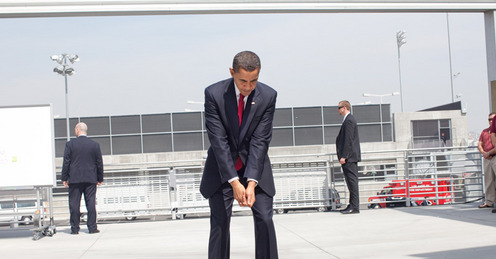
The grip of a golf club was light in Barack’s hand
Like the fate of the Middle Class throughout The Land.
He had a kind face and whispered so sweetly,
“Let us worry of that, we’re The Power Elitely!”

(From www.golf365.com)

The grip of a golf club was tight in his hand …
(From http://www.golf365.com)

He was chummy and glib, quite full of himself
So Joe Voter shrugged off the misgivings he felt.
The Democrat leaders returned to their caucus,
Plotting and planning how to best drain the coffers.

In the end their Big Gamble, it soon fell apart.
Their opponents, the ‘Publicans refused to impart
Higher taxes without spending restraint and responsibility
Towards an Economy renown for its fragile instability.

Joe Taxpayer saw this, and wondered aloud
“The Gambit was futile, so let’s kick this around.
The budget’s important!  The worst case is here!
You can’t stand on principle, and at taxpayers sneer!”

But the Democrats were nothing if not committed
To getting what they wanted without being fitted
With ceilings and limits to what they could spend
Even if it was Taxpayers who suffered in the end.

“We need them to suffer, to really feel hurt
From silly cuts in Park services to the pay for their work!
So process those furloughs!  Don’t spare them any Pain!”
The POTUS was certain their pain was his Gain.

So as Barack headed off on another vacation,
He climbed up the steps of his tax-paid ‘portation.
And we heard him exclaim as he flew out of sight
“Happy  furloughs to all!  Thanks for paying The Price!”

Obama-Claus-600

The Admirals (Walter R. Borneman)

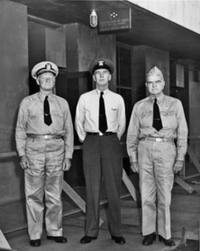
Fleet Admirals Chester W. Nimitz, Ernest J. King and Bill Halsey

Fleet Admirals Chester W. Nimitz, Ernest J. King and Bill Halsey

I have always enjoyed reading American history, especially about both the American Civil War and World War II.  One – a domestic conflict – determined the future course of America’s development as a “united nation”; the other – a world-wide conflict – resulted in America’s emergence as a global leader.

That’s not to say I have read everything out there on either subject.  And from time-to-time I run across a book that teaches me a new thing or two.  In the case of The Admirals, I gained a new perspective on America’s military leadership during the last world war to end all world wars.

Walter R. Borneman ‘s enlightening work focuses on the four admirals, who transcended the U.S. Navy’s pre-World War II rank hierarchy, to become the first five-star admirals in American history.  This development was made necessary by the British Allies’ penchant for Fleet Admirals and Field Marshalls.  The 5-star rank was added (by Act of Congress in June 1944) to the American military ranks to place U.S. admirals and generals on equal footing with their European counterparts.

Flag of the Fleet Admiral of the U.S. Navy

Flag of the Fleet Admiral of the U.S. Navy

Five-star ranks of Fleet Admiral were bestowed on the four U.S. Navy Admirals and subjects of the book: William D. Leahy, Ernest J. King, Chester W. Nimitz, and William F. Halsey, Jr.  Fifth stars have not been issued to a Navy officer since 1945 and the conclusion of World War II.

Prior to reading The Admirals I was much more familiar with the four U.S. Army Generals, who carried the five-star rank of General of the Armies:  George C.Marshall, Douglas MacArthur, Dwight D. Eisenhower, and Henry H. Arnold.  (Omar Bradley was added as a five-star General in 1950, the only officer in U.S. military service so honored after WWII.)

In The Admirals a new appreciation is gained for the leadership exhibited by two men often overlooked in most media presentations on the War in the Pacific.  Those men are Admirals Leahy and King.  Until I picked up The Admirals, I had no appreciation for the contributions they made in the prosecution of America’s WWII efforts.

The exploits and accomplishments of Admirals Nimitz and Halsey during the Pacific campaign are well-known and referred to relatively often.  For instance, the other night I could not resist watching part of the movie, Midway in which Nimitz and Halsey are prominent.  For that reason, the following speaks mostly of Bill Leahy and Ernest King.

____________________
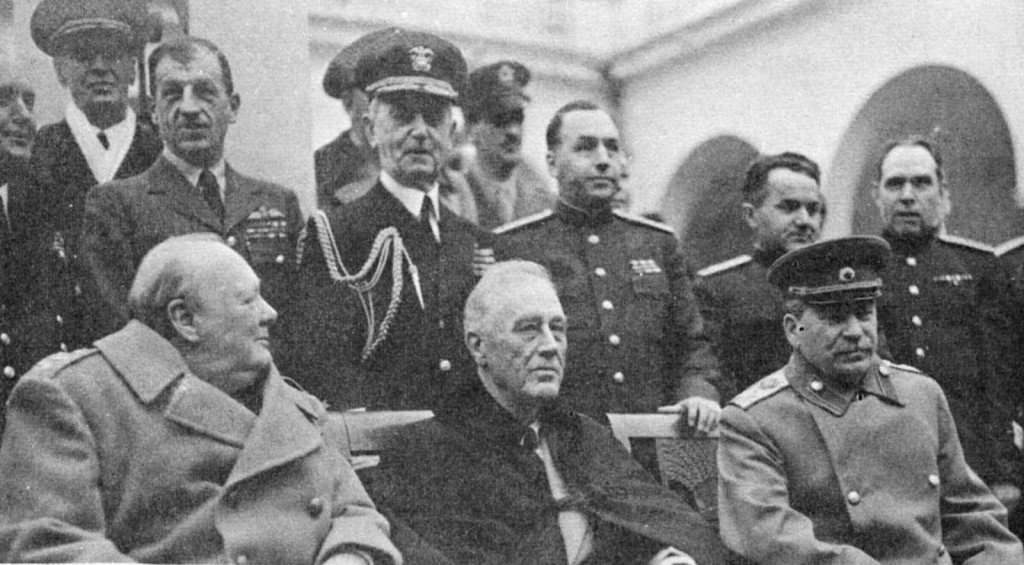
Admirals King, top left and Leahy, behind FDR, at the Yalta Conference in June 1945

Admirals King, top left and Leahy, behind FDR, at the Yalta Conference (June 1945)

Bill Leahy had been age-retired and was serving as Governor of Puerto Rico when the long-anticipated conflict with Japan broke with the attack on Pearl Harbor on December 7, 1941.  His friendship with Franklin Delano Roosevelt, cultivated during a period in his Navy career when – as a Navy captain – Leahy ferried the then Assistant Secretary of the Navy up and down the U.S. eastern coast.  Their relationship led to Leahy being named the Ambassador to Nazi-controlled Vichy, France when the Germans had overrun most of Western Europe.

Leahy’s role as ambassador was to influence the Vichy government from total subservience to the Nazi government, especially when it came to the remnants of the French fleet.  When the Vichy eventually fell in line with the Nazis through the elevation of the pro-German Pierre Laval to the head of its government, FDR kept his promise to the previously retired Admiral Leahy; brought him home from France; and recalled him to military service to help fight the war.

Leahy, left, and King, top right, in conference with Generals George C. Marshall, right, and Henry "Hap" Arnold, top left

Leahy, left, and King, top right, in conference with Generals George C. Marshall, right, and Henry “Hap” Arnold, top left

Tragedy befell Leahy as he prepared to leave the Vichy.  His wife, Louise died suddenly from medical complications of a rushed hysterectomy performed in France.

In time Leahy came to be viewed by  FDR and – almost as importantly – General George Marshall as the perfect candidate to become Chief of Staff to the Commander-in-Chief and Chairman of the Joint Chiefs of Staff.  From this position Bill Leahy would not only coordinate the military’s strategic implementations with FDR’s global considerations, he became the man The President relied upon more and more for all manner of domestic and foreign policy execution.

Admiral Leahy accompanied President Roosevelt to most of the major war conferences, being left behind once in Tunis and missing Casablanca due to a high fever.  He acted as a gatekeeper to information, communications, and personal access to FDR; coordinated execution of the both military and domestic presidential directives; and as Roosevelt’s health diminished, assumed responsibility for the daily functions of The Chief Executive.

The true testament to Admiral Bill Leahy’s effectiveness in those positions was his retention by Harry S Truman as his Chief of Staff for the entirety of his first term following FDR’s death in April 1945.

_______________

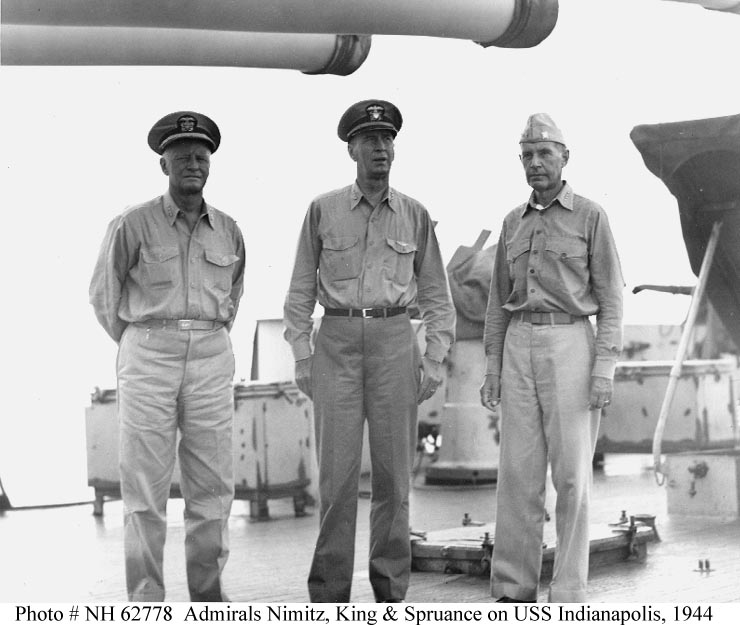
Fleet Admirals Nimitz and King with Admiral Raymond Spruance aboard the U.S.S. Indianapolis

You gain keen insight from the earlier, less exciting chapters of The Admirals for the process through which the U.S. Navy ensures its officers and future leaders are well-rounded and thoroughly trained.  In the pre-World War II chapters, Borneman concentrates on the early careers of his four study subjects.  What is learned is the important role played by the Navy’s Bureau of Navigation (Bureau of Navy Personnel since 1942), an administrative position that controls the assignment and detailing of naval officers throughout the vast opportunities offered by Navy service.  Each of the World War II five-stars is exposed to the various types of boats, ships and planes.  From destroyers, to submarines, through cruisers, battleships and aircraft carriers …

Although none of the four officers Borneman follows gains experience in every possible Navy assignment, the reader sees how each officer’s background developed and how those experiences contributed to their efforts, ideas and strategies during the war.

For a U.S. Navy plying the seas leading to an intriguing World War II theatre of operations in a Pacific Ocean covering tens of millions of square miles, this background provides perspective to the Navy’s evolution from a force built around the great battleships of the Great White Fleet to a fighting force oriented around the aircraft carrier and the long-distance reach of ship-borne aircraft.

It was this kind of ingenuity, an ability to take what was experienced and learned in career assignments that led to a vastly improved vision of modern ocean combat.  The kind of vision that most adequately prepared the U.S. Navy for the challenges of fighting a veteran Japanese navy in the expansive Pacific Theatre.

For this reason, Borneman’s focus remains almost exclusively on the Pacific side of the two-front war America faced during World War II.  There is little mention – aside from Admiral King’s assignment as Commander-in-Chief, Atlantic Fleet – of the Atlantic conflict that was more narrowly focused in the fight against the German U-boat.

__________________
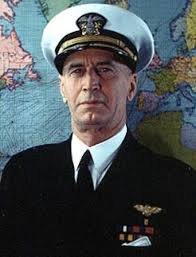
Fleet Admiral Ernest J. King

Fleet Admiral Ernest J. King

Ernest J. King was known as cold, career-oriented, hands-on boss with a penchant for hard-drinking, something which changed in the years just before the war broke out.  One of the most senior Navy officers, who was on the short list for mandatory retirement when the Japanese bombed Pearl Harbor.

Recalled to active fleet duty, King was initially assigned to lead the Atlantic campaign against the German U-boats.  After convincing FDR to use his flag-ship, U.S.S. Augusta in his initial meeting with Winston Churchill off the coast of Newfoundland, King began consolidating a leadership position that would eventually land him as Commander-in-Chief, U.S. Fleet (COMINCH).  From this position he would direct the overall strategy of fending off the advances of the Japanese in the Pacific even as the U.S. and its allies pursued its Germany First war strategy in Europe.

King realized that to leave the Japanese free to roam the Pacific, if the Allies became exclusively focused on Fortress Europe, would make retaking the largest ocean in the world that much harder.  Throughout the war King would beg, borrow and steal to keep the Japanese at bay, then slowly start pushing them back towards their home islands.

It was King who charged Nimitz with preserving the vital ocean links from the U.S. west coast to Hawaii and Wake Island as well as the ocean routes to Australia through New Caledonia and Saipan. A strategy that led to the early and successful battles at Coral Sea and Midway.

Admiral "Fighting Bill" Halsey on a Victory poster

Admiral “Fighting Bill” Halsey on a Victory poster

King also endorsed a plan, developed by his Operations Officer, Captain Francis “Frog” Low to bomb Tokyo with Army Air Force bombers launched from aircraft carriers known as the Doolittle Raid.  King’s global strategic vision made winning the war in the Pacific less costly than a myopic obsession with Germany First could have cost the Allies in time, lives and treasure.

As with such major world conflicts, even Allies don’t always get along.  Besides clashes with British and Soviet priorities and strategic visions, American military leaders had to deal with their own internecine struggles over power, resources, and tactical ideas.  As one would expect the U.S Army and Navy did not always see eye-to-eye on how and where the great battles should be fought.  And with personalities as large as Generals George Marshal and – more pointedly – Douglas MacArthur there were more than a few opportunities for paralyzing disagreement.

Borneman credits Admiral King for smoothing the often ruffled feathers of his Army counterparts, particularly MacArthur.  King’s relationship with General Marshall got off to a slow start; would never be particularly close; but was always of mutual respect.  King wholeheartedly endorsed Eisenhower to head the North African invasion (Operation Torch), a success that led to Ike’s leading of the D-Day invasion of Normandy, France (Operation Neptune).

MacArthur, as most who competed with or tried to control would learn, was another story.  But King was deft at keeping MacArthur from interfering too much in the Navy’s war efforts; and usually was able to keep him happy enough to remain an effective threat to the Japanese.

_________________

In an attempt to summarize this very long post, Borneman’s The Admirals forces the reader to focus on the complexities of developing properly trained, strategic-thinking naval officers; the prosecution of wide-ranging global warfare on a scale rarely seen in any generation; and the way personalities and the politics of leadership comes together in just one arm of the U.S. military.  In a war that encompassed much of the globe and no less than three major Allied powers, respective political establishments and military organizations, it is a tribute to confident and visionary Allied leadership that the effort didn’t simply collapse under the weight of its divergent personalities and priorities.

Admiral of the Fleet Chester W. Nimitz at Japanese surrender Behind him stand MacArthur, Halsey and Admiral Forrest Sherman

Admiral of the Fleet Chester W. Nimitz at Japanese surrender
Behind him stand MacArthur, Halsey and Admiral Forrest Sherman

Other random bits of knowledge picked up from reading The Admirals:

  • Vice Admiral Ernest King staged an attack on Pearl Harbor in 1938 from the U.S.S. Saratoga as part of Fleet Problem XIX manuevers.  The result was complete surprise.
  • When asked what won the war in the Pacific, Bull Halsey stated, “I would rank them in this order: submarines first, radar second, airplanes third, bulldozers fourth.”
  • By FDR’s fourth inaugural, Roosevelt was so weakened and Bill Leahy so trusted by the President that it was Leahy who rendered Roosevelt’s remarks at his fourth inaugural dinner.
  • In early December 1941 Vice Admiral Bill Halsey commands Task Force 8 on a mission to reinforce one of America’s isolated island bases.  Bad weather delays their expected return to Pearl Harbor on Saturday, December 6.
  • Ensign Chester A. Nimitz ran his very first ship command, the destroyer U.S.S. Decatur, aground on a reef near Manila Bay in 1908, an event that usually dooms a Navy officer’s career.  He also once jumped into the water to rescue an overboard sailor who could not swim.
  • Admiral Nimitz almost died in a PB2Y Coronado (flying boat) crash at
    PB2Y Catalina

    PB2Y Catalina

    NAS Alameda after the Battle of Midway.  The crash was caused by a telephone pole-sized piling allowed to drift into the landing area.  The aircraft flipped onto its back and broke apart.  Although Nimitz escaped without injury, the co-pilot, Lt. Thomas M. Roscoe of Oakland, CA, was killed.

  • Early in the war, U.S. submarines were plagued by a host of defective torpedoes.  Many exploding prematurely or, when they did hit, simply emitting a hollow thud and sinking.  The problem wasn’t solved until well after the summer of 1943.
  • In another torpedo story, as FDR – with Admiral Leahy in tow – was sailing across the Atlantic Ocean to the Teheran Conference (November 1943 with Churchill and Stalin) aboard the battleship U.S.S. Iowa, the destroyer U.S.S. W.D. Porter decided to track the Iowa in a targeting exercise.  Inexplicably, with the President on the main deck watching a gunnery exercise, someone on the Porter accidentally hit the FIRE button for one of the torpedo tubes.  The Iowa’s skipper, Captain John McCrea, was forced to take violent evasive action to prevent the accidental assassination-by-friendly-fire of much of the country’s war leadership!

As you can see, there’s a lot of good sea and war tales in this very enjoyable and informative book.  And despite the length of this post, it barely scratches the surface.  If you have a “WWII habit” like I do, you should find a few new topics in The Admirals to scratch that itch.

Once upon a Furlough …

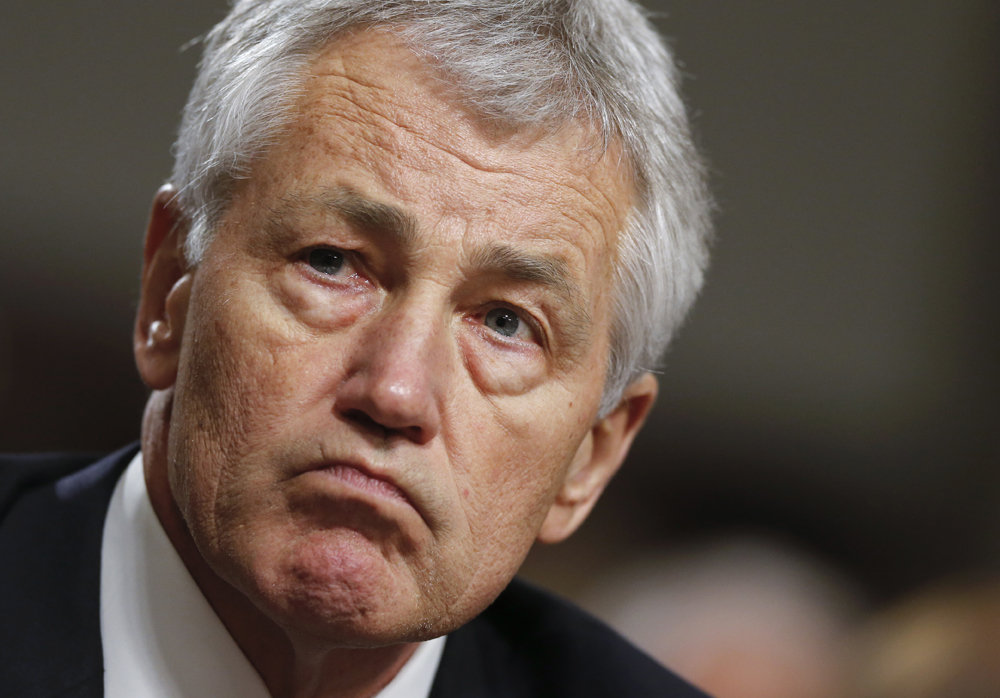
Chuck Hagel

DoD Secretary Nagel, it’s “fair” to furlough Navy employees, despite the assertion that cuts can be absorbed without furloughs.

Well, it finally happened, after 33 years of Federal employment … My first Adverse Action.  A furlough, long speculated upon and hanging out there like a piece of space rock that you know is screaming – maybe more like meandering – towards you; yet you’re not quite sure if or when it might hit, or how big the mess if it does.

So it appears to be hitting, regardless of my own personal opinion (denial?) that there was no way they would allow said space junk to impact.

The story gets much uglier the further you peel the onion.

My first attempt at writing this, the day after we received our Notice of Proposed Furlough, came off like an angry rant … which it surely was.  It went in part like this:

I’m mad at all the bozos in Washington, D.C.!  All of those who would rather drive their ideological stakes into the ground and tether to those constraints the Government’s ability to function, the Country’s long-term economic health, and the tenuous condition of the Middle Class rather than dealing with the realities of the National Budget!

That goes for the Democrats as much as the Republicans, the Conservatives as much as the Liberals.  Governance requires Adults.  Unfortunately few can be found among those currently taking up space in the building they call The Capitol.  A building which frankly should have a sign draped across the front, advertising it as “The World’s Largest Day Care”!

bg-1-136694

But the biggest chunk of anger I feel is towards The White House …

That last part won’t surprise anyone who has visited here before, as I reserve a  particular animosity for those who created such an unpredictable sequestration gamble with the livelihoods of working class Americans!

But yes, I feel a little better today, thank you.  Still more than a little pissed however.

The reason is summarized somewhat by today’s title, “Once upon a Furlough …”, a twist on a phrase used by story-tellers since at least the year 1380 according to the Oxford English Dictionary.  Afterall, sequestration with all its head-scratching “cost savers” – among them the furlough of federal employees – is great big Fairy Tale.  And the story has its origins in The Oval Office during the 2011 debt-ceiling negotiations.
Sequestration Fairy

Sequestration Savings Fairy

At that time The White House was working with the Democrat’s Congressional delegation, trying to figure a way to wheedle agreement from the Republican side of The House to raise the federal debt limit.  It was then Chief-of-Staff Jack Lew (now Treasury Secretary) and White House Congressional liaison Rob Nabors who “brain stormed” The Great Sequestration Gamble of 2013.

The idea being that the sequestration would be such a painful penalty for not agreeing to a future “grand bargain” on the budget and deficit, and more importantly on what – if any – cuts could be made to said budget, and who and how much more in taxes would be paid.  This “pain” of course was aimed squarely at the Republicans, a bet on the prospects that the politics of the situation would force the Republican’s hand at a crucial moment.

Like much of what this Adminstration does, it was a poorly developed gamble that was just as shoddily executed, minus any form of Presidential Leadership, and with no fall back position other than to blame the whole mess on the Republicans in Congress.

Problem is the ploy required building sufficient political pressure to force Republicans to seek a deal.  But the Republicans dug in; refused to yield on earlier commitments to taxpayers; and held the Democrats and The White House to their promise of suitable budget cuts without more in tax revenue than Congress accepted to avoid the other contrived 2013 budget trigger – the New Year’s fiscal cliff .

Leadership???

Leadership???

The Democrats’ problem – and a continuing theme – became the need for strong Leadership from The White House.

As Scoobie Doo was so fond of saying … “Ruh Roh!”

Of course no Leadership emerged … only insistence that more tax revenue was the solution and a lot of political rallies disguised as “taking the argument to the people”.

“Ruh roh …”

Sequestration Dragon

Sequestration Dragon

And when the time came for the put-up-or-shut-up necessary to cut the heart out of the Sequestration Dragon, The White House decided to double down and really force the issue.  Though it would not be through strong leadership, circumspect vision, and the art of compromise in seeking a deal on spending and taxing.

No, no, no … Instead came the none-too-subtle message to the Republican caucus in the House of Representatives, Refuse to surrender, and the Country will suffer!

“Ruh roh …”

That’s how we ended up with the silly cancellation of White House tours, hand-wringing over Easter egg hunts, contrived air travel delays, and accusations that every unfortunate event from a bridge collapse to the bombings in Boston were the result of the sequestration.

pennyHowever, as I outlined earlier this year, the actual affect of sequestration on the 2013 fiscal budget was just 1% of everything the federal government will spend in Fiscal Year 2013.

A penny on every dollar!

And yet, here we are.

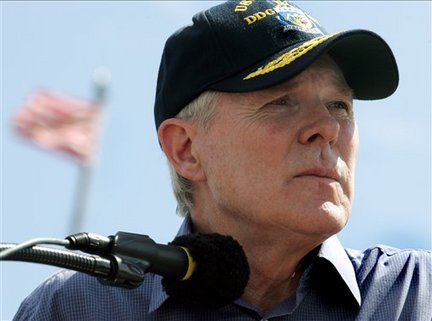
For federal employees of the U.S. Navy, the sequester furloughs are particularly infuriating because they are completely unnecessary!  Secretary of the Navy, Ray Mabus and other senior Navy executive leaders have made it known that the U.S. Navy could comfortably absorb the sequestration-driven budget cuts without a single civilian furlough.

Secretary of the Navy Ray Mabus

Secretary of the Navy Ray Mabus

The response from White House Cabinet DoD Secretary Chuck Hagel?  Yet another absence of Leadership … Insisting that the Navy furlough it’s civilian workforce in order to “be fair” to those who work for the Army and Air Force.

What?!?

Yep, that’s right  … Fairness now is the real reason for the furloughs of Navy employees as opposed to “the extraordinary and serious budget challenges facing the Department of Defense” as my deliberately misleading furlough notice states.

DoD has every indication that the Navy can absorb its share of the shared pain from this silly sequestration without affecting the incomes of its civilian employees; yet they insist the Navy reduce their employees annual earnings by 20% in order to “be fair” to those working for the Army and Air Force!

Welcome to Fairy Tale Land!

So what’s a Federal Employee to do?!?  Make them pay more of course!

imagesOne of the protections, federal employees enjoy is that of the Merit System Protection Board.  The MSPB is expecting a potential tsunami of appeals over the furloughs being forced on federal employees.  Since an appeal to the MSPB can cost the Government up to $10,000 (See “Cost of Appeals”), the Federal Government desperate for a way to stay within budget and sacrificing its employees, ends up potentially paying twice as much as it expects to save for each employee who decides to file an MSPB appeal.

For this reason every Federal Employee should consider filing an appeal regardless of how dim the prospects are for vindication!  For Navy employees in particular, Chuck Hagel has laid a very nice gift at your feet.

You can view instructions and a link to the appeal process here.  MSPB even has an e-file application to ease the confusion.  Furloughed employees have 30 days from the date-of-notice or from the first day-of-furlough, whichever is later, to file their MSPB appeals.

There … now I feel much better!

Cranky Man’s Lawn ’13: Cold Spring Stupor

lawn1Spring was still a rumor here in Southeast Pennsylvania up until this past Sunday afternoon.  Yet I remained skeptical until Monday, when I could actually feel Spring’s warm caress on my hair-challenged head without the benefit of three layers of insulating clothing.

Last Spring was recognized as one of the warmest in recent history.  Good if you like warm weather in March, not so good if you’re a climate alarmist.  But there was no problem this Spring worrying about frantic warnings of rising oceans, melting ice caps, and dying forests.  Everybody was too busy trying to keep warm … on Easter Sunday … in Southern Florida …

So, with Spring delayed what’s a Lawn Junkie to do?

For one thing, hopefully you didn’t jump the gun!

Observed several neighbors putting down lawn treatments LAST WEEK!  Way, way too cold for that to accomplish anything.  Few but the hardiest weeds have appeared and crabgrass season was still weeks away.  A little bit of rain and anything that rotary spreader was meant to accomplish was a wasted effort.

Such is the price of not paying attention.

The only piece of data to pay attention to this time of year is ground temperature, not air temp.  The only treatment you should even remotely prepare for – right now – is crabgrass. And it is still too cold for even a pre-emergent application.

Quite possibly, this weekend will be the first where a pre-emergent will be effective.  Look for the blooming of the forsythia!

lawn2Get your lawn clean-up done!  This is what my lawn looked like pre-cleanup.  The picture heading this post shows how it looked after three hours of raking, mowing, and trimming.

Found some weed infiltration along the edges of the lawn, which is common since the edges of a well-fertilized lawn is the only place generally where a weed seed can gain a foothold.  It’s best to try to eliminate them early to deny them the opportunity of spreading.

But it’s still too early for an effective weed ‘n feed application.  Let that go until the end of April at this point.  Instead, I expect to find a good weed product in spray form to hit those edge areas where weeds have popped up.

Just make sure whatever product you grab will not affect the grass around it.

602097_628034453876978_1726053180_n

Note brown lawn across street. Just sayin’ …

Killing Kennedy

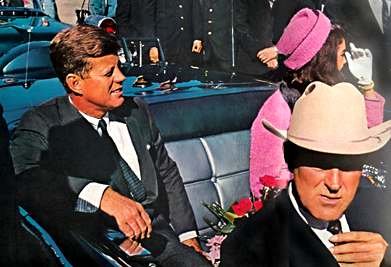
300806jfkIt has become cultural cliché that everyone – old enough to be aware that day – remembers where they were when they heard JFK had been shot … or when the planes hit the World Trade Center … or 70 years ago when the Japanese attacked Pearl Harbor.

Yet by whatever definition we now describe such memories does not change the fact that they indeed will last a lifetime.  And as in the events described above, they will also transcend generational experience.

Friday, November 22, 1963 was a pleasant day for the week before Thanksgiving.  I was a first-grade student at the Immaculate Conception Roman Catholic elementary school located on Chelten Avenue in the Germantown section of Philadelphia.

UnknownIt was close to lunch when the quiet of the classroom was broken by the unexpected squawk of the intercom system.  At first just a confusing message to this 7-year-old, “Please say a prayer, the President has been shot!”  Initially all of us were puzzled, but the one image that was seared into my memory was the look of horror on Sister Anne’s normally placid face.

Minutes later came the words I remember so clearly, as though it was only yesterday, “The President is dead.”

111026.1L

A sign of those times in a Romans Catholic family, though not exactly what hung in our home.

What I remember most from then, particularly those days after the assassination was the reaction of my parents.  As Irish Catholics, the Kennedy election and inauguration held a special sense of pride for them.  In our house one wall contained two pictures, one of John F. Kennedy, the other Pope John XXIII … side by side.  The days after November 22 were filled with an almost non-stop vigil in front of the television, where we first witnessed some of the images that accompany our never-fading memories of those emotional days.

Recently I came across Killing Kennedy: The End of Camelot (Bill O’Reilly and Martin Dugard) in an unexpected place – my 23-year-old son’s bedroom.  It was a bit surprising given the way many historical events get lost within our natural focus on more current events.  But Brian has always been a bit of a book-worm, and was never very parochial about his reading choices.

And in his room I also found a Steven King fiction, 11/22/63, that revolves around the Kennedy assassination.  Of course I immediately confiscated it; and added it to my reading list as well.

Apparently, the Kennedy assassination had indeed transcended Brian’s generational experience and interests.

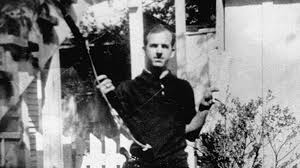
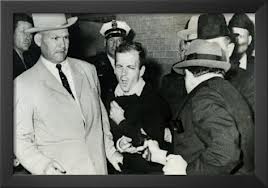
Lee Harvey Oswald

Lee Harvey Oswald

This is certainly not the first book on the Kennedy tragedy I have picked up.  My first in-depth look into that day in Dallas was Josiah Thompson‘s conspiracy piece Six Seconds in Dallas, a book that sowed all sorts of doubts in my young mind on the official version of the assassination as set forth in the Warren Commission Report.

O’Reilly and Dugard do a credible job of identifying those organizations and criminal elements long considered as potential conspiracists in the Kennedy assassination.  Yet they do an even better job of describing Lee Harvey Oswald as a dejected reject of both the Soviets and Cubans, a man who always believed he was deemed for “greatness” despite doing little to achieve even a passing notoriety.

Even his relationship his wife, Marina, an increasingly disenchanted spouse, shows a man who had a very difficult time living up to even pedestrian expectations.  Oswald was the loser lone gunman that has become the all too familiar figure in many objectified killings, be they the assassination of key public figures or the serial killing of more common citizens.

Oimages-1ne of the well-developed themes of Killing Kennedy is the ability to look back through the perspective of time and pull an entire picture together.  The book looks back at the figures and events that led up to that bloody day in Dallas.  But it is even more interesting to relive those legends that surrounded the troubling facade of the Kennedy Camelot.
  • Most Americans from that era are familiar with JFK’s propensity for extra-marital relationships.  Chapter 5 of Killing Kennedy deals openly with Kennedy’s well-known affair with Marilyn Monroe.  But how many people dazzled by the Kennedy mystique ever considered the lengths to which his wife, Jacqueline Bouvier Kennedy (and later Onassis) went to enable – if not condone – said dalliances?

    Jacqueline Bouvier Kennedy

    Jacqueline Bouvier kennedy

Jackie was known to leave The White House almost every Thursday for weekends away at the family’s Glen Ora estate in Virginia.  She was no fool when it came to JFK’s escapades, yet she left him each weekend alone with Dave Powers, who kept a constant stream of young women accessible to the President.

Kennedy actually claimed that he needed sex almost every day to prevent debilitating headaches (the male twist on the headache-sex relationship?).  As for Jackie, she eventually took the unusual step for the 1960s and sought frank, explicit sex advice from Dr. Frank Finnerty, a cardiologist and family friend, in an attempt to improve the First Couple’s intimacy and keep The President from wandering.

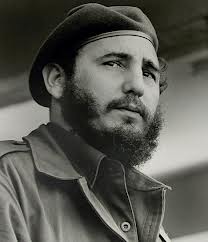
  • Another interesting facet of Killing Kennedy is its frank discussion of the Bay of Pigs disaster, that ill-advised, poorly executed attempt to invade Cuba and overthrow the young revolutionary, Fidel Castro.  One  factor in the military disaster was Kennedy’s own part in forcing the Bay of Pigs plans to its infamous conclusion.  Kennedy was particularly hard on the images-2Eisenhower Administration’s for what he described as its soft stance on Communism – and Cuba in particular – in the 1960 election campaign against Vice President Richard Nixon.

After such a showing Kennedy was in no position to forego a plan that had its origins in the Dwight Eisenhower administration despite his obvious misgivings in the lead-up to the invasion.  Once it became apparent that the invasion would fail, Kennedy further complicated his mistake by being indecisive and timid; and then abandoning the effort completely, leaving many of the Cuban expatriates spearheading the invasion to die or to suffer years of imprisonment in Castro’s new Cuba.

  • Amazingly enough it appears that the Soviet-Cuban Missile crisis resulted in Kennedy’s far wiser embargo strategy against Communist Cuba; and it also may have saved the Kennedy marriage.  Many within the Kennedy inner circle, even the men on the Secret Service detail, saw a marked change in JFK’s womanizing after the Soviets almost forced a nuclear showdown over placing offensive, nuclear-capable missiles on the island just 90 miles from Florida.  As a result of that nuclear near-miss, the President appeared to become a much more family oriented and accessible husband and father.
  • It is not difficult to appreciate JFK’s actions to end racial discrimination in the South.  Although his
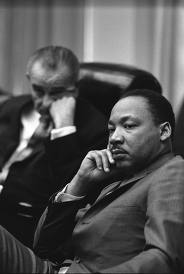
    Martin Luther King, Jr and LBJ at a meeting in the Kennedy White House

    Martin Luther King, Jr and LBJ at a meeting in the Kennedy White House

    civil rights efforts really found their impetus in Attorney General Bobby Kennedy, the actions – and reactions – taken in the early stages of the 1960s would continue as a central theme of the Lyndon B. Johnson administration and culminate in the Civil Rights Act of 1964.

As I read Killing Kennedy much attention was being given to the 50-year anniversary of the Birmingham campaign to protest racial discrimination .  It’s sobering to consider that just 50 years ago African-Americans – some as young as elementary school students – were motivated to expose themselves to physical violence at the hands of white law enforcement authorities to press their case for equal treatment under the law in the racially hostile South.  The author’s description of the Birmingham Children’s Crusade is provocative.

Other facts I found interesting and enlightening in Killing Kennedy:

  • Jack Kennedy was hardly the decisive Navy PT boat Commander immediately after PT-109 was cleaved in half by a Japanese warship in the South Pacific.  Initially Kennedy is hesitant to make command decisions, instead polling his crew as to the best course of action.  But he certainly made up for his timidness as the episode progressed.
  • Kennedy was in constant pain over most of his adult life as the result of injuries from the PT-109 incident.  To relieve his back pain, Kennedy liked to swim naked in the since removed White House pool.  This activity also led to some embarrassing episodes with young female staff members.
  • During the Bay of Pigs Kennedy was beset with diarrhea and urinary tract infection that severely tested his ability to concentrate.
  • Jackie Kennedy was a closet chain-smoker, who continued the practice even during pregnancy!
  • UnknownThe Kennedy’s despised LBJ; and him them.  This is not difficult to understand, given the way the Kennedy brothers brought Johnson onto the 1960 ticket in order to land the Electoral College votes of Texas then eviscerated his political power as Vice President.
  • Just weeks before his death, Kennedy already has the U.S. heavily involved in the survival of the South Vietnamese government.
  • JFK greatly embarrassed Frank Sinatra when he cancelled long-made plans to stay at Sinatra’s Palm Springs home following a speech at UC-Berkeley in 1962. This after Sinatra had already gone to the trouble of making significant changes to his property, even adding a helipad.  Instead Kennedy stayed at Bing Crosby‘s estate, purportedly bedding Marilyn Monroe for the first time there, because of Sinatra’s alleged relationship with La Cosa Nostra.  Sinatra, irate when Peter Lawford – a Kennedy by marriage – was forced to break the news, eventually became a Republican.

Regardless of whether you come from my generation, an earlier one, or a generation much younger and far removed from the shock of an assassinated President, you will enjoy the historical perspective provided by Killing Kennedy!

Sequester ’13: The Magic Penny Theory

pennyFive days have passed, and so far the Earth has not – as yet – careened off its axis to spin wildly off into the black void of deep space.  Commercial air travel did not turn into a nightmare overnight due to air traffic controller layoffs; the schools are still open; and I still had to go to work!

You would think that maybe – just maybe – all the Chicken Little with hair-afire warnings might have been just a little exaggerated.  Just a little …

Recently I finished reading Killing Kennedy: The End of Camelot (Bill O’Reilly and Martin Dugard), and it brought back a lot of memories.  One concept brought to mind from the aftermath of that horrific day was the Warren Commission’s development of the Magic Bullet Theory.  The bullet was believed to be the first shot that struck President John F. Kennedy; and although it was not the fatal shot, it passed through Kennedy and did major life-threatening damage to Texas Governor John Connally, who was riding in the seat in front of The President.

A second or third shot, depending on who you read, ended President Kennedy’s life.

The Magic Bullet Theory was originally greeted with much disdain by those history and conspiracy buffs, who delighted in disparaging the physics involved and the presentation made by Warren Commission Assistant Counsel Arlen Specter.

It was even the subject of a segment on Seinfeld!

Bare with me here …

Last week’s move into Sequestration automatically put into effect $85 billion in across-the-board budget cuts.  That certainly sounds like a lot of money … until you consider that the Federal Budget for Fiscal Year 2013 is $3.8 trillion!

The Congressional Budget Office, an apolitical organization that performs independent analyses of budgetary and economic issues to support the Congressional budget process, released a report stating that the effect of sequestration cuts for Fiscal Year 2013 will be $42 billion, not even half of the full measure of $85 billion estimated as sequester-related cuts!

Of course that assumes that the sequestration will last throughout the remainder of the fiscal year.  I wouldn’t bet the House … or the Senate … on that proposition.

In fact another trigger date – a Continuing Resolution – is scheduled to hit by the end of March.  Lack of an agreement then could shut down ALL of Government, minus the traditional exemption provided the Department of Defense.  Will this opportunity also pass without a Presidential Vulcan mind-meld (Sorry, couldn’t resist.) on a grander solution?

But it’s the math involved with this current sequestration that is irrefutable.  $42 billion equates to $0.01 ($42 billion/$3.8 trillion = $0.01) for every dollar in the FY13 federal budget.  One stinkin’ cent … an Abe, and not the more lovable $5 Lincoln … One penny on every dollar!

But that single cent is one Magic Penny!

The Magic Penny set off the wailing of the sirens warning of National misfortune and personal misery from The White House and Democrats.  There have been almost daily pronouncements of Sequester Doom & Gloom in local newspapers, on national broadcasts, and on-line media.  The Sequester, a mechanism that was actually resurrected by The White House and proposed by those very Democrats in debt ceiling negotiations, would have profound effects on the country and its citizens at the hands of those heartless Republicans in Congress.

Now all of us, particularly those outside the upper reaches of the top tax brackets, have been under constant financial pressure for the past 5-6 years.  Most recently, you lost the 2% reduction in payroll tax from 2010.  And while some will argue the expiration of tax relief is not a tax increase per se.  Fact is you are paying more in taxes; bringing home less money.  Call it what you will, your household is doing with less income.

Even if your wages have held fairly stable over this period, certainly your Costs of Living continue to rise.

Have those increases in taxes and rise in daily costs been more than a penny on your dollar?  Most probably … Were you able to adjust; do without some things; change plans; push out major expenditures waiting for better financial times?  Probably …  Has your loss of buying power been an adverse development for your household budget?  Most likely …

But you made the adjustments. You do what you can.  You bag the rest, and hope for better times.

Sequestration is perhaps the WORST strategy for fiscal negotiations ever to be uttered by any White House Administration.  And certainly, both sides should get back to work on a solution that will benefit the long-term economic health of the Nation.  But for President Obama and the Democrats to expect capitulation by the Republican Congress on their principles of fiscal responsibility over cuts equal to a penny on the dollar in the Federal budget is simply silly.

Yet Washington Democrats – in particular The White House and President Obama – will have you thinking the sky will be falling all over that Magic Penny!  Some of the pronouncements coming out of The White House have been downright hyperbolic.

National air travel would be disrupted; teachers were being furloughed, The President said (That is until the press corps challenged The White House to give one example – just one – of a school district that had issued pink slips.  They couldn’t!);  National Parks would be closing; dangerous food situations would increase, caused by the loss of food inspectors; coastal inhabitants would be at the mercy of Superstorms because weather forecasting will be unaffordable; an entire aircraft carrier group held back from active front-line service; grannies kicked to the curb; the Nation would totter on the brink of financial ruin; communities would no longer be able to protect its citizens …

All over one penny on the dollar of a ridiculously bloated Federal Budget!

That, my friends, is what Seinfeld would call One Magic Loogie!

Sequestration: The President’s ugly Child

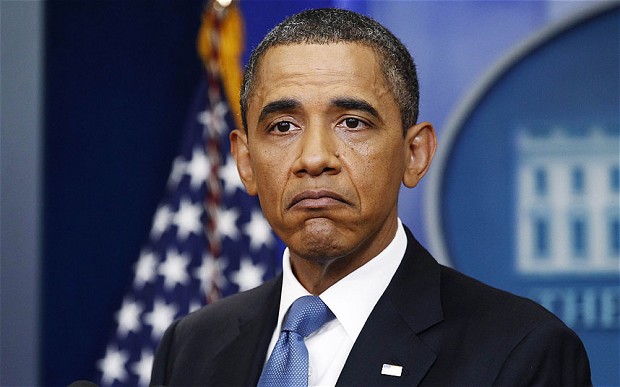
obamaHow many people realize sequestration, which The White House continually warns will be a “disaster” for the country and its citizens from Arizona to Connecticut, was actually The White House’s brain-child???

Don’t listen to the hype … or the lies.  The sky, if it falls, will not be the sole responsibility of Congress.  Heck, it wasn’t even their idea.

The Public is a pawn in this chess game.  The political pressure being applied by The White House, in the form of Dire Economic Impacts on individual states and even the victims of Superstorm Sandy, is intended to force Congress (i.e. Republicans) – by portraying them as the troublemakers – to cave in so they can pass to the American people an even bigger financial federal budget burden without cutting a single one of the Democrats’ Sacred Cows.

Sequestration was the gamble suggested by then White House Chief-of-Staff Jack Lew (Secretary of the Treasury nominee) and White House Congressional liaison Rob Nabors.  It was endorsed by President Obama before being presented to the Senate Finance Committee, and proposed as a negotiating strategy to Senate Majority Leader Harry Reid (D-Nev) during the 2011 negotiations to raise the National Debt Ceiling.

Certainly House Republicans accepted the sequestration as part of those negotiations, but it wasn’t their idea; it wasn’t their gamble.

It was the President’s idea of “leadership” in difficult political times.  Push it off; deal with it later.  Maybe, just maybe it will go away on its own.

Keep that in mind as you continue to hear about how Sequestration will damage your benefits; your income; your local economy!

Remember it when The President shows up on C-Span or the nightly news speaking about the dangers of sequestration and surrounding himself with Emergency Responders, teachers, healthcare workers, and seniors warning about all the damage the sequestration cuts will entail.

Sequestration:  The President’s ugly child!

Who were those people in the background?

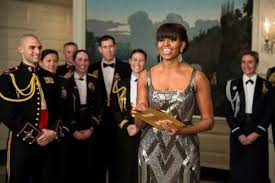
imagesNow I know the Obamas receive a lot of criticism was those who do not agree with them politically, socially, economically, etc.  Some of it is over-the-top, some of it valid as well.

But performances like tonight, where Michelle presented the Best Picture Nominees and Winner at The Oscars, is what gets people talking about their priorities and values.

As Michelle spoke live from Washington, D.C. to the Hollywood elite, many of whom contributed significantly to The President’s re-election, her backdrop consisted of several young military personnel in full parade dress.

(View the entire segment here.)

She spoke about overcoming obstacles, courage, the importance of art to young people, and “that vitally important work” being done in Hollywood …

Seriously … Their “vitally important work” …

But never once was the presence of those young people in uniform acknowledged, their service recognized.

It appeared that those courageous young people in their dress uniforms were there simply as drapery.

Did you notice?

What’s wrong with that picture?