Sunday morning, caffiene driven newspaper musings

Lobster, lobster everywhere and “market price” menus 

We’re gonna need a bigger butter boat!

The lobsters are running wild off the coast of Maine.  Lobstermen are bringing to market so many of the popular crustacean that prices have dropped dramatically.  As of last week lobster – once selling for as much as $4.00 a pound – is down to $1.35 per pound.

But what is especially good for those of us in plastic bibs, toting buckets of melted butter is not necessarily good for those who sweat out the challenges of supporting a family from the dangers of Old Man Sea and the unpredictable mechanics of supply and demand.  These lobstermen find themselves working even harder to bring in the quantities needed to offset the low price, supply driven market.  It’s an inescapable cycle.

The lobstermen’s problem should be a good thing for lobster lovers at the other end of the lobster pipeline however.  The words “market price” on restaurant menus is always a cause for pause when cost-conscious diners consider dabbling in the finer culinary seafood options.  One never wants to be embarrassed by asking what the “market price” is, when the answer is likely to be “too much”.  So now would seem to be the best time to take advantage of more diner-friendly market conditions. 

At the very least, you can find out whether your chosen dining establishment really lives by the “market price” mantra or simply uses it to fleece uninformed customers.  If you get the chance to investigate, let us know what you find! 

.

The hidden reality of the Affordable Care Act

For a nation already experiencing physician shortages, the new healthcare law is likely to widen the gap.   The Association of American Medical Colleges estimates that by 2015 the country will be short over 62,000 doctors of those needed to provide sufficient healthcare options to its citizens.  By 2025, the estimated shortage will be 100,000 doctors, and that’s before any consideration is given to the effects of the ACA (Obamacare) will have on doctor demand.

An example is the case of California’s Inland Empire, a region that covers the counties of Riverside and San Bernardino.  The Inland Empire has grown by 42% since the turn of the century.  (2000 that is, not 1900.)  The increase of over 640,000 people comes along with a jobless rate of 11.8%! 

In view of recommendations that any given region be serviced by 60-80 primary care and 85-105 specialists for every 100,000 in population, the Inland Empire barely makes do with an average of 40 primary care physicians and 70 specialists per 100,000.  The region has a more complicated problem attracting doctors, being in such close proximity to Los Angeles and Orange County where doctors prefer to work due to the prospect of better paydays.

The real kick in the teeth for Inland Empire healthcare is the 300,000 new patients that will be seeking routine medical care when the ACA extends coverage to them in 2014. 

Normally these individuals would seek care at hospital emergency rooms, which is not the most cost-effective way to meet their needs.   And the purpose of this post is not to suggest that extending healthcare coverage to them through the ACA somehow creates a cost issue from nothing.  But it does point out another rather interesting effect.

Once healthcare coverage is extended to these individuals, they will seek the preventative, health-maintaining care they used to neglect.  Again, all good things … Any effort to see doctors when healthy and before medical problems develop will reduce the overall per capita cost of healthcare.  The question though becomes what happens to accessibility and convenience of healthcare once the shortage of physicians is exacerbated by the sudden increase in better insured patients?

As Mark D. Smith, head of the California HealthCare Foundation, suggests, “It’s going to be necessary to use the resources that we have smarter in the light of the doctor shortages.”  For those living in areas like The Inland Empire, the prospect of de facto rationed medical care has to be the real concern, as it will be anywhere doctors are in short supply already.  Longer waits for well-care doctor appointments, more trips to emergency rooms for less-than-urgent medical issues, and substantial backlogs for tests and other treatments are a very real possibility.

In the end, supply driven rationing could very well be the unavoidable consequence of the Affordable Care Act.

 .

Mike’s lazily delicious ribs …

As I sit here writing this, I am cooking up a batch of short ribs on the barbecue.  I’m a notoriously lazy griller, but my comment cards indicate that many who have partaken are generally impressed.  As a lazy griller, I refuse to deal with the muss and fuss of charcoal.  I have not built a stone and mortar Cathedral of Grilling in my backyard.  I choose a gas Weber that’s push-button easy to use and even easier to maintain.

My ribs are slow cooked, wrapped in aluminum foil and seasoned with whatever flavorings I can find in the spice rack (as a minimum onion, pepper, garlic, oregano, and a bit of crushed red pepper).  At 400 degrees of indirect heat, it takes two hours for my ribs to be perfectly cooked …  roasted throughout without the annoyance of falling apart, yet melt-in-your-mouth juicy and fall-off-the-bone tender. 

Once the ribs are done, remove from the foil.  Place on the grill curved side down, coat the tops thoroughly, and let grill for 10 minutes.  Reduce the heat by half; flip the ribs; coat the insides and grill for five minutes.  Then one more flip and re-coat for another five minutes.  If they do not turn out well-cooked and delicious, you messed up the easiest rib recipe on earth!

.

The Bear on the Delaware

A $1 million lawn sprinkler?

For a good chuckle read the story of the Union Fire Company in Bensalem, PA and their new $1 million boat toy, paid for by the taxpayer via the Department of Homeland Security.  It’s an interesting tale of inter-Township jealousy and pettiness, poor boatmanship and weekend showboating, officially licensed largesse and fiscal mismanagement.

But the real horror is a Homeland Security budget that allows for the disbursement of $1 billion a year that encourages pushing money out the door with little obvious investigation and even less judgement as to what’s really needed and where.  The good news is, if you lose an IED (improvised explosive device) somewhere along the Delaware River above Philadelphia, the Union Fire Company can help you find it with their $37,000 sideview sonar!

.

Lastly, another iteration of my most recent,  favorite discussion topic – Pennsylvania’s new voter ID law …

It’s been fun watching the Democrats in Pennsylvania throwing a fit over the new photo voter ID law.  It seems to matter not that the U.S. Supreme Court weighed in on the subject in its 2008 decision on Indiana’s version of the law.  They somehow think the Pennsylvania Supreme Court will hold a softer view of their complaints that the law is an unreasonable burden and barrier to voting rights.  It’s telling that they are forgoing the federal USSC route, which is usually the very first route taken when it comes to alleged civil rights violations.

Their biggest weapon in trying to prove the dark underbelly of the law has been the Commonwealth’s own data relating to mismatches between voter registration records and PENNDOT driver licenses. 

Holy poll tax, Batman!  750,000 Pennsylvanians might be “disenfranchised”!!

Uh … not quite …

As I argued here earlier, the numbers cited by the Pennsylvania Department of State are seriously flawed.  And The Philadelphia Inquirer‘s own look into the numbers showed some very interesting inconsistencies.  Some of the individual cases of “disenfranchisement” were downright amusing.   Names found on the mismatch list included former Philadelphia Mayor W. Wilson Goode and his son WWG Jr., four Philadelphia Councilmen, and former Veterans Stadium drunk court judge, Seamus P. McCaffrey.

The funny part?  All of them have valid Pennsylvania driver licenses!   What’s a panicky Democrat to do?!?  Why keep on truckin’ of course!

The problem – as one can imagine when it comes to record-keeping and government – is in the details.  Seems the Commonwealth’s databases and operating systems have a real issue with the nuances of people’s names.  Apostrophes, hyphens, capitalization, and even spacing threw its PENNDOT-voter registration for a loop.  Many of the names showing as mismatched are really nothing more than the fallout of poor programming and inconsistent inputs.

But one note should make the Democrat Champions of the Disenfranchised feel a bit better.  In today’s Philadelphia Inquirer, Emily Bazelon, a senior editor at Slate, describes information passed to her by an anonymous insider purporting to show that the data on potentially endangered voters skews no further Democrat than it does Republican, with many voters living outside both Philadelphia and Pittsburgh (i.e. more likely Republican) also being affected.  But of course, Ms. Bazelon also jumps to the conclusion that this initiative was an effort to disenfranchise Democrats overwhelmingly more so than Republicans.

At least now the whole picture is finally coming out, and it supports a politically neutral law designed to facilitate a more secure vote!
When the crazies kill, why sanction the legal and responsible?

Here we go again …

Another crazy gets hold of an arsenal of weapons; breaks almost every law in the books; and shoots scores of innocents.  And the result is predictable … a groundswell of opinion that never wavers … PASS LAWS TO RESTRICT GUN OWNERSHIP!

The problem with that sentiment is that third word … “LAWS”.  Because “laws” only apply to those inclined to obey them in the first place!  

It’s one thing if our elected leaders had the backbone to take on such an unpopular position (unpopular that is to most people who do not live in large, liberal-run cities) and accept the political consequences.  But that’s rarely ever the case, when politics and power are of greater value.  And that’s exactly the sentiment that was expressed by Democrat stalwart Senator (CA) Dianne Feinstein, who stated, although a sane discussion on gun control and a ban on military-type assault rifles was important, an election year was not the time to address it. 

Huh?!?  Wouldn’t that be the PERFECT time to address the issue?!?

Apparently the Democrats see a discussion of gun control to be a political loser in a year when President Obama is fighting for re-election in what is expected to be a close election.  For these Democrats, the subject of limiting gun violence by restricting access to guns for everyone is trumped by White House aspirations.  It says much about where the issue really sits with the political animals of the Democratic Party.  So, if they refuse to have this discussion now, why should they be taken seriously when they finally get around to it? 

In that same vein, we are still waiting for The President to get around to his 2008 campaign promises on gun control.  Instead, President Obama has signed bills allowing guns in national parks and even on Amtrak!   He has steadfastly refused to seek reinstatement of the Assault Weapons Ban.  And maybe that’s the real reason Democrats – like Senator Feinstein – do not wish to bring it up now!

But in truth, even if we did have this conversation today, it would accomplish NOTHING for keeping guns of all shapes, sizes, and magazine capacities from the criminals and the crazies. 

If it were that easy, we wouldn’t have had Aurora … or Columbine … or Howard Unruh … or the University of Texas clock tower … or Virginia Tech …

That’s the REAL problem … the criminals and the crazies.  You have no right to ask law-biding citizens to give up access to responsible gun ownership if you have no prospects for denying similar weapons to the criminals and the crazies.  And it’s mind-boggling that anyone would propose such a ban in an age where our own Federal Government openly distributed guns to the most dangerous criminals currently on the continent.  They must solve the problem of keeping automatic assault weapons from the drug runners, the gangs, and criminally insane before asking John Q. Citizen to even consider doing the same.   

I ain’t holding my breath on the former, but fully expect continued efforts to do the latter.

For another reason entirely, I laugh when gun opponents run up the flag of the Founding Fathers to claim that they had no intention for gun ownership to exist outside what was needed for the purposes of organized state militias.  That may well have been their original intent, just like it was to restrict the voting rights of women or to count African slaves as 3/5 of a person.  In reality, the concept of militia had little-to-nothing to do historically with the development of a gun culture in the United States.

Every household in 18th century America REQUIRED the possession of a firearm.  This was not a legal requirement; it was a requirement for survival.  For if you lived anywhere other than the relative safety of early American cities, a gun was as important as food in surviving the dangers and hostilities of the unsettled frontier. 

Whether it was dealing with the growing hostility of a native population or using the point-of-a-gun to discourage foreign intervention and push American civilization West across the North American continent, the National Government fostered the concept of private gun ownership – far removed from the concept of militia service – among its citizens.  Huge tracts of territory were settled and controlled; colonial forces from Spain, Britain, and France were pushed out; and the Wild West was colonized, then civilized with the help of armed citizens that NEVER once stepped foot into a militia formation.

It renders the concept of “militia” a convenient interpretation of a badly worded phrase in the Bill of Rights.  So for better or worse – depending on your point-of-view – America grew and flourished as the result of a gun culture that was accepted by a Government led directly by those same Founding Fathers.  The same ones who supposedly never intended private gun ownership outside of a quasi-military apparatus. 

The irony seems lost on those who want to blame the carnage on law-biding citizens and their long-held rights.

Understanding China – John Bryan Starr

China has become one of the most important influences on U.S. foreign policy in the years since the United Soviet Socialist Republic (USSR) dissolved into a smaller version of itself (Russia) and a collectively less prominent scattering of nation states.  The Peoples Republic of China has impressively grown beyond being Southeast Asia’s powerbroker of the 1970s and ’80s to be recognized as an international force in the world’s economy, as well as a major industrial contributor to the planet’s environmental problems.

It slowly dawned on many Americans that China was emerging as the United States chief international rival.  But the relationship between the two major superpowers developed a unique twist that was never an issue in the U.S. competition with the U.S.S.R.  China became a significant holder of American international financial debt, a situation created in part by our own credit card addict’s view of financial (mis)management, aggravated by a growing U.S.-China trade imbalance.

For these reasons I became very interested in former Ambassador to China, John Huntsman’s unsuccessful run at the Republican Presidential nomination.  Suddenly, here was someone who understood the intricacies of our relationship with the Chinese.  But I also came to realize my own “China problem”.  I knew very, very little about the Peoples Republic of China. 

This glaring blind spot led me to John Bryan Starr‘s Understanding China, an expanded 2010 study of a nation so few of us know much about, let alone understand.  This is Starr’s third revision of his original book, published in 1997.

Starr is a former U.S. Navy officer and current political science lecturer at Yale University.  Before Yale he taught Chinese politics at UC-Berkeley.  He has served as Executive Director of the Yale-China Association and as President of the China Institute in New York City.

The Great Wall

I found Understanding China to be a well-organized and enlightening look into a region of the world I have admittedly ignored over the years, at least since those heady days of fifth-grade geography and 10th grade world science.  Starr’s approach begins with a discussion of 12 critical issues facing China as it moved from being the brunt of jokes about cheap toys and flimsy consumer products to a regional military power and international economic force. 

The 12 issues range from those that most affect the Chinese people (e.g. housing and feeding a growing population, restrictions in the free flow of information) to the issues that challenge the country of China as it emerges as a developing economic power (e.g. environmental degradation, finding sufficient sources of energy, relationships with Taiwan, Hong Kong, and the United States).  This outline sets in the reader’s mind the questions that will be addressed throughout the book and serves as a useful guide for framing Starr’s discussion.

It proves difficult for me to do such in-depth studies justice in a blog post.  So many of my readers have short attention spans and prefer lawn care tips over international political science.  With those restrictions in mind, I’ll limit my discussion here to those aspects of China I found new and most interesting.  A serious study such as Understanding China is a useful tool for gaining an overview on a broad spectrum of issues; the reader can then decide which specific areas might require more in-depth research. 

Points of interest I was surprised to learn:

  • China experiences approximately 120,000 very public protests every year.  Quite the surprising statistic for such an authoritarian and – in the case of the 1989 Tiananmen uprising – downright brutal government.
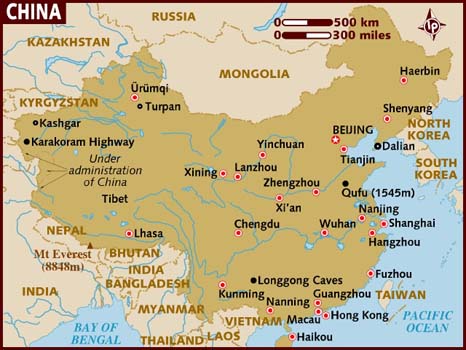
  • China is just a tad larger than the United States (3.7 million square miles vs. 3.6 million).  But 75% of its population lives on just 15% of the land mass; two-thirds of which is covered by mountains akin to the U.S. Rockies.  China’s arable land for farming is limited to just 10% of the total.
  • The 2008 global financial meltdown had a relatively limited effect on the Chinese economy.  The reason was the authoritarian government’s capability to quickly and effectively inject new capital into the domestic economy.  So there does seem to be at least one advantage to not having to kowtow to a democratically elected legislature … quick action in a crises!
  • Foreign investment, channeled primarily through the Special Administrative Regions (Hong Kong, Macao), tops $1.6 trillion a year; consisting of 60,000 joint ventures; and accounting for half of all Chinese exports.
  • China’s People’s Liberation Army receives an official annual budget of only $70 billion; but experts estimate that it’s truly 3-4 times that large.  In addition, the PLA self-finances in part through the manufacture and international sale of military weapons and equipment.  And until recently ordered to divest,  military-owned and operated facilities also produced consumer goods for domestic sale that accounted for 20% of the domestic consumer market. 
  • In 2004 Morgan Stanley estimated that high quality, less expensive Chinese products saved the U.S. consumer an astounding $100 billion!    

There were several topics in which I was keenly interested, given China’s expanding global presence and impact.

Interests of local authorities and economies vs. objectives of the national government …

Despite China’s authoritarian communist rule, the countryside is relatively free of control by the central government.  Local authorities are delegated much latitude on a broad spectrum of administrative and operational issues.  This arrangement serves to contradict certain objectives like reducing pollution and feeding an expanding population. 

The crux of the problem is that local authorities at regional and village levels are incentivized (or penalized) based on production outputs and cost efficiencies, along with ensuring compliance by its citizens with social programs (e.g. one-child birth policy).  Often the extent of local compensations, power, and access to corruptive practices causes local interests to run counter to national policy.  Local leaders will overlook environmental threats, sacrifice arable land – which are already scarce in relation to farming needs – for modern industrial facilities, and coerce social compliance with the one-child policy simply as a cost reduction measure.

Mao Zedong

The environment was just one sacrificial lamb in Mao Zedong’s vision of the Chinese nation.  He portrayed Nature as an enemy to be overcome in the struggle for a powerful, independent China.  Water and energy were provided free of charge, which ensured no one questioned the economies of conservation or the use of alternate energies. China is the largest user of coal, the second largest of oil (with 60% coming from the Middle East), and home to 16 of the 20 most polluted cities on the planet. 

China’s refusal to commit to most international environmental restrictions is based on its claim as a developing industrialized power (i.e. not yet fully developed).  The claim has some merit since all developing nations, including the U.S., have histories as a major polluters as they grew into advanced industrial powers.  This standoff does not bode well for international efforts to reduce the global effects of man-made pollution.

The family responsibility system …

The Chinese are well-known for the strength of their family system; and this is illustrated nowhere better than the reliance on the family responsibility system as a glue that holds Chinese rural society together.  Due to China’s sparse infrastructure outside its urban concentrations, huge swaths of rural land especially in the north and west have limited accessibility, little in the way of government and social support structures (hospitals, schools, roads, communication, etc.), and less government control.  As a result, a loose federation of local authorities coupled with a strong family agrarian culture are left to their own devices for sustenance, industry, and social support.

The family structure is most important here.  The family system is responsible for seeing the individual through life from birth to death.  With national priorities focused on feeding the much larger urban populations, the family structure is crucial to the success of rural farms which are owned and operated primarily by family units.  Farming and limited rural industrial capacity is owned, managed, and staffed almost entirely within the family system.  For this reason the limits of the one-child policy are largely ignored in rural areas since the larger the family, the greater the output; the greater the output, the more healthy and wealthy the family.  These families find the penalties for multiple births and additional children over one-child to be well worth the investment, even a matter of pride. 

In addition, older Chinese in rural areas do not benefit from the pensions city dwellers can accumulate.  So younger generations see providing for their elderly parents and grandparents to be part of their family duty. 

One interesting spinoff from this significant urban-rural divide is that rural Chinese do not identify with the problems and shortcomings faced by those Chinese in the big cities.  As a result, rural Chinese felt little compulsion to become involved in the Tiananmen Square uprisings of 1989, which were initially caused by protests over poor education and living conditions at Chinese universities, located in its major urban centers like Beijing.      

Remaking the Chinese economy …

This post is already way too long for some of my attention-span-challenged fans, but Starr’s biggest contribution to my understanding of China’s present day status was his explanation of the remaking of the Chinese economy.  For decades China was the land of cheap toys and poorly made consumer products.  Now it’s known for cheaper priced consumer products and top-line brand-name clothing and electronics.

China’s status as The Land of American Outsourcing hits a sensitive nerve with work-a-day Americans, particularly those without good jobs and especially those who have lost jobs to cheaper overseas labor.  It’s an issue that will plague Chinese-American relations for years to come until some form of equilibrium is reached.  One cold, hard reality is that the outsource destinations did nothing other than take advantage of the high cost structure in this country, much of it the result of the high level of Government regulation and the expenses of a union-committed labor force.

China’s big chance to remake its often ridiculed economy came with the cessation of Hong Kong by Great Britain.  This handover opened the door for China’s own brand of “capitalism with Chinese characteristics”.  Hong Kong, which had long existed as a conduit for financial activity, opened the floodgates for a dramatic expansion of foreign investment. 

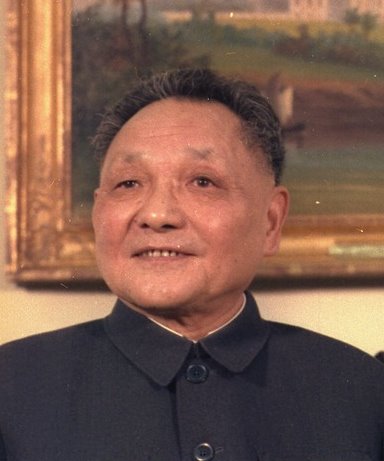
Deng Xiaoping

It was Deng Xiaoping who set the stage by initiating a number of reforms that eased the transition for China’s economy.  Deng’s reforms included moving industrial development from central government planing to market-driven decisions, and shrinking the state-owned industrial sector in favor of an expanded private sector.  These decisions accomplished more for China’s economy than any other outside development.  

From the socialist/communist point-of-view however, China also moved from an economy among the most equal in income distribution to one that is now one of the most unequal in terms of the differences between rich Chinese and poor Chinese.  This just goes to prove that trying to force a philosophy of income equality for all does absolutely nothing for the long-term financial and economic health of a developing country.

And that’s it, a rather long-winded but inadequate attempt to portray John Bryan Starr’s look inside the Chinese behemoth.  I certainly have skipped and skimmed a large part of Starr’s treatment.  For a real appreciation of China’s story from the age of dynasties to land of Wal*Mart you really need to pick up Understanding China.

Exaggerating the Pennsylvania Voter ID “crisis”

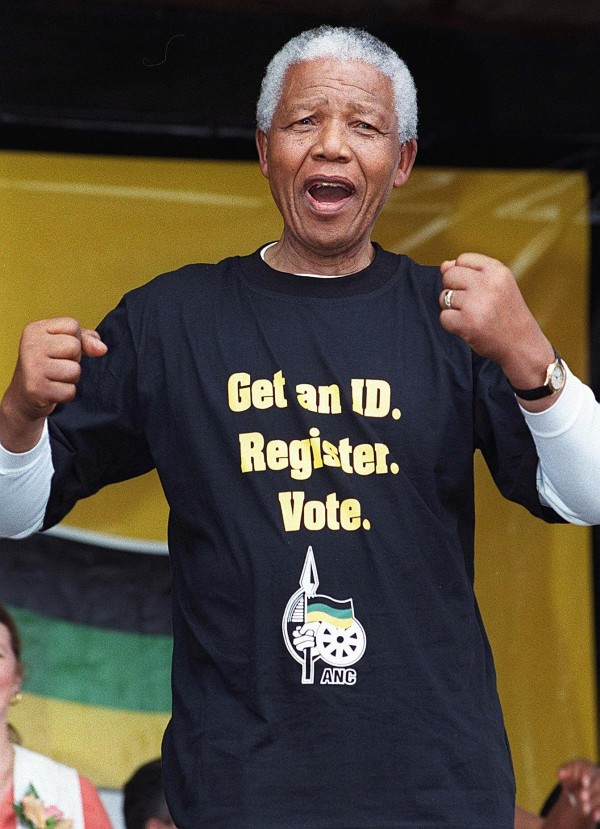
Nelson Mandela expresses his views on Voter ID laws

Nelson Mandela expresses his views on Voter ID laws

The news sent shock waves throughout the Commonwealth of Pennsylvania and the national political media networks.  Over 700,000 Pennsylvanians lacked the most common, state-provided form of photo identification, meaning that over 9% of the Pennsylvania’s registered voters might be unable to vote in this year’s Presidential election!!

The claims of a voting rights armaggedon were prolific!  Ten percent of registered Pennsylvanian voters would be turned away at the polls because they lacked photo ID!  In Philadelphia, the numbers are supposedly TWICE as bad!  The nefarious plot, born of Republican designs to defeat President Obama in November, was working to perfection!  Woe is us!  Democracy was D-E-A-D!!!

As you can see, I love an overabundance of exclamation points!  It never really makes silly arguments any more plausible or intellectually honest; but it does gives the eyes a thrill.  Best of all, it might even distract one from looking at what’s behind the numbers.

So let’s take a peek under the curtain.

The first statistic that jumps out is that 22% of those 758,000 Pennsylvania voters would statistically fall into the “inactive voter” category, meaning that they have not voted since 2007.  In other words, these 170,000 Pennsylvanians have been sitting on their voting hands for at least 5 years.  It also means – by the way – that not a single one of them bothered to vote in the 2008 Presidential election. 

Frankly, I find that 22% to be well on the low side.  From my own experience working on the polls in Horsham Township, the number of voters who do not bother to vote in even the most important presidential races is much closer to 40% than it is to 20%.  A 22% inactive voter rate would conversely suggest a 78% voter turnout, which has not been experienced in Pennsylvania since 1992 (82%).  In 2008, in one of the most provocative national elections in U.S. history, only 68% of Pennsylvania voters cast ballots.  That’s a 32% “no-vote rate”.  If that rate is applied to the 758,000 without PA photo IDs, 242,000 would not be expected to vote in this year’s Presidential contest.   

In addition, the gap in voter registration-to-PENNDOT photo ID includes college students who lived in Pennsylvania while attending in-state colleges and universities; registered to vote during their studies here; then left the state following graduation to pursue their careers.  There are roughly 590,000 college students attending over 3200 schools in Pennsylvania.  According to a 2010 Student Retention Survey, Philadelphia enjoys a 58% student retention figure.  Even though this would be considered a bit on the high side for the entire state, let’s assume it applies.  It still suggests that every four years roughly 62,000 college students leave the state (590,000/4 years x 42%). 

Without even trying all that hard with admittedly fuzzy math, I’m able to whack that 758,000 by 40% (304,000).  And that’s without addressing the multitudes living in large city environs who simply have not needed a PENNDOT drivers license because they rely on mass transit. 

Now let’s consider that a goodly number of these mismatched Pennsylvania voters have other acceptable forms of identification: 

  • Accredited Pennsylvania colleges or universities (with photo and expiration date)
  • Pennsylvania care facilities
  • Military identification
  • Valid U.S. passports (cannot be expired)
  • Other photo identification issued by the federal or Pennsylvania government
  • Employee identification issued by the federal, Pennsylvania, or a county or municipal government

It’s impossible to count those who will have the above at their disposal; but a valid assumption is they would significantly reduce the number of those left without acceptable forms of voter ID.

Finally, comes a number that illustrates why Democrats really fear the numbers being thrown around by PENNDOT.  That number is 2477, or the total number of voters – according to Karen Heller’s column in The Philadelphia Inquirer – who have sought photo voter IDs from PENNDOT since the new voting law was passed in March 2012.  That’s just 620 people per month!

Is that a systemic problem, caused by inaccessible PENNDOT facilities, long lines, poor transportation options, bad customer service, overly complicated documentation requirements, etc.?  Or is there another reason why citizen response has been slow and not nearly adequate to address this “constitutional crisis”?

The critics would like you to believe that all the remaining individuals who haven’t bothered to seek the required photo IDs, are all physically disabled, obscenely poor, or 93-year-old grandmothers born in far away Southern states where racial discrimination rendered them unable to produce native state birth certificates. 

The real problem for Democrats might just be that those they count on to carry the vote in urban locales – like Philadelphia – simply won’t be motivated enough by their precious constitutional right to vote to bother trying to get a valid photo ID.  Excuses will abound for this.  Some will be valid; others will be nothing more than excuses.  You can be certain that, if our newly minted and recently upheld Affordable Care Act required a photo ID to obtain federally subsidized health insurance, the lines outside local PENNDOT offices would be long and suddenly so very easy to reach.

Certainly the truth lies somewhere in between my admittedly cynical, sometimes sarcastic analysis and the breast-beating wails of Jim Crow and poll taxes.  If you were in Houston this week, you could have heard the Obama Administration’s view of the voter ID controversy from none other than U.S. Attorney General Eric Holder, who addressed the NAACP’s convention on the issue.  Unfortunately you could only get inside the convention site by showing up with your government-approved photo ID!!

For me, it’s incredibly difficult to reconcile a view that requires photo ID to cash a check, ride an airplane, visit a new doctor, sign for a mortgage, or taking an opportunity to listen to the insights of the U.S. Attorney General, yet shuns the same added integrity and transparency for one of our most precious freedoms with the same level of effort.

Only in America …

The missing Political Middle; the loss of American governance

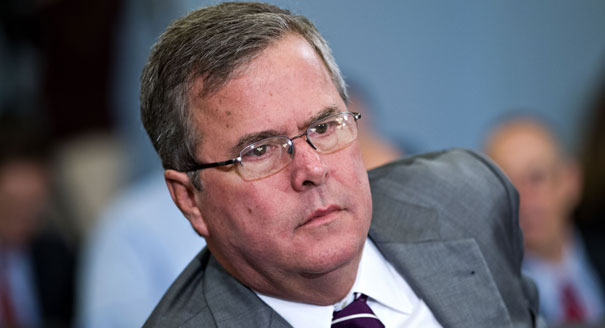
Thank you, Jeb Bush for putting into words what I have been thinking for quite some time!  How exactly to express my frustration with a National Leadership that is getting absolutely nothing done.  Nothing fair, nothing honest … simply nothing at all.

Washington, D.C. is broken.  And while Jeb Bush touched on one aspect of the problem – the severe hyper-partisan divide, my frustration is centered on another cause of this political stagnation.

What has happened to the Moderate Middle in American politics?!?

First off, allow me to lay the basis of my beliefs for this post:

  • Hyper-partisanism is a problem with BOTH political parties.  The Democrats in Washington are just as hyper-partisan as the Republicans.  A point which former Florida Governor Jeb Bush acknowledged in his e-mail to The Associated Press this week. 
  • There is no such thing as RINOs (Republican In Name Only) or DINOs (Democrat-INO).   

I have a HUGE issue with this blatant misrepresentation, intended to do nothing more than silence all but those on the extreme Right or Left of the political parties.  This is also problem relevant to BOTH parties, although RINO seems to get much more play than DINO.  In my opinion, Liberal Dems are simply more subtle in their efforts to trample over The Middle.

There was a time when the Democrats included conservative elements, such as those in The South known as Dixie Democrats.  There was also a time when there were Liberal Republicans, those who were more liberal on social issues while sticking to the economic virtues extolled by established GOP Conservatives. 

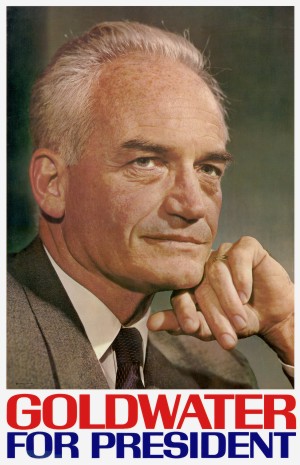
Barry Goldwater, a stalwart Conservative Republican in the ’60s and ’70s was more tolerant in his views on social issues.  Goldwater even appreciated the need for Liberal viewpoints as a counterweight to conservatism.  Anticipating that Somewhere in the Middle the two would meet!

Well, that’s simply not happening anymore …

  • The true and proper context for these misleading labels – assuming we even need them – is CINO (Conservative In Name Only) or LINO (Liberal-INO)
  • The Political Middle is the real issue here.  Moderate political viewpoints and participation serves as a buffer to the far edges of the political spectrum.  And it offers a middle ground for the germination of political compromise. 
  • The problem?  The Political Middle has all but disappeared in this country!

I consider myself a Moderate Republican with conservative leanings.  I believe in Smaller Government, reduced Government spending, and a strong National Defense.  But I also hold more moderate views on Social Issues (e.g. poverty, illegal immigration, LGBT lifestyles, education, and women’s rights).  I believe there are times when increased Government spending is both necessary and unavoidable (e.g. economic crises, natural disaster, military conflict, international leadership). 

I have a pragmatic view about taxes.  I hate like hell paying them.  I despise paying more of them.  But at times you simply have to cringe and bear it.  And yes, some people should pay more if their financial means allow for it, especially when the condition of the fiscal house rivals an EPA Superfund site.

The spread of views I possess apparently classifies me for the title RINO.  Not that I care …

Yet this explains exactly how we have gotten to the point in this country where no National Leader will dare make compromise or reach “across the aisle” to work towards solutions to our very real problems. 

  • It led to President Obama’s decision to throw his own debt reduction plan – Simpson-Bowles Commission – under the bus, because – God forbid – we can’t deal with the specter of social benefit reductions at a time when the federal deficit is roiling out of control!  Don’t want to get on the wrong side of the Liberal political base!
  • It led to the recent attempt to recall Wisconsin Governor Scott Walker for nothing more than his desire to reign in state spending and break the cycle of union-politician cronyism.    
  • It led to the rejection by every single Republican Presidential candidate of the very pragmatic suggestion of increasing tax revenues by $1 for every $10 reduction in government expenditures.  Because – ya know – you don’t want to piss off the Tea Party or Grover Norquist …  

I wholeheartedly agree with Jeb Bush’s statement, “If you could bring to me a majority of people to say that we’re going to have $10 in spending cuts for $1 of revenue enhancement — put me in, coach.” 

Dealing in absolutes in politics is a recipe for stagnation.  Stagnation in Leadership, stagnation in developing solutions to real problems, stagnation in progress, stagnation in a much-needed, too long developing economic recovery.  What you get – what we have now – are both the Left and the Right burrowing down and digging in behind jingoism and intransigence. 

So how did we get here? 

In essence, the Political Middle has abandoned the political field of play to both political extremes.  It’s simple really to understand.  Most people disdain or – perhaps more accurately – are apathetic towards politics, especially given its hateful tone in recent years.  For those with no hard and fast anchors on the more edgy political and social questions of the day, politics are just nasty, dirty, aggravating … a waste of time better spent elsewhere.  In some ways, it’s hard to blame The Middle for its retreat.

On the other hand, those individuals who possess solid political and social issues anchors, see politics as a Means to their Ends.  And this is magnified in those who willingly describe themselves as Ultra-Liberals or Right Wing Conservatives.  For instance, they recognize the importance of the primary vetting process for weeding out Presidential candidates they perceive as weak on their respective anchor issues.  This is why the early primaries in Iowa, South Carolina, New Hampshire receive such out-of-proportion attention.  By the time those of us in Pennsylvania get the chance to cast a primary vote, the candidate list has been pared down to one or two candidates.  Indeed they will simply be the candidates who could repeat their talking points without making the Left or the Right throw up in their mouths.  

This explains how we so often find our National political choices limited to Evil and The Lesser of Two.  It explains why many well-qualified individuals will forego involvement in politics and the responsibility of civic leadership.  They simply won’t subject themselves to cannibalization by those on the edges of the political spectrum.   

 Yet few of those who survive this vetting ordeal can be elected without the votes of the Political Middle.  And so we see, as soon as the primary process ends, the rush by the annointed candidates to appeal to The Moderate Middle.  Their sole objective: to win a general election so they can continue to pander to the only segments who will pay attention to what they do and say afterwards – The Left and The Right.

And so the cycle repeats.    

What has happened to the Political Middle? 

I guess they think they have better, more important things to do.  They do not appreciate that crucial decisions on issues and problems that could potentially affect them for years are being made without their input, long before they – The Middle – even realizes another Election Day is coming.  And these decisions are not limited to the social issues that drive stalwart Liberals and Conservatives to action.  They include decisions critical to the economy, to education, to fuel and energy prices, the environment, the deficit, and ultimately their futures and the futures of their children. 

The Middle’s political apathy is – mildly put – mind-boggling! 

So while we wait for America’s Political Middle to wake up to today’s reality, the partisans dig in and refuse to budge, refuse to solve, refuse to govern.  The economy continues to falter; the federal deficit continues to grow.  We wait for yet another Presidential election where our choices are weak and uninspiring; all the while knowing, nothing’s going to change regardless of the outcome.

Jeb Bush recognizes part of the problem.  When will we recognize the solution is a formidable, continuous presence of Moderate political voices?

The evolution of a President?!?

It is refreshing to witness President Obama‘s “evolution” on the issue of gay marriage.

His Darwinesque mutation took only three years!!  That’s just the three years he spent in The White House.  Should you discount his two years as an active U.S. Senator, his seven years as a State Senator, and his years serving as a community organizer?  Perhaps gay marriage was never an important issue to him or a conscious thought that simply never crossed his mind.

Interesting that Evolve has suddenly found its way into President Obama’s skill set at a time when so many Liberals choose the very same word as a snarky suggestion to Conservatives who come down on the wrong side of social issues.  Apparently Conservatives weren’t the only ones needing to “evolve”.

Well, at least we can take comfort in knowing this was not a politically motivated “coming out”!  It’s not like he …

  • wanted to avert all eyes from the Economy during a re-election year, or
  • needed a Vice President and Press Secretary to stick their heads up out of the foxhole first to see if it was safe, or
  • was headed for a HUGE George Clooney-organized Hollywood fund-raiser …

George Clooney‘s Obama fundraiser …. oops!

Oh, c’mon … That couldn’t be the reason why this was announced now … in a re-election year … on the eve of a night with deep pocketed, gay and gay-supporting Hollywood types … Could it?!?  Nah ….

The best part is that our Brave, Forward-Thinking, Ground-Breaking President has once again given the objective media chills … be they up Chris Matthews leg or down Robin Roberts back!

I’m just thankful this evolution was totally the result of careful introspection and the need to lead the Nation in the right direction, completely devoid of any political motivation whatsoever!

Next up … Fixing the Economy!!

Now I can get back to figuring out how to help that Nigerian Finance Minister rescue that £150 million …

What qualifies one to serve as Pennsylvania’s Attorney General?

As a registered Republican voter and local committeeman, I tend to stay out of Democrat primary contests.  But I appreciate the benefit of having Minority Party participation in positions like Attorney General and Comptroller.  In my opinion, such an arrangement – regardless of which party is in the majority – ensures a system of checks-and-balances that instills confidence in Government. 

 There is no better firewall from the abuses of power than having someone from your opposing party holding onto the purse strings or being the Chief Law Enforcer.  Even if you inherently don’t trust Government, you should find comfort in such arrangements.  

So with this in mind, I must ask the following question …

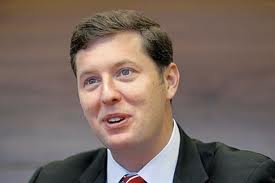
How is Patrick Murphy qualified to be Pennsylvania’s Attorney General?

Patrick Murphy

Patrick Murphy

Not a problem is Murphy”s failure to take the Pennsylvania Bar Exam.  Lawyers may take the bar in one state and get licensed by other states based on the out-of-state test results.  Murphy claims to have taken Wisconsin’s Bar Exam simply because Wisconsin was known for releasing Bar Exam results faster than other states. including Pennsylvania.  One caveat I add here is the extent to which the PA Bar might be tailored to cover Pennsylvania-specific laws, guidelines, and requirements.

What is an issue is that Patrick Murphy has NEVER prosecuted a criminal case in Pennsylvania!  This is a MAJOR ISSUE!  How does one present themselves as AG material having NEVER experienced a Pennsylvania criminal court.  He’s never been before the judges; never worked with public defenders; never worked with, perhaps never even met the Commonwealth’s AG personnel; has never been a part of PA Justice system’s political network.

I don’t get it.  It’s very difficult to conclude that Murphy would be the Most Qualified to fill the Attorney General’s office.  To me, it smacks of a politician simply look for a paycheck and a place to hang his hat until something better comes along.  Murphy joined other AG candidates in promising to serve their full terms; yet he’s already violated one promise to avoid negative campaign ads just days after making it.  So go figure …

I do not profess to know what Patrick Murphy’s eyes are on.  But I doubt it’s staying on as Pennsylvania’s Attorney General if a more sexy political opportunity arose. 

Kathleen Kane

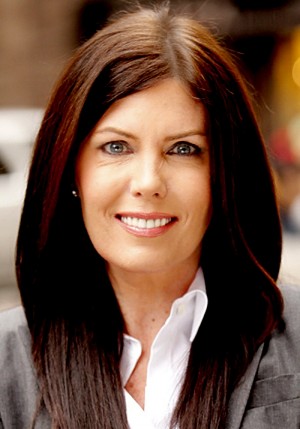
Kathleen Kane, on the other hand, has served as an Assistant District Attorney for Lackawanna County.  She has fought crime, insurance fraud, sexual abuse and murderers here in Pennsylvania!

A far better choice … if you ask me … as an interested outsider who appreciates the benefits of a highly qualified investigative and enforcement watchdog.

Although I applaud Murphy’s service in the U.S. Army – in Bosnia and Iraq – and the Judge Advocate General (JAG) Corps.  I just do not believe that experience makes him The Best Choice for Attorney General.  As a Republican, I could see myself voting for Kathleen Kane, not so Patrick Murphy.

The Republican Party has settled on David Freed, current Cumberland County District Attorney since 2006 with DA experience in York and Cumberland County since 1997.  He is obviously well qualified! 

Donald A. Bailey, a civil rights lawyer and perennial Pennsylvania political candidate – for everything from Congressional Representative to Governor – is also running as an independent. 

No Democrat has held the office of Attorney General in Pennsylvania since it became an elected office in 1980.

You read it in the Sunday papers.

This is a regular feature … as in regular, not weekly … of Cranky Man’s Lawn, where we look at – and comment on –  a few articles that catch our eye during my regular … as in weekly … Sunday morning coffee’n paper lounge-about.  My regular Sunday morning read is The Philadelphia Inquirer.  But if you do not get The Inqy delivered to your door, links to the applicable articles are provided as the header to each discussion.

.

Need a watch “dog”?  You can get one for less than $5

Parts of Texas and northwest Louisiana are in the grips of a long-lasting drought.  When drought strikes, it means cattle and sheep cannot be sustained in a way that’s profitable for ranchers.  Aggravating the situation even further is the ragged, slow state of the economy which affects the costs of everything including the price of hay, which is used to feed the herds.  As a result, ranchers have been forced to unload their livestock in order to reduce the financial footprint of the ranching operation.

One unusual consequence of the situation in this region of the country is the releasing of hundreds of donkeys by ranchers who can no longer afford to maintain them, nor can they find buyers when the animals are put on the market.

Apparently, donkeys make exceptional watchmen!   They are able to provide a passive security of sorts for the herds they accompany as they – the donkeys – eat, sleep and live among the cattle and sheep.  The ranchers use FEMALE donkeys to provide security for herds located in isolated pastures on the very large ranches located in this region.  The donkeys are naturally hostile towards wolves and coyotes.  They will even go to lengths to attack them should they come into close proximity!

The problem is that they eat the same hay that the herds eat; so if you are not feeding livestock you don’t have, you don’t need the donkeys or the costs of feeding them.  So what happens is the donkeys are simply set loose or are pushed onto the lands of other ranches … a sort of reverse rustling.

The shame is that the animals are abandoned and left to fend for themselves.  Animal rescue organizations are overwhelmed, their valuable resources used to clean up an unfortunate mess.  So if you could use a sentry animal or a decent burro around your spread, check into acquiring a Watch Donkey.  They’re going cheap!

.

Reading the minds of Supreme Court Justices

This has become a favorite activity of cable and television commentators, political bloggers and analysts, State and Federal officials, and health insurance executives over the past week.  Three days of unprecedented testimony was held this week over the challenge by 26 states, including Pennsylvania over the mandates set forth in the Patient Protection and Affordable Care Act (a.k.a. Obamacare).

We have seen this coming as early as the day former House Speaker (I still enjoy saying that!) Nancy Pelosi stated that to find out what’s in the bill, Congress would have to pass it!

It was an amazing admission of just how rushed and ill-conceived the Obamacare package really was.  With so much power concentrated in the hands of the Democrats in their heady days when Hope and Change were the agenda, they stupidly threw together a terribly complex and pork laden bill (like Nebraska’s special Medicaid deal to land Senator Ben Nelson’s support) and shoved it down the Legislature’s – and America’s – throat.  Even its favorable and sensible aspects, like covering dependent children until age 26 and ending exclusions for people with pre-existing conditions, may be lost because of the short-sighted hubris of the Democrats.

In The Sunday Inqy’s Business section Chris Mondics Law Review column took a look at the comments and questioning that emanated from the Supreme Court Justices to gauge their leanings on the law.  His take was not good news for the Democrats.

There is no surprise that Justice Antonin Scalia was pointed, sarcastic, and a bit testy with U.S. Solicitors representing the Administration’s case in favor of the law.  But the questioning coming from Chief Justice John G. Roberts and Justice Anthony Kennedy were much more troubling for the Obama Administration and the Democrats in Congress.  Both Roberts and Kennedy have been seen as the only hope for a majority decision in favor of Obamacare; yet neither seemed impressed with the Administration’s arguments.  Worse yet for the besieged healthcare law, both also seemed unlikely to let separate parts of the bill stand if the central buttress – the individual mandate – gets overturned.

The Democrats should have seen this coming the moment Nancy Pelosi opened her mouth!

The funny thing is, if the Democrats had framed the healthcare law as a tax to pay for national coverage, similar to Medicaid, it most likely would have passed muster with the Supreme Court.  But no, they were not committed enough to covering the uninsured to go to that great length.  Why?  Because they KNEW the word “TAX” would have cost them enormous political capital and a few elections along the way.  I guess being in power and staying there was just a tad more important than universal healthcare, eh?

By the way, if you have ever had a meltdown speaking in front of an audience during an important presentation, listen to find audio of Soliciter General Donald B. Verrilli, Jr. hemming and hawing; uhing and duhing; gulping copious amounts of water; and rambling barely coherently during his presentation on the individual mandate.  It goes on and on for much, much longer than presented in the link.  One wonders if he suddenly realized as he began his presentation, “Sh*t, this law really is unconstitutional!”

.

U.S. Navy and environmental pollution

Seems the U.S. Navy has been getting a lot of attention from environmental groups over it SINKEX program, under which they tow old out-of-commission ships to sea and allow Navy ships to hit them with bombs, torpedos, and missiles until the sink.  They do this quite naturally to give its sailors the chance to use the same weapons they will be called upon to use in a real ocean conflict.

The problem?  The ships often contain unacceptable levels of toxins from PCBs to asbestos.

I won’t get into the rest of the article, which makes a lot of good points about sinking toxins in the ocean.  Instead I wanted to address the work being done by the Navy in its efforts to REDUCE the environmental footprint it leaves on the oceans it travels through and operates in.

For several years I have worked with a group responsible for environmental policies applicable to all Navy ships, though I have not worked directly in any of these programs.  The Navy has spent a lot of money on reducing the amounts and types of garbage they eject from their ships every day.  All ships do this, from those luxury cruise ships you like to travel on to those tankers and cargo vessels our economies rely upon.

Garbage in the form of biodegradables like foods, some paper products, and human waste generally present no harm to the ocean environment provided they are treated in some way before disposal.  Other trash like plastics, styrofoam, caustic solutions and industrial products are another story altogether, and should never be dumped into the seas.

The Navy has been working deliberately and diligently to eliminate the dumping of any non-biodegradable substances into the oceans.  The fleet is under strict guidelines to prevent to eliminate the need to dump dangerous substances into the ocean.  The Navy has re-engineered the way it collects, handles, and removes harmful substances that are unavoidably generated by ships holding hundreds – if not thousands – of sailors along with their weapons, aircraft, and equipment.

I have worked for a short time on one program that dealt with the handling and disposal of trash generated aboard nuclear submarines as they spend upwards of six months cruising – non-stop at times – around the world’s oceans.  You can not grasp the difficulty of this effort to reduce ocean pollutants until you appreciate the problems faced with the mess that gets created aboard a cramped, closed system – essentially a tube filled with people, electronic equipment, and war fighting capability.

Suffice it to say, the U.S. Navy has been doing a heck of a job in getting on top of their waste issue and in its efforts to eliminate to the extent possible its fleet’s impact on the ocean environment!

.

Generation Y is having a difficult time with life after college.

This post is already getting a bit too “wordy” as my friend, Bob likes to remind me; so I’ll leave you to read the specifics of the series in The Inqy that started on Sunday about the problems college graduates are having finding work  in a stifled economy.

I have one son just out of Millersville University and exploring the job market.  But he just completed his requirements in December, so he’s fairly new to the market.  And my youngest is a freshman now at Temple University.  So the details of Generation Y’s post-college job market frustrations is of particular interest.

I was not really sure how to take the stories provided in The Inquirer article.  I guess I hope that these are the worst case scenarios.  But as a parent you worry.  You want the best for them.  Who wouldn’t?

So my message to my sons – all three of them – is to make sure you are making the right decisions as you build your background and your resume’.  Don’t take shortcuts.  Don’t blow off classes.  Don’t be satisfied with “OK grades”.  Maintain your flexibility when it comes to future employment opportunities and career choices, unless you are truly fixed on a very specific field of study and profession.  Don’t limit yourself to specific jobs to certain employers in limited geographic areas.

The reality is that you could do everything right and still not land a suitable opportunity.  But a well-developed resume’ and maximum personal flexibility should give you the best chance of getting a job of which you can be proud.

Good luck to them and to all who are searching for a fair post-college opportunity!

“Game Change”, HBO’s new Democrat-umentary

democratumentary – (def) a media production presented as a “documentary” when it really only addresses issues and events from a subjective point-of-view favorable to the Democratic Party. 

I try not to be a cynic.  I really do.  But when it comes to politics, I am no longer a match for the machinations of those on the National political stage.  And when they are joined by willing sycophants in the media and entertainment industries, it’s about all I can stand without blowing a Cranky Man gasket! 

My latest migraine comes courtesy of the abomination made by HBO of the best-selling book Game Change, authored by John Heileman and Mark Halperin following the 2008 presidential election. 

If you happened to watch this HBO democratumentary this past Sunday (I didn’t, and won’t; and why will become obvious to you as you read this.), please take a moment and read my review of the book Game Change, written for this blog back in January 2011.  And as you read my review, see if you can identify what was left out of the HBO democratumentary.

(Cranky hums the Jeopardy theme song as he patiently waits for his readers as they enjoy another brilliant Cranky Man piece.)

That’s right!  Not a single mention, character casting, or on-screen appearance of any significance by any Democrat that participated in that 2008 presidential election!  Not a single one …

This despite that the dominant theme of Game Change – the book –  was the Hillary Clinton-Barack Obama battle in the Democrat primaries, and the harrowing details of John Edwards’ disastrous campaign and failing marriage! 

Not a peep …

I had seen several of the teasers and promos for the HBO democratumentary, and kept wondering where was the Clinton-Obama characters?  What about the confrontation between the two on the tarmac of Reagan National Airport?  Where was the controversy over the Clinton campaign’s speculation on past drug use by Obama and rumors of his Muslim roots?  Where was the grab-you-by-the-collar stories of John and Elizabeth Edwards’ constant fights and dysfunction?      

Nowhere, that’s where …

It’s gets even uglier – as in Rielle ugly – when you peruse the political donations of the cast and production executives that worked on the democratumentary. 

Tom Hanks, producer well over $100, 000 to the DNC since 1994, $36,500 to liberal causes like SEN Al Franken’s Midwest Values.  Republicans: not a dime

Ed Harris (SEN John McCain), $9500 to Democratic candidates, $11,975 to liberal special-interest groups like MoveOn.org.  Republicans: squat, nada, nil

Woody Harrelson (Steve Schmidt, McCain-Palin chief strategist), $4,300 to Democratic candidates, $3,500 to liberal causes like GreenVote.  Republicans: zip, zero, zilch

Jay Roach, director/co-executive producer, $15,800 to Democrats; Republicans?  You should be recognizing the theme by now!

Julianne Moore (Sarah Palin), $2,250 to Democrats, $7,500 to DNC, Democratic White House Victory Fund and special-interest groups.  Republicans: Everybody join in!

Danny Strong, co-executive producer, $2500 to Obama Victory Fund.  Republicans: a big wet willie 

You don’t need someone to draw the picture for you.  It’s just sitting there plain as day.

You would think the movie-based-on-the-book would have at least addressed in some way the REAL Game Change in 2008, Barack Obama as the first African-American President.  But that story had to be ignored, to avoid the ugliness of the Democrats’ 2008 campaign and to maximize the spotlight on the Republican-Sarah Palin debacle.

Afterall, you never want to beat the horse you’re betting on.      

(Shout out to reader Mark D for tipping me to the donation information.)

Lady Allyson of the 1%

Democracy can be a tough nut to crack.  But it gets so much harder in this day and age if you have neither the power nor the money that your opponent can muster and use to keep you at bay.

Nate Kleinman

This was the lesson Nate Kleinman learned this week in his bid to challenge Representative Allyson Schwartz for the Democratic nomination in the Pennsylvania 13th Congressional District.

Kleinman is a human rights activist and political organizer within the Democratic Party.  He has worked for President Obama and Joe Sestak in his failed U.S. Senate bid.  He is also considered the first Occupy Wall Street political candidate.  But he really had no chance against the very well-financed, very well-connected Schwartz.

REP Allyson Schwartz (D-PA 13)

REP Allyson Schwartz (D-PA 13)

Allyson Schwartz, currently serving her fourth term, has always been a savvy fund-raiser, and is reported to have in excess of $2.3 million in her war chest.  Her only Republican challenger is Joe Rooney, a former U.S. Marine fighter pilot and current resident of Ardsley.

Schwartz’s funding for the 2011-12 election cycle came primarily from large individual contributors (57%) and Political Action Committees (38%), only 3% came from small individual contributors.  Her biggest corporate and association sponsors include Comcast Corp, Teva Pharmaceuticals, and the American Association of  Orthopaedic Surgeons.  Her top industry support comes from lawyers, health professionals, pharmaceuticals and insurance companies.

Not exactly residents of the 99%

You would think that with all that fire power behind her, the last thing Allyson Schwartz needed was the appearance that she was insensitive to the interests of the Occupy Wall Street movement.

Yet when it came to Nate Kleinman, Allyson Schwartz went for the throat.  She could out spend, out fund-raise, out network, and out wait just about any in-party challenge with one hand tied behind her back.  Not to mention the difficulty such an insurgent Democrat faces in getting any form of support from within The Establishment of the DNC when running against such a successful incumbent.

Challenging the validity of nomination petition signatures (required to qualify to appear on Election Day ballots) has become a regular tool for suppressing political opposition.  It’s the quick and dirty way to score a knockout; yet it rarely works to the satisfaction of the petition challenger.

The petition challenge has become one of the accepted political practices with which I have a problem.  When did it became acceptable to silence opposition in the public square?  It smacks of fear for open debate.  It makes a candidate look petty, aloof, and overbearing.  But as bad as that looks, it gets even worse when the conqueror decides to machine-gun the life rafts.

And this is the part of the Kleinman episode that makes Allyson Schwartz look ruthless and more than a little afraid.

Last week, Kleinman decided to withdraw his name from the ballot as a formal challenger to Schwartz’s Congressional seat.  Instead he decided to continue his candidacy by seeking to win the April 24 primary via write-in ballots.

As if Democracy wasn’t already hard enough.

The reason Kleinman decided to throw his lot with the Hail Mary of write-in ballots is the tortured hell that Schwartz’s campaign intended to put Kleinman through just to keep his candidacy hidden from the Democratic voters of the PA 13th.  In a move reminiscent of Richard Nixon-esque dirty tricks, the Allyson Schwartz campaign pushed the nominating petition issue to the extent that Kleinman, who has no real political organization, would have had to spend weeks of his own time sitting down with Schwartz’s rather ample campaign staff to go over each and every individual petition signature to prove their validity or to rehabilitate questionable entries.

In other words, keep Mr. Kleinman penned up in a conference room, off the street, out of the public’s view, and away from any potential media attention.

And just when Nate Kleinman was standing there like a deer in the headlights, the Schwartz campaign pulled out the napalm by filing a claim that would have required Kleinman to pay the legal costs incurred by the Schwartz campaign!  It’s a legal option for the campaign to request that Nate Kleinman pay legal fees,” says Rachel Magnuson, Rep. Allyson Schwartz’s Chief of Staff.

Nice …

And since Kleinman’s “campaign war chest” totals just $10-15,000., as compared to Schwartz’s $2.3 million, it’s not hard to see what that move was all about.  It was an attempt to threaten Nate Kleinman with personal financial retribution for having dared to challenge Lady Allyson of the 1%!