Comonwealth Court Judge Robert Simpson upholds Pennsylvania’s voter ID law and refuses to issue injunctive order to stop law from taking effect for November election!
No doubt this will head to higher Court for immediate injunction and appeal.
Comonwealth Court Judge Robert Simpson upholds Pennsylvania’s voter ID law and refuses to issue injunctive order to stop law from taking effect for November election!
No doubt this will head to higher Court for immediate injunction and appeal.
Happy Lawn Days are here again!
Wet, humid conditions in our Southeast corner of Pennsylvania have resurrected our Summer-baked lawns with damp air and plentiful rains. A quick look around your neighborhood will reveal lawns much greener than should be expected for mid-August, especially if you followed the rules for helping your lawn beat the heat. Those of us, who value the work and money spent on keeping our lawns green and vibrant, appreciate what a bit of Summer rain and the prospects for cooler temperatures will bring.
Now is the time to set up your lawn for the Fall growing season!
The biggest advantage September will bring are cooler nights. Even when temps hit the 90s during Indian Summer, the cooler nights allow for substantial dew falls that effectively water your lawn ever so slightly every day. This combination of warm days and cool, dewy nights are perfect conditions for grass growth.
Here are several things you can do to get the maximum benefit out the September to mid-November growing season:

Dethatching rake
1. Clear dead matted grass where it exists in large patches.
For this I recommend a good dethatching rake; although if you have significant dead grass issues, you may want to look into renting a dethatching machine (a.k.a. lawn comb). Using the dethatching rake, look for those areas where the dead grass is thick and covering the ground. Then use your mower to mulch the dead growth into the soil. Removing dead grass will provide a good bed for dropping seed and will allow existing grass plants to spread and fill in bare spots.
2. Aerate
Most home owners probably aerate in the Spring, many in the Fall. Some aerate twice a year. Aerating is an important step in
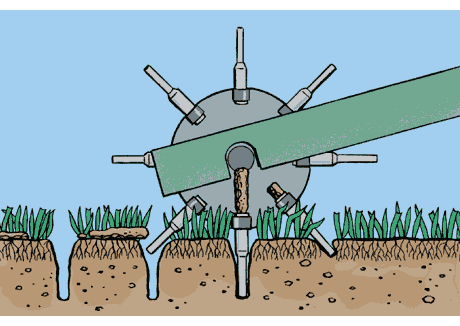
How core aerator works
lawn health by reducing soil compaction caused by foot traffic and normal settling. Aerating allows air and nutrients to penetrate the soil, helping roots grow deeper and healthier.
Use a core aerator as opposed to a spike aerator. The core aerator removes a plug of soil each time it penetrates, whereas a solid spike aerator simply compresses the soil even further, defeating the purpose of aerating. For maximum effectiveness wait for wet weather to soften up the ground. Plugs that result from aerating will naturally decay and provide additional food for the lawn.
Personally, I will aerate only once every other year, since my lawn no longer gets the foot traffic (i.e. kids) it used to. I never got around to doing it in this past Spring, when the wet weather makes aerating easier. Hopefully, I’ll get to it weather-permitting this Fall.
3. To “Weed & Feed” or “Seed and Fertilize”?
Do one or the other, not both!
If you experience a lot of brown or bare spots that need attention, overseeding after you clear out dead growth and applying a Starter fertilizer would be the way to go. Make sure you this happen no later than mid-September (Labor Day weekend is ideal.) to take maximum advantage of favorable Fall weather. If you decide to put down new seed, DO NOT apply a Weed & Feed product. The weed portion of the weed & feed treatment will prevent new grass seed from germinating.
Weed & Feed is the way to go however, if you decide not to overseed. Even if you applied a Weed & Feed in the Spring, another application in the Fall will give your lawn a boost in growth, and provides weed-free momentum to your lawn that will help keep weeds away next Spring!
4. Water

Man’s other Best Friend
Yes, the weather has been delightfully wet recently. But all we need is a stretch of 7-10 days of dry, hot days and all our work could be undone, especially if you decided to put seed down. So keep an eye on the forecast; be mindful of your lawn’s condition; and drag out the hose and sprinkler, if you’re not fortunate enough to have an in-ground irrigation system.
5. When the leaves start falling …
Make sure you get excess leaves and debris off your grass as much as is practicable. Ensure your lawn isn’t covered by a choking layer of dead leaves when the weather turns cold. Dead leaves left to blanket your grass – especially once the snow starts falling – can destroy what grass plants are there underneath.
I have several large trees on neighboring properties, but only a small one in my front yard. I have learned my lesson from Falls past, and worry about removing dead leaves only after most – if not all – the trees have lost their leaves. Otherwise, you will be out there all Fall long. Work smart, not hard!
6. Winterfeed
The last step for the Fall, is a Winter feeding that should be applied no later than mid-November. The Winter feed goes right to the grass roots and is stored there over the Winter. Once Spring arrives, the root-stored nutrients will give your lawn a growth boost to start the season off right.
Now get to work; and Good Luck out there!
(Cautionary Tale: These tips are based on my experience alone. I offer no illusions of formal turf training or professional experience. This is solely what seems to work for me and my Southeast Pennsylvania lawn. Always proceed with caution and be mindful of conditions in your specific region.)

“Eat mor Kow!”
That would have been the best reaction to the strong position against gay marriage struck by Dan Cathy, CEO of the Chick-Fil-A franchise system. If you disagree, you simply take your appetite – and your money – somewhere else.
Cathy’s stated position was a lightening rod for LGBT proponents for recognition of gay unions. That he held these positions was no surprise to anyone who knows even the least of Chick-Fil-A’s corporate development and very public record. That he dared express those views was treated as if he single-handedly threatened the civil rights of every non-hetero American.
Usually, I don’t allow myself to get caught up in these social battles. But it was the reaction of officials from several large U.S. cities that prompted to me to leap to Cathy’s defense.
When you hear government officials of any stripe talking about running a prominent and successful businessman out of “their city” for doing nothing else but expressing his opinion, consistent with his long-held religious beliefs and personal philosophy, you should be compelled to object!
From cities like Philadelphia, Boston, New York City and Chicago you heard local officials threaten to close Chick-Fil-A franchises or to deny them business opportunities. And that’s when I decided to stand up for Dan Cathy’s freedom to express his views free from retribution by those who did not agree. This was also the basis for such actions as the Same Sex Kiss Day planned by LGBT groups targeting Chick-Fil-A franchises. The objective is to embarrass the public face of the Chick-Fil-A corporation in an attempt to shut them up.
These are exactly the kind of politicians of whom you should really be afraid. The ones who will condemn a successful corporation and endorse efforts to deny it business opportunities based on the expression of an unpopular opinion. If they will stoop to that level over a position on a social issue, imagine what they might do if … say … you balked at their sugary drink policy or refused to donate to their political party!
But their suggested sanctions won’t hurt Chick-Fil-A. Given the support the restaurant chain received yesterday, I’m certain Cathy would have no problem moving his franchises and JOBS out to the suburbs.

Warrington Chick-Fil-A crowd
Based on the reactions seen all over the country on Wednesday. Chick-Fil-A may very well experience the best single week in terms of retail sales than ever before. When I attempted to treat the wife to Chick-Fil-A takeout Wednesday evening (Yeah, she was a bit flummoxed.), we could not get close to their Warrington, PA location. The standing line went out the door and threaded itself far enough along to wrap around the building at least once. The drive-thru line went around the building, out the driveway, and hundreds of yards down PA Rt 611. Reports had the wait for service running between 60-90 minutes at 7:00 PM!
Many of those who made the trek and withstood the lines (We decided not to.), certainly were motivated by former presidential candidate Mike Huckabee’s original social media call to honor Cathy’s stand against gay marriage. But many – like I – were simply there to recognize and support Cathy’s right to believe what he believes; to speak freely in accordance with those beliefs; and to be free of intimidation and punitive action by those who disagree … particularly those in government with no legal basis to judge or penalize such expressions.
The LGBT/Chick-Fil-A confrontation is a challenging lesson in the demands of American citizenship. Freedom of Speech requires that you endure messages and viewpoints that are guaranteed to make your blood boil. That’s what Freedom of Speech requires at its very core.
The question really comes down to this … Are you strong enough to LIVE what you claim to embrace?
Lobster, lobster everywhere and “market price” menus

We’re gonna need a bigger butter boat!
The lobsters are running wild off the coast of Maine. Lobstermen are bringing to market so many of the popular crustacean that prices have dropped dramatically. As of last week lobster – once selling for as much as $4.00 a pound – is down to $1.35 per pound.
But what is especially good for those of us in plastic bibs, toting buckets of melted butter is not necessarily good for those who sweat out the challenges of supporting a family from the dangers of Old Man Sea and the unpredictable mechanics of supply and demand. These lobstermen find themselves working even harder to bring in the quantities needed to offset the low price, supply driven market. It’s an inescapable cycle.
The lobstermen’s problem should be a good thing for lobster lovers at the other end of the lobster pipeline however. The words “market price” on restaurant menus is always a cause for pause when cost-conscious diners consider dabbling in the finer culinary seafood options. One never wants to be embarrassed by asking what the “market price” is, when the answer is likely to be “too much”. So now would seem to be the best time to take advantage of more diner-friendly market conditions.
At the very least, you can find out whether your chosen dining establishment really lives by the “market price” mantra or simply uses it to fleece uninformed customers. If you get the chance to investigate, let us know what you find!
.
The hidden reality of the Affordable Care Act
For a nation already experiencing physician shortages, the new healthcare law is likely to widen the gap. The Association of American Medical Colleges estimates that by 2015 the country will be short over 62,000 doctors of those needed to provide sufficient healthcare options to its citizens. By 2025, the estimated shortage will be 100,000 doctors, and that’s before any consideration is given to the effects of the ACA (Obamacare) will have on doctor demand.
An example is the case of California’s Inland Empire, a region that covers the counties of Riverside and San Bernardino. The Inland Empire has grown by 42% since the turn of the century. (2000 that is, not 1900.) The increase of over 640,000 people comes along with a jobless rate of 11.8%!
In view of recommendations that any given region be serviced by 60-80 primary care and 85-105 specialists for every 100,000 in population, the Inland Empire barely makes do with an average of 40 primary care physicians and 70 specialists per 100,000. The region has a more complicated problem attracting doctors, being in such close proximity to Los Angeles and Orange County where doctors prefer to work due to the prospect of better paydays.
The real kick in the teeth for Inland Empire healthcare is the 300,000 new patients that will be seeking routine medical care when the ACA extends coverage to them in 2014.
Normally these individuals would seek care at hospital emergency rooms, which is not the most cost-effective way to meet their needs. And the purpose of this post is not to suggest that extending healthcare coverage to them through the ACA somehow creates a cost issue from nothing. But it does point out another rather interesting effect.
Once healthcare coverage is extended to these individuals, they will seek the preventative, health-maintaining care they used to neglect. Again, all good things … Any effort to see doctors when healthy and before medical problems develop will reduce the overall per capita cost of healthcare. The question though becomes what happens to accessibility and convenience of healthcare once the shortage of physicians is exacerbated by the sudden increase in better insured patients?
As Mark D. Smith, head of the California HealthCare Foundation, suggests, “It’s going to be necessary to use the resources that we have smarter in the light of the doctor shortages.” For those living in areas like The Inland Empire, the prospect of de facto rationed medical care has to be the real concern, as it will be anywhere doctors are in short supply already. Longer waits for well-care doctor appointments, more trips to emergency rooms for less-than-urgent medical issues, and substantial backlogs for tests and other treatments are a very real possibility.
In the end, supply driven rationing could very well be the unavoidable consequence of the Affordable Care Act.
.
Mike’s lazily delicious ribs …
As I sit here writing this, I am cooking up a batch of short ribs on the barbecue. I’m a notoriously lazy griller, but my comment cards indicate that many who have partaken are generally impressed. As a lazy griller, I refuse to deal with the muss and fuss of charcoal. I have not built a stone and mortar Cathedral of Grilling in my backyard. I choose a gas Weber that’s push-button easy to use and even easier to maintain.
My ribs are slow cooked, wrapped in aluminum foil and seasoned with whatever flavorings I can find in the spice rack (as a minimum onion, pepper, garlic, oregano, and a bit of crushed red pepper). At 400 degrees of indirect heat, it takes two hours for my ribs to be perfectly cooked … roasted throughout without the annoyance of falling apart, yet melt-in-your-mouth juicy and fall-off-the-bone tender.
Once the ribs are done, remove from the foil. Place on the grill curved side down, coat the tops thoroughly, and let grill for 10 minutes. Reduce the heat by half; flip the ribs; coat the insides and grill for five minutes. Then one more flip and re-coat for another five minutes. If they do not turn out well-cooked and delicious, you messed up the easiest rib recipe on earth!
.

A $1 million lawn sprinkler?
For a good chuckle read the story of the Union Fire Company in Bensalem, PA and their new $1 million boat toy, paid for by the taxpayer via the Department of Homeland Security. It’s an interesting tale of inter-Township jealousy and pettiness, poor boatmanship and weekend showboating, officially licensed largesse and fiscal mismanagement.
But the real horror is a Homeland Security budget that allows for the disbursement of $1 billion a year that encourages pushing money out the door with little obvious investigation and even less judgement as to what’s really needed and where. The good news is, if you lose an IED (improvised explosive device) somewhere along the Delaware River above Philadelphia, the Union Fire Company can help you find it with their $37,000 sideview sonar!
.
Lastly, another iteration of my most recent, favorite discussion topic – Pennsylvania’s new voter ID law …
It’s been fun watching the Democrats in Pennsylvania throwing a fit over the new photo voter ID law. It seems to matter not that the U.S. Supreme Court weighed in on the subject in its 2008 decision on Indiana’s version of the law. They somehow think the Pennsylvania Supreme Court will hold a softer view of their complaints that the law is an unreasonable burden and barrier to voting rights. It’s telling that they are forgoing the federal USSC route, which is usually the very first route taken when it comes to alleged civil rights violations.
Their biggest weapon in trying to prove the dark underbelly of the law has been the Commonwealth’s own data relating to mismatches between voter registration records and PENNDOT driver licenses.
Holy poll tax, Batman! 750,000 Pennsylvanians might be “disenfranchised”!!
Uh … not quite …
As I argued here earlier, the numbers cited by the Pennsylvania Department of State are seriously flawed. And The Philadelphia Inquirer‘s own look into the numbers showed some very interesting inconsistencies. Some of the individual cases of “disenfranchisement” were downright amusing. Names found on the mismatch list included former Philadelphia Mayor W. Wilson Goode and his son WWG Jr., four Philadelphia Councilmen, and former Veterans Stadium drunk court judge, Seamus P. McCaffrey.
The funny part? All of them have valid Pennsylvania driver licenses! What’s a panicky Democrat to do?!? Why keep on truckin’ of course!
The problem – as one can imagine when it comes to record-keeping and government – is in the details. Seems the Commonwealth’s databases and operating systems have a real issue with the nuances of people’s names. Apostrophes, hyphens, capitalization, and even spacing threw its PENNDOT-voter registration for a loop. Many of the names showing as mismatched are really nothing more than the fallout of poor programming and inconsistent inputs.
But one note should make the Democrat Champions of the Disenfranchised feel a bit better. In today’s Philadelphia Inquirer, Emily Bazelon, a senior editor at Slate, describes information passed to her by an anonymous insider purporting to show that the data on potentially endangered voters skews no further Democrat than it does Republican, with many voters living outside both Philadelphia and Pittsburgh (i.e. more likely Republican) also being affected. But of course, Ms. Bazelon also jumps to the conclusion that this initiative was an effort to disenfranchise Democrats overwhelmingly more so than Republicans.
At least now the whole picture is finally coming out, and it supports a politically neutral law designed to facilitate a more secure vote!
Here we go again …
Another crazy gets hold of an arsenal of weapons; breaks almost every law in the books; and shoots scores of innocents. And the result is predictable … a groundswell of opinion that never wavers … PASS LAWS TO RESTRICT GUN OWNERSHIP!
The problem with that sentiment is that third word … “LAWS”. Because “laws” only apply to those inclined to obey them in the first place!
It’s one thing if our elected leaders had the backbone to take on such an unpopular position (unpopular that is to most people who do not live in large, liberal-run cities) and accept the political consequences. But that’s rarely ever the case, when politics and power are of greater value. And that’s exactly the sentiment that was expressed by Democrat stalwart Senator (CA) Dianne Feinstein, who stated, although a sane discussion on gun control and a ban on military-type assault rifles was important, an election year was not the time to address it.
Huh?!? Wouldn’t that be the PERFECT time to address the issue?!?
Apparently the Democrats see a discussion of gun control to be a political loser in a year when President Obama is fighting for re-election in what is expected to be a close election. For these Democrats, the subject of limiting gun violence by restricting access to guns for everyone is trumped by White House aspirations. It says much about where the issue really sits with the political animals of the Democratic Party. So, if they refuse to have this discussion now, why should they be taken seriously when they finally get around to it?
In that same vein, we are still waiting for The President to get around to his 2008 campaign promises on gun control. Instead, President Obama has signed bills allowing guns in national parks and even on Amtrak! He has steadfastly refused to seek reinstatement of the Assault Weapons Ban. And maybe that’s the real reason Democrats – like Senator Feinstein – do not wish to bring it up now!
But in truth, even if we did have this conversation today, it would accomplish NOTHING for keeping guns of all shapes, sizes, and magazine capacities from the criminals and the crazies.
If it were that easy, we wouldn’t have had Aurora … or Columbine … or Howard Unruh … or the University of Texas clock tower … or Virginia Tech …
That’s the REAL problem … the criminals and the crazies. You have no right to ask law-biding citizens to give up access to responsible gun ownership if you have no prospects for denying similar weapons to the criminals and the crazies. And it’s mind-boggling that anyone would propose such a ban in an age where our own Federal Government openly distributed guns to the most dangerous criminals currently on the continent. They must solve the problem of keeping automatic assault weapons from the drug runners, the gangs, and criminally insane before asking John Q. Citizen to even consider doing the same.
I ain’t holding my breath on the former, but fully expect continued efforts to do the latter.
For another reason entirely, I laugh when gun opponents run up the flag of the Founding Fathers to claim that they had no intention for gun ownership to exist outside what was needed for the purposes of organized state militias. That may well have been their original intent, just like it was to restrict the voting rights of women or to count African slaves as 3/5 of a person. In reality, the concept of militia had little-to-nothing to do historically with the development of a gun culture in the United States.
Every household in 18th century America REQUIRED the possession of a firearm. This was not a legal requirement; it was a requirement for survival. For if you lived anywhere other than the relative safety of early American cities, a gun was as important as food in surviving the dangers and hostilities of the unsettled frontier.
Whether it was dealing with the growing hostility of a native population or using the point-of-a-gun to discourage foreign intervention and push American civilization West across the North American continent, the National Government fostered the concept of private gun ownership – far removed from the concept of militia service – among its citizens. Huge tracts of territory were settled and controlled; colonial forces from Spain, Britain, and France were pushed out; and the Wild West was colonized, then civilized with the help of armed citizens that NEVER once stepped foot into a militia formation.
It renders the concept of “militia” a convenient interpretation of a badly worded phrase in the Bill of Rights. So for better or worse – depending on your point-of-view – America grew and flourished as the result of a gun culture that was accepted by a Government led directly by those same Founding Fathers. The same ones who supposedly never intended private gun ownership outside of a quasi-military apparatus.
The irony seems lost on those who want to blame the carnage on law-biding citizens and their long-held rights.
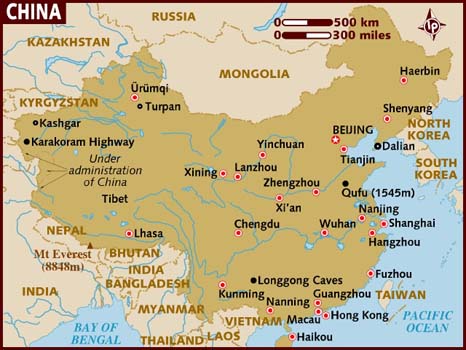 China has become one of the most important influences on U.S. foreign policy in the years since the United Soviet Socialist Republic (USSR) dissolved into a smaller version of itself (Russia) and a collectively less prominent scattering of nation states. The Peoples Republic of China has impressively grown beyond being Southeast Asia’s powerbroker of the 1970s and ’80s to be recognized as an international force in the world’s economy, as well as a major industrial contributor to the planet’s environmental problems.
It slowly dawned on many Americans that China was emerging as the United States chief international rival. But the relationship between the two major superpowers developed a unique twist that was never an issue in the U.S. competition with the U.S.S.R. China became a significant holder of American international financial debt, a situation created in part by our own credit card addict’s view of financial (mis)management, aggravated by a growing U.S.-China trade imbalance.
For these reasons I became very interested in former Ambassador to China, John Huntsman’s unsuccessful run at the Republican Presidential nomination. Suddenly, here was someone who understood the intricacies of our relationship with the Chinese. But I also came to realize my own “China problem”. I knew very, very little about the Peoples Republic of China.
This glaring blind spot led me to John Bryan Starr‘s Understanding China, an expanded 2010 study of a nation so few of us know much about, let alone understand. This is Starr’s third revision of his original book, published in 1997.
Starr is a former U.S. Navy officer and current political science lecturer at Yale University. Before Yale he taught Chinese politics at UC-Berkeley. He has served as Executive Director of the Yale-China Association and as President of the China Institute in New York City.

The Great Wall
I found Understanding China to be a well-organized and enlightening look into a region of the world I have admittedly ignored over the years, at least since those heady days of fifth-grade geography and 10th grade world science. Starr’s approach begins with a discussion of 12 critical issues facing China as it moved from being the brunt of jokes about cheap toys and flimsy consumer products to a regional military power and international economic force.
The 12 issues range from those that most affect the Chinese people (e.g. housing and feeding a growing population, restrictions in the free flow of information) to the issues that challenge the country of China as it emerges as a developing economic power (e.g. environmental degradation, finding sufficient sources of energy, relationships with Taiwan, Hong Kong, and the United States). This outline sets in the reader’s mind the questions that will be addressed throughout the book and serves as a useful guide for framing Starr’s discussion.
It proves difficult for me to do such in-depth studies justice in a blog post. So many of my readers have short attention spans and prefer lawn care tips over international political science. With those restrictions in mind, I’ll limit my discussion here to those aspects of China I found new and most interesting. A serious study such as Understanding China is a useful tool for gaining an overview on a broad spectrum of issues; the reader can then decide which specific areas might require more in-depth research.
Points of interest I was surprised to learn:
There were several topics in which I was keenly interested, given China’s expanding global presence and impact.
Interests of local authorities and economies vs. objectives of the national government …
Despite China’s authoritarian communist rule, the countryside is relatively free of control by the central government. Local authorities are delegated much latitude on a broad spectrum of administrative and operational issues. This arrangement serves to contradict certain objectives like reducing pollution and feeding an expanding population.
The crux of the problem is that local authorities at regional and village levels are incentivized (or penalized) based on production outputs and cost efficiencies, along with ensuring compliance by its citizens with social programs (e.g. one-child birth policy). Often the extent of local compensations, power, and access to corruptive practices causes local interests to run counter to national policy. Local leaders will overlook environmental threats, sacrifice arable land – which are already scarce in relation to farming needs – for modern industrial facilities, and coerce social compliance with the one-child policy simply as a cost reduction measure.

Mao Zedong
The environment was just one sacrificial lamb in Mao Zedong’s vision of the Chinese nation. He portrayed Nature as an enemy to be overcome in the struggle for a powerful, independent China. Water and energy were provided free of charge, which ensured no one questioned the economies of conservation or the use of alternate energies. China is the largest user of coal, the second largest of oil (with 60% coming from the Middle East), and home to 16 of the 20 most polluted cities on the planet.
China’s refusal to commit to most international environmental restrictions is based on its claim as a developing industrialized power (i.e. not yet fully developed). The claim has some merit since all developing nations, including the U.S., have histories as a major polluters as they grew into advanced industrial powers. This standoff does not bode well for international efforts to reduce the global effects of man-made pollution.
The family responsibility system …
The Chinese are well-known for the strength of their family system; and this is illustrated nowhere better than the reliance on the family responsibility system as a glue that holds Chinese rural society together. Due to China’s sparse infrastructure outside its urban concentrations, huge swaths of rural land especially in the north and west have limited accessibility, little in the way of government and social support structures (hospitals, schools, roads, communication, etc.), and less government control. As a result, a loose federation of local authorities coupled with a strong family agrarian culture are left to their own devices for sustenance, industry, and social support.
The family structure is most important here. The family system is responsible for seeing the individual through life from birth to death. With national priorities focused on feeding the much larger urban populations, the family structure is crucial to the success of rural farms which are owned and operated primarily by family units. Farming and limited rural industrial capacity is owned, managed, and staffed almost entirely within the family system. For this reason the limits of the one-child policy are largely ignored in rural areas since the larger the family, the greater the output; the greater the output, the more healthy and wealthy the family. These families find the penalties for multiple births and additional children over one-child to be well worth the investment, even a matter of pride.
In addition, older Chinese in rural areas do not benefit from the pensions city dwellers can accumulate. So younger generations see providing for their elderly parents and grandparents to be part of their family duty.
One interesting spinoff from this significant urban-rural divide is that rural Chinese do not identify with the problems and shortcomings faced by those Chinese in the big cities. As a result, rural Chinese felt little compulsion to become involved in the Tiananmen Square uprisings of 1989, which were initially caused by protests over poor education and living conditions at Chinese universities, located in its major urban centers like Beijing.
Remaking the Chinese economy …
This post is already way too long for some of my attention-span-challenged fans, but Starr’s biggest contribution to my understanding of China’s present day status was his explanation of the remaking of the Chinese economy. For decades China was the land of cheap toys and poorly made consumer products. Now it’s known for cheaper priced consumer products and top-line brand-name clothing and electronics.
China’s status as The Land of American Outsourcing hits a sensitive nerve with work-a-day Americans, particularly those without good jobs and especially those who have lost jobs to cheaper overseas labor. It’s an issue that will plague Chinese-American relations for years to come until some form of equilibrium is reached. One cold, hard reality is that the outsource destinations did nothing other than take advantage of the high cost structure in this country, much of it the result of the high level of Government regulation and the expenses of a union-committed labor force.
China’s big chance to remake its often ridiculed economy came with the cessation of Hong Kong by Great Britain. This handover opened the door for China’s own brand of “capitalism with Chinese characteristics”. Hong Kong, which had long existed as a conduit for financial activity, opened the floodgates for a dramatic expansion of foreign investment.
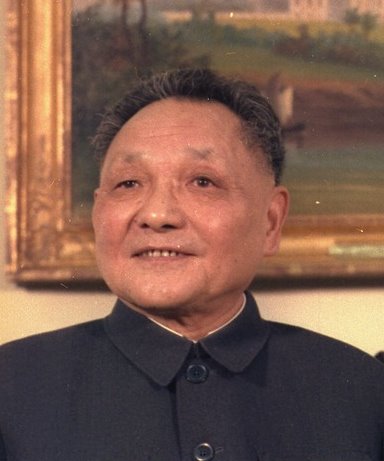
Deng Xiaoping
It was Deng Xiaoping who set the stage by initiating a number of reforms that eased the transition for China’s economy. Deng’s reforms included moving industrial development from central government planing to market-driven decisions, and shrinking the state-owned industrial sector in favor of an expanded private sector. These decisions accomplished more for China’s economy than any other outside development.
From the socialist/communist point-of-view however, China also moved from an economy among the most equal in income distribution to one that is now one of the most unequal in terms of the differences between rich Chinese and poor Chinese. This just goes to prove that trying to force a philosophy of income equality for all does absolutely nothing for the long-term financial and economic health of a developing country.
And that’s it, a rather long-winded but inadequate attempt to portray John Bryan Starr’s look inside the Chinese behemoth. I certainly have skipped and skimmed a large part of Starr’s treatment. For a real appreciation of China’s story from the age of dynasties to land of Wal*Mart you really need to pick up Understanding China.
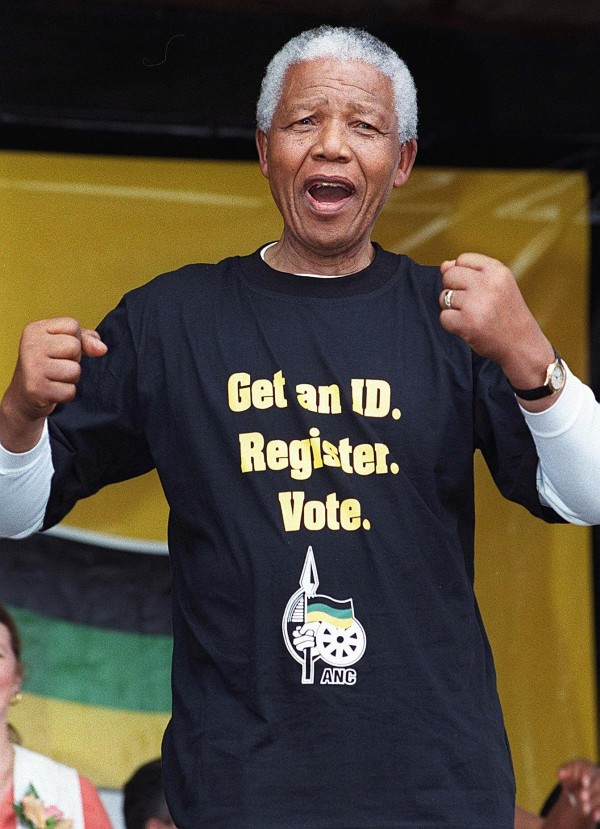
Nelson Mandela expresses his views on Voter ID laws
The news sent shock waves throughout the Commonwealth of Pennsylvania and the national political media networks. Over 700,000 Pennsylvanians lacked the most common, state-provided form of photo identification, meaning that over 9% of the Pennsylvania’s registered voters might be unable to vote in this year’s Presidential election!!
The claims of a voting rights armaggedon were prolific! Ten percent of registered Pennsylvanian voters would be turned away at the polls because they lacked photo ID! In Philadelphia, the numbers are supposedly TWICE as bad! The nefarious plot, born of Republican designs to defeat President Obama in November, was working to perfection! Woe is us! Democracy was D-E-A-D!!!
As you can see, I love an overabundance of exclamation points! It never really makes silly arguments any more plausible or intellectually honest; but it does gives the eyes a thrill. Best of all, it might even distract one from looking at what’s behind the numbers.
So let’s take a peek under the curtain.
The first statistic that jumps out is that 22% of those 758,000 Pennsylvania voters would statistically fall into the “inactive voter” category, meaning that they have not voted since 2007. In other words, these 170,000 Pennsylvanians have been sitting on their voting hands for at least 5 years. It also means – by the way – that not a single one of them bothered to vote in the 2008 Presidential election.
Frankly, I find that 22% to be well on the low side. From my own experience working on the polls in Horsham Township, the number of voters who do not bother to vote in even the most important presidential races is much closer to 40% than it is to 20%. A 22% inactive voter rate would conversely suggest a 78% voter turnout, which has not been experienced in Pennsylvania since 1992 (82%). In 2008, in one of the most provocative national elections in U.S. history, only 68% of Pennsylvania voters cast ballots. That’s a 32% “no-vote rate”. If that rate is applied to the 758,000 without PA photo IDs, 242,000 would not be expected to vote in this year’s Presidential contest.
In addition, the gap in voter registration-to-PENNDOT photo ID includes college students who lived in Pennsylvania while attending in-state colleges and universities; registered to vote during their studies here; then left the state following graduation to pursue their careers. There are roughly 590,000 college students attending over 3200 schools in Pennsylvania. According to a 2010 Student Retention Survey, Philadelphia enjoys a 58% student retention figure. Even though this would be considered a bit on the high side for the entire state, let’s assume it applies. It still suggests that every four years roughly 62,000 college students leave the state (590,000/4 years x 42%).
Without even trying all that hard with admittedly fuzzy math, I’m able to whack that 758,000 by 40% (304,000). And that’s without addressing the multitudes living in large city environs who simply have not needed a PENNDOT drivers license because they rely on mass transit.
Now let’s consider that a goodly number of these mismatched Pennsylvania voters have other acceptable forms of identification:
It’s impossible to count those who will have the above at their disposal; but a valid assumption is they would significantly reduce the number of those left without acceptable forms of voter ID.
Finally, comes a number that illustrates why Democrats really fear the numbers being thrown around by PENNDOT. That number is 2477, or the total number of voters – according to Karen Heller’s column in The Philadelphia Inquirer – who have sought photo voter IDs from PENNDOT since the new voting law was passed in March 2012. That’s just 620 people per month!
Is that a systemic problem, caused by inaccessible PENNDOT facilities, long lines, poor transportation options, bad customer service, overly complicated documentation requirements, etc.? Or is there another reason why citizen response has been slow and not nearly adequate to address this “constitutional crisis”?
The critics would like you to believe that all the remaining individuals who haven’t bothered to seek the required photo IDs, are all physically disabled, obscenely poor, or 93-year-old grandmothers born in far away Southern states where racial discrimination rendered them unable to produce native state birth certificates.
The real problem for Democrats might just be that those they count on to carry the vote in urban locales – like Philadelphia – simply won’t be motivated enough by their precious constitutional right to vote to bother trying to get a valid photo ID. Excuses will abound for this. Some will be valid; others will be nothing more than excuses. You can be certain that, if our newly minted and recently upheld Affordable Care Act required a photo ID to obtain federally subsidized health insurance, the lines outside local PENNDOT offices would be long and suddenly so very easy to reach.
Certainly the truth lies somewhere in between my admittedly cynical, sometimes sarcastic analysis and the breast-beating wails of Jim Crow and poll taxes. If you were in Houston this week, you could have heard the Obama Administration’s view of the voter ID controversy from none other than U.S. Attorney General Eric Holder, who addressed the NAACP’s convention on the issue. Unfortunately you could only get inside the convention site by showing up with your government-approved photo ID!!
For me, it’s incredibly difficult to reconcile a view that requires photo ID to cash a check, ride an airplane, visit a new doctor, sign for a mortgage, or taking an opportunity to listen to the insights of the U.S. Attorney General, yet shuns the same added integrity and transparency for one of our most precious freedoms with the same level of effort.
Only in America …

Once again the result of another Battlefield Summer Lawn was both predictable and unavoidable, if you are one of the common folk who struggle to maintain a healthy, vibrant lawn without the benefit of an in-ground irrigation system.

Honey, did you let the dog out?!?
In the last week you lost. You lost BIG! Your lawn looks like a short-cropped version of Africa’s Serengeti Plain during the dry season, missing the lions and lionesses lounging about your tinder-dry prairie, waiting for Fido to venture off the front porch.
But if you have been paying attention, you realize you may have lost Battle Summer, yet you could still win The Lawn War!
Question is, did you follow the Cranky Man Rules for Summer Lawn Survival?

Hippocrates preaching lawn care, circa 400 B.C.
In the words of Hippocrates … “Do no harm! And make sure you water regularly!” (Few appreciate Hippocrates’ legendary reputation for lawn care!)
Yes, watering your lawn even when it’s hot, brown, dry, and as hard as your driveway can make a difference!
The long-term health of your lawn lies in its root system. Even when the grass looks dead, it’s really just dormant. Dormant on top, but the roots still function and they NEED water to stay healthy and strong!
This is best demonstrated after a few days of cool, wet weather. If your lawn is healthy, you should see immediate improvement in greenness and growth. It will not come back completely green very quickly; but you should definitely notice a difference!
So even if your lawn looks like straw and smells like straw when you water it, you are helping your lawn survive another long, hot summer and setting the stage for a quick, easy lawn recovery once the dog days of summer are over.

Replica of Hippocrates Garden and Lawn Center on the island of Kos, Greece.
… Remember the sacrifices paid to keep this country, its citizens, its future citizens, its traditions free from tyranny and oppression.
Of course the reason we will all be enjoying the Jersey shore, our National Parks, picnics, fireworks and apple pie is the anniversary of another year of The Grand Experiment, where a collection of 13 former British colonies took the first step towards forming a government “… by the people , for the people…”.
“The preservation of the sacred fire of liberty . . is finally staked, on the experiment entrusted to the hands of the American People.” – George Washington
Thirteen years before Washington spoke those words in his first inaugural speech, fifty-six brave men put their names to a document – The Declaration of Independence – that gave birth to a new country at the risk of their own lives and the success of a rebellion against a powerful European ruler. In 1776, these men dared Great Britain to defy their pledge to pursue life, liberty and happiness.
And on that very same date – exactly 50 years later – in 1826 both John Adams and Thomas Jefferson, the second and third elected Presidents to serve and protect this Grand Experiment succumbed to age and died within hours of each other. In 1831 James Monroe, the 5th U.S. President also passed away.
Today, July 3 marks the anniversary of the high-water mark of the Southern Confederacy’s failed efforts to secede from the Union and enslave African people on plantations and in commerce throughout the South. On this day in 1863, General James Longstreet’s corps, under the command of General Robert E. Lee and led into battle by General George Pickett reached the zenith of the Confederacy’s attack on Northern soil on the final day of the Battle of Gettysburg. At a place known as The Angle Pickett’s Charge marked the ebb of the South’s attempt to force an end to The Civil War by threatening Northern cities and eventually the capital, Washington, D.C..
During the charge approximately 4000 Americans were killed or wounded. The Battle of Gettysburg claimed roughly 35,000 killed and wounded.
The following day, the 87th anniversary of the signing of The Declaration of Independence, the Confederate garrison at Vicksburg, Mississippi under the command of Lt. General John C. Pemberton surrendered to General Ulysses S. Grant’s Army of Tennessee after a six-week siege of the city. 3200 Americans were killed or wounded during the siege.
The one-two punch of Gettysburg and Vicksburg formed a recognizable turning point in the American Civil War as Northern industrial might and an overwhelming population advantage formed an insurmountable barrier to future attempts by the South to force a political capitulation from the North. And although the war dragged on for almost two more years, the South never really threatened the North again.
And finally on July 4, 1944 ….
Private First Class William K. Nakamura distinguished himself by extraordinary heroism in action on 4 July 1944, near Castellina, Italy. During a fierce firefight, Private First Class Nakamura’s platoon became pinned down by enemy machine gun fire from a concealed position. On his own initiative, Private First Class Nakamura crawled 20 yards toward the hostile nest with fire from the enemy machine gun barely missing him. Reaching a point 15 yards from the position, he quickly raised himself to a kneeling position and threw four hand grenades, killing or wounding at least three of the enemy soldiers. The enemy weapon silenced, Private First Class Nakamura crawled back to his platoon, which was able to continue its advance as a result of his courageous action.
Later, his company was ordered to withdraw from the crest of a hill so that a mortar barrage could be placed on the ridge. On his own initiative, Private First Class Nakamura remained in position to cover his comrades’ withdrawal. While moving toward the safety of a wooded draw, his platoon became pinned down by deadly machine gun fire. Crawling to a point from which he could fire on the enemy position, Private First Class Nakamura quickly and accurately fired his weapon to pin down the enemy machine gunners. His platoon was then able to withdraw to safety without further casualties. Private First Class Nakamura was killed during this heroic stand. Private First Class Nakamura’s extraordinary heroism and devotion to duty are in keeping with the highest traditions of military service and reflect great credit on him, his unit, and the United States Army.
Private First Class Nakamura was posthumously awarded the Congressional Medal of Honor.
And so, as you enjoy your holiday, your friends, your family … REMEMBER what it has meant to those who have sacrificed for all of us!
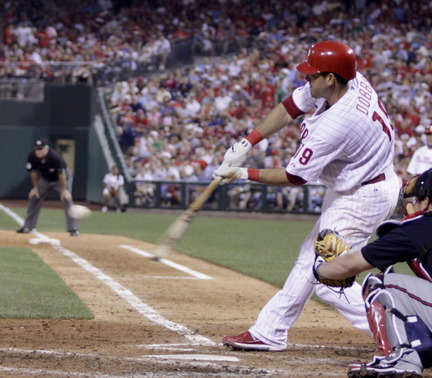
Greg Dobbs launching another assault attempt
Gregory Stuart Dobbs, former Philadelphia Phillies and current Miami Marlin should keep an eye on his mailbox over the next couple of weeks. He will undoubtedly find an unpleasant surprise awaiting him. But before I get into that …
I am proud to announce the end of a personal drought that has run for roughly 48 years! It began when I was about 8. (Might have been 6. It was a LONG time ago …)
That’s when I attended my first Philadelphia Phillies game at venerable Connie Mack Stadium! In all those years, I had NEVER caught a batted ball during game play … or during batting practice … or even as a casual flip by a player into the stands.
You get my drift. Never the chance to smell the processed leather scent of a new ball, to feel the slightly raised stitches or the slick whiteness of the MLB sphere. There was a hole in life … a small hole, but nonetheless …

Connie Mack Stadium: Where it all began
It’s one of those silly things guys who like their sports, who adore the Game of Baseball, are driven to “accomplish”. Just one of those experiences you want to check off the Minor Bucket List.
Most of us pursue our quarry willy-nilly on those occasions when we go to a ballgame and get the chance to sit in The Good Seats … in just the right place in the stadium where the fouls balls will most assuredly fall like manna from the heavens throughout the entire game. Those of us who cherish this quest will deliberately study potential ball flight paths, homeplate proximity, and immediately calculate the odds of a catch as soon as we get to our seats.
Yes, we are a sorry breed.
My personal drought ended on a Saturday evening, June 23, 2012 in the fourth inning of a game at Citizens Bank Park between the hometown Phils and the Tampa Bay Rays.
The Catch will forever go down in Family Lore as a diving, one-hand snag of a screaming line drive into the seats. At least that will be the story I plan to pass down to every one of my grandchildren … eventually. I will have to redefine the meaning of “catch” to include “gaining possession of an object that’s barely moving”. And I might throw in a small child or grandmother saved from a potential cataclysmic head injury.

Me and my elusive quarry, finally captured
But today will be the only time the true story will be told. But first back to my potential lawsuit against Greg Dobbs …
Since the World Championship season of 2008, we have held good ball-potential seats. Section 135 at Citizens Bank Park, just behind third base, halfway down the left field line, 21 rows from the field. We’ve had our share of close calls, including one in 2009 off the bat of the soon-to-be-lighter-in-the-wallet Gregory Stuart Dobbs.
In a game which has faded from memory, Mr. Dobbs assaulted us in our Section 135 seats. His weapon was a screaming line drive foul ball.
As soon as I saw it off the bat, I said to no one in particular, “Uh oh!” (no, not one of my more eloquent observations) The round missile was traveling at roughly the speed of sound and right at my bride’s delicate noggin.
To this day, she insists she would have caught it, had I not stuck my mitt-less mitt in front of her face. But by my calculation, she would still be in a head cast, sipping dinner through a straw.
So I did the gentlemanly thing and knocked her out of the way – gently … kinda – and bravely stuck my hand out to protect my woman … and of course, to see if I could grab that elusive sphere. When the dust settled, the ball was in the possession of a regular Section 135 resident who sits right behind us; I had a knot the size of Placido Polanco’s head growing on my thumb; and the spousal unit was in a tiff because I ruined HER CHANCE to catch one in the teeth!
For years I have lived with the humiliation of missing that Impossible Catch, the shame of ruining Carol’s “big chance” at a Grade III concussion, and the taunts of a coworker who sits a row ahead of us on the same 17-game ticket plan.
The torment finally ended that Saturday night!
 Future Hall-of-Fame shortstop, Elliot Johnson (OK, so he’s off to a slow start.) swung at a Kyle Kendrick offering as I sat next to Carol and sipped my chosen adult beverage, a Flying Fish Extra Pale Ale.
As the ball arced tightly toward the population of Section 135, I received a mental text message from that compartment of the brain in charge of Semi-Athletic Endeavors … PUT THE BEER DOWN. As I complied, I thought “Why am I bothering? That ball’s not getting here.”
Sure enough the ball hits three rows ahead of us and about 6 seats to our right. I had stood up just before the ball hit flailing flesh, keenly abiding the next two intra-brain text messages … STAND UP, STUPID and LOOK FOR A REBOUND …
Several people lunged for the possession prized by so many, though it means so little. The ball got through outstretched arms and struck the back of a seat a row or two in front of us, still off to our right.
As I searched for a ricochet, I was stunned to see the ball bounding down our row; seat-back high, clanking off grabbing hands, bouncing off cowering women folk. It struck someone or something and plopped into a seat a row in front and just to the right of my Android-distracted spousal unit. (Later, she would insist she would have had the ball had she not been playing with her phone. Well, at least this time she wouldn’t have needed all that dental work.)
Since I was obediently standing up already, I was in the perfect position to plunge down and grab the valueless trinket. Yet for some reason, I waited for the next rather frantic, emotion-filled brain text that screamed GET IT, YA DOPE!!!
As I swooped down (dismiss all pre-existing concepts of what “swooping” looks like), another gentleman equidistant from the seat on the other side of Carol also lunged down and flailed at the elusive prize. My cat-like movements (consisting of me clawing at the still bouncing ball like a large, slow-moving cat) simply knocked the ball around the seat some more, as I and my competition continued to swat and grab. Finally, I cornered the ball and plucked it from the seat!
I rose triumphant and exhilarated! Displaying my trophy for all The World to see, including that smart ass from work who predicted I would NEVER get my first in-game ball! I was King of the World!
Then Kendrick threw another pitch, and I was just a middle-aged doofus making too much out of corralling a worthless, slightly used baseball.
And that leads me back to Gregory Stuart Dobbs.
I heard that Elizabeth Lloyd and her husband are suing an 11-year-old Little League player in Manchester Township, NJ for $300,000 after allegedly plunking her in the face with a baseball … that might have been traveling 10 miles an hour … while she sat completely oblivious to what was going on around her at a baseball game with pre-teens swinging metal bats and throwing rock hard objects.
I don’t really buy this – that you can hold an 11-year-old accountable for your own lack of attention – but it was inspiring on a much higher financial level! Afterall, if Ms. Lloyd is successful, imagine what I could get from a grown man and well-paid ballplayer – Mr. Dobbs – who was “engaging in inappropriate physical and/or sporting activity” in the presence of 45,000 people!!
In addition, I also lost the “services, society and consortium” of my wife. This was the indisputable result of my thumb injury, which prevented me from completing my “move”, as I prefer The Pinch over The Swirl. For weeks I was reduced to using The Knuckle. It was HORRIBLE! The loss was devastating, insufferable, humiliating, and completely fabricated.
But hey, get me a good lawyer, and I could make take me a fortune!
Greg Dobbs, the bell tolls for thee!
 Cranky Man's Lawn