Seems like a lighter-than-expected turnout so far. Nice seeing the neighbors coming out.
Democrats still relying on outside individuals to man their ground game. Take note when you get to your poll.
Seems like a lighter-than-expected turnout so far. Nice seeing the neighbors coming out.
Democrats still relying on outside individuals to man their ground game. Take note when you get to your poll.
 To be honest, I don’t pay a lot of attention to Elections for Judges. In my humble opinion, this should always be viewed – first and foremost – as a competency issue, as opposed to a question of political philosophy.
Choices for Courts of Common Pleas are preserved The People of Pennsylvania to decide. On Tuesday, November 5, Montgomery County voters will be choosing between four candidates for two openings in the Court of Common Pleas for Montgomery County (PA).
It’s an important decision for Voters, particularly in Pennsylvania where it’s purported to be easier to become a judge than it is a cosmetologist!
So where does one go to find out which Judges are considered to be most competent? Answer – for me at least – is the Montgomery Bar Association, which every year offers its recommendations for the election of Judges.
There are four candidates for two open positions on the Montgomery County Court of Common Pleas. In Pennsylvania the Court of Common Pleas hears and decides major civil and criminal cases.
The Montgomery (PA) Bar Association’s Judiciary Committee gives only Maureen Coggins, Esq. its Highly Recommended rating. She was the ONLY Montgomery County lawyer to receive this recommendation.
The remaining three candidates, Sharon L. Giamporcaro, Esq., Steven C. Tolliver, Sr., Esq., and Gail Weilheimer, Esq. are provided Recommended ratings.

Maureen Coggins, esq.
Maureen Coggins is the only one of the four candidates I can remember having met or heard speak. I caught her presentation for support from Montgomery County Republican Committee members in January 2011 in which she was unsuccessful that November.
I was much impressed by her passion, commitment, and no-nonsense plan for making the most of a judicial position if elected. At the time, I felt that Montgomery County missed a great choice for The Bench.
Of the other three candidates, I was most impressed by the backgrounds and experiences of both Ms. Giamporcaro and Mr. Tolliver.
As a citizen however, you should rightfully be most concerned about the Quality of the Judges you elect; and for that, Maureen Coggins comes Highly Recommended!
Of the others, choose wisely.
.
A Scott Freda update for Horsham Township voters
Last week, I gave my not so surprising views on the upcoming election for Horsham Township Council. But I missed a BIG piece of information on candidate Scott Freda, who served as an advisor to President Bill Clinton.
It appears that Freda’s name was prominently mentioned in an investigation into illegal campaign contributions related to the 2000 Presidential campaign of Al Gore.
The L.A. Times in an article published in June 2007 described the sordid connections between a California businessman, Ray Jinnah, and advisors to the Clinton Administration as they worked to get Gore elected. The network allegedly ran to Terry McAuliffe, a Democrat fundraiser and close friend of the Clintons.
McAuliffe, in another interesting twist, is currently running to become Governor of the Commonwealth of Virginia!
In part, the Times article notes …
“The Times obtained a copy of a stock certificate showing 10,000 shares in the name of Scott Freda, a fundraiser and McAuliffe associate. Freda said he recalled Jinnah promising stock to him, but never receiving it.”
It’s best to read the entire L.A. Times article in order to draw your own conclusions. (See the June 2007 link above.)
Jinnah eventually fled to his native Pakistan to avoid prosecution, returning to face the music and plead guilty in 2006.
Freda was never prosecuted for his involvement; but he freely admitted that Jinnah promised him stock. The “Big Aha!” for me is that the L.A. Times piece fails to mention whether Mr. Freda ever went to the authorities with the first-hand information he knew of Jinnah before being confronted with it years later.
My thoughts on this?
Where there’s Smoke, there’s Fire!
Voters of Horsham Beware!

Horsham Library
CNN/Money Magazine
There are two observations relating to politics in which I strongly believe.
On November 5th the residents of Horsham, PA and the Hatboro-Horsham School District face a crucial election for several local offices.
Local elections have a greater direct effect on you, the Taxpayer; the community in which you live; and the schools your children attend. In addition, the decisions we make on November 5th will impact the prospects for Horsham’s future in terms of the NAS-JRB Willow Grove airbase. How that process plays out in the next decade will be reflected in the taxes we will pay and in the value of our homes and property.
No other election will affect your quality-of-life more directly than local government offices that control spending, property (schools) and township taxes, not to mention the potential for your township’s Economic Future.
When it comes to local elections, History is an effective barometer of Future Success. In Horsham’s case, Success is not a theory or a couple of good terms in office. It’s a history built over DECADES of Growth, Vision, and the kind of efficient management and intuitive policy that built a community lauded as one of the Best Places to Live (Horsham #34, CNN/Money Magazine 2013).
 Growth, managed properly and carefully, allows for township taxes that have not been raised in over a decade. Efficiency is what ensures your streets and neighborhoods are kept safe; operating smoothly; and cleared of snow in the winter. Vision is taking the forward-looking action to establish a Horsham Local Redevelopment Authority (HLRA) that preserved for Horsham residents control over the key decisions surrounding the BRAC (Base Realignment and Closure) closure of the NAS-JRB Willow Grove airbase.
No single action did more to preserve the Quality-of-Life in Horsham than the establishment of the HLRA. Few people appreciate the fact that any local or regional entity (Montgomery County, Bucks County, Delaware Valley Regional Planning Commission, etc.) could have filed for official status as the LRA for the Horsham base. If just one of them had been as quick to act as Horsham Township‘s Council, you can bet there would already be an airport operating at the airbase.
W. William Whiteside and Deborah Tustin were part of the team that took the initiative to preserve for Horsham residents the decisions that will shape Horsham’s future, as will be reflected in those 862 acres sitting so prominently on Rt. 611! Newcomer Tom Johnson, a mainstay in Horsham commercial and industrial development, has the experience and the Horsham-grown philosophy to maintain this consistently successful approach to our future.
And what of their Democrat challengers? What is it they have to offer? Apparently not much more than misrepresentations of fact and plenty of negativity.
 They say they can make Horsham even better. But how could they improve a community already ranked so prominently as one of The Best Places to Live? Ask yourself the practical question … How much they can actually improve today’s Horsham?
Then recall all those negative mailings they sent to your home … over and over again … day after day in the last few weeks.
How much better do you think the Democrat challengers will make Horsham now?!?
The only new ideas I was able to identify from their mailings were confrontation and obfuscation. For a group that speaks so much of making Township Government more “open”, they have a funny way of misrepresenting the truth and trying to fool Horsham voters.
Fact is, Horsham Township government is the most open governing process I have ever witnessed. You can find on-line public notices of all township and school board meetings. At the HLRA website you can find agendas, minutes, and even sign up for e-mail notifications of future meetings.
I remember – as part of the HLRA redevelopment plan process – hundreds of local and regional citizens learning about and watching the evaluation and decision-making process.
 I attended as many of these meeting as I could. I sat with hundreds of people and participated directly in an open-to-the-public charrette process for brainstorming ideas and layouts for a theoretical, redeveloped NAS-JRB property. I was there the night that hundreds of attendees gave a rousing ovation for the decision to reject a Bucks County Airport Authority proposal to operate an airport at the base.
In my opinion, the Horsham Democrats’ most egregious behavior is the deliberate and repeated misrepresentation of the purpose and meaning of the HLRA’s painstakingly created Redevelopment Plan.
The plan is intended to accomplish nothing more than to prove that Horsham Township has the means and capability for properly managing the redevelopment effort. It forms the basis for the U.S. Navy to conduct its Environmental Impact Statement and for developing an anticipated cost structure for its eventual execution that can be evaluated for its economic feasibility.
Like all carefully laid plans, the specific details of the redevelopment plan are tenuous projections of what can be accommodated on the airbase property. But the fact is, none of it means anything without developers and their financing to make the plan a reality. In that regard, the HLRA could say it plans to build the Taj Mahal on the airbase site. But without developers with the money and interest to make any specific plan a reality, it’s all pie-in-the-sky.
To speak about golf courses, bowling alleys, and hockey rinks is simply being deliberately dishonest for the sole purpose of political advantage.
But of course this is the BEST idea the Democrats could come up with in their efforts to get Horsham voters to look their way. Attack and obfuscate …
You can tell a lot about the Democrats’ plans for Horsham by carefully dissecting the messages they keep sending you in those ugly mailers. And if you caught their cable commercial, it tells you even more.
 There is a plan here apparently. It’s the Get Scott Freda Elected to Something plan!
Remember all those negative mailings you been receiving?? Just check the small print that lists the “Paid for by …” election requirement on all those negative mailers.
Scott Freda‘s “plan” for Horsham is laid out for you right there!!
His cable commercial? If you see it, you will be hard-pressed to find his running mates in that commercial, except as props. There is no mention of them by name, only Mr. Freda’s name is prominent.
Then ask yourself The Big Question.
Where is all this money for negative mailers and cable TV commercials coming from?
Did you know that the leadership of the Horsham Democrat Committee has a strong connection to Philadelphia political organizations? That’s why every year at polling places throughout Horsham, you will find the Democrats’ Election Day ground game manned by representatives of these Philadelphia organizations!
Not Horsham residents … Outsiders with their own self-serving interests!
It’s an interesting combination, quite frankly. Certainly these Philadelphia organizations would just LOVE to get a friendly foot in the door of the airbase redevelopment effort and all that development money.
But who wants Philadelphia politics in Horsham?
So ask yourself, are the goals of Philadelphia political bosses and their organizations consistent with Horsham Township’s best interests?
Hopefully, Horsham Township voters are smart enough to know the difference between ugly divisive Outsider Politics and effective locally controlled government!
Don’t forget to vote Republican for Horsham on November 5!
 No one wants to be unpopular, unwanted, or – worse – to feel used and abused. Yet for a significant portion of the Republican Party, many are encouraged to express their political beliefs only on Election Day. But when it comes to discussing the direction of the Party nationally and the Country in general, they better toe the most Conservative of party lines or prepare to be labeled.
For the past several years, it has become clear to self-described “moderate Republicans” that we are to sit quietly in the back; keep our thoughts to ourselves; and let the “real” Republicans make the grown-up decisions!
Yes, we are the RINOs (Republicans In Name Only). And it’s getting more than a little tiring.
Used to be that various permutations of the Republican value set were welcomed in the development of the GOP platform. We share the same values that fought slavery; checked the spread of post-WWII Communism; and punished the protagonists of radical Islamic terror.
We were welcomed in a strong coalition that valued – above everything – an efficacious American system of government. Smaller bureaucracy, productive budgets and spending, and compassionate solutions to social problems were the mantras of Goldwater and Reagan that we all worked towards.
It was a coalition of minds, accepting of moderately divergent views toiling in unison on core values we all shared.
 Now, you dare not step off the strict Conservative reservation or risk the dreaded RINO label! This is an issue I have spoken of before in frustration at the lack of cooperation nationally and the loss of American governance.
In a recent article for the Providence Journal, Froma Harrop asked where have all the moderate Republicans gone?
Oh, we are here all right, hunkered down in our fox holes; reluctant to poke our heads above ground level. We seem to make such inviting targets.
Many like me, who live in largely suburban-metropolitan areas where some of us have evolved politically over time from the Liberal leanings of youth towards more conservative views on matters of economics and national ideals, have taken solace in the age-old adage that “All politics are local.” We work to keep our communities on sound fiscal footings, our schools and municipal infrastructures efficient and lean, our neighborhoods safe; and try to apply those same principles to County and State government.
But we dare not speak of our moderate approaches to social issues and the process of pragmatic governance, particularly on a National level. Because if we do, we know immediately where we stand with the more assertive Voices of the GOP.
RINO! You would think we were traitors to The Cause.
Certainly, if The Right wanted to portray us as CINOs (Conservative In Name Only), I wouldn’t complain. CINO sounds more pleasant than RINO too! But in the “good old days” you could indeed be less than Big C Conservative and still be considered a stand-up Republican.
Not so much any more.
Harrop makes a point which I believe go directly to the GOP Losses in the last two Presidential elections. Both John McCain and Mitt Romney were weak (McCain) or weakened (Romney) candidates once they went head-to-head with Barack Obama.

Shouldn’t be what a national Republican primary looks like
McCain was a horrible presidential candidate, although it’s difficult to believe he could have beaten the first African-American candidate regardless. Instead, he was simply the last Crash Test Dummy to survive the 2008 GOP Primary Candidate Roast. It wasn’t even that he was “conservative enough” to win the Party’s pageant. He was simply smart enough to stay on the periphery and survive the carnage.
In Romney’s case, for an election he should have been well-positioned to win, he was faced with the choice of moving hard to the Right to win the nominating campaign. Then he was faced with the prospect of a convention revolt to bring in a more Conservative nominee.
When he had finally nailed down the GOP’s endorsement, he was not only unrecognizable as the successful, bipartisan Governor of perhaps the most Liberal state in The Union, he had stumbled into several verbal traps that plagued his campaign throughout the National Election!
Defeat snatched from the jaws of Victory!
Used to be our moderate positions were viewed as the route to effective compromise, the bridge from one Far Side to the other Far Side. The way efficient Governance was effected.
Not so much anymore …
Now we’re the ones stuck in No Man’s Land watching the rockets screaming over head between the Right and the Left. That is when BOTH sides aren’t trying to outflank us and pick us off!
True story …
In the Spring of 2012 and the run-up to the Presidential Election, I was asked to participate in a TV show involving a round-table discussion of political issues, where two Democrats were to be paired off against two Republicans. It was a small local cable access station in Abington, PA; and the gig lasted all of two shows before the Producer up and retired. But I was flattered, and it was a trip just to be asked.
The experience was fun. I held my own despite the nerves. But it was clear that I was the more moderate of the two Rs participating that night.
After the first episode taped, my far more Conservative Republican counterpart and I went out to eat. And our dinner conversation revolved around our various positions on a number of political and social issues. When I wasn’t asked back for the second episode, but was mistakenly sent an e-mail with the agenda for episode 2. I checked around and found out that my spot had been taken by a much more conservative Tea Party member.
The message – to me at least – was pretty clear. Not Conservative enough …

If it comes to this, so be it!
Returning to Harrup’s question, my theory is that the RINOs – us RINOs – have tired so much of the frenetic fire fights, many of us have simply dropped out of the National Debate. We draw fire from one side simply through association with a more conservative set of governing ideals with which we agree. Then we get outflanked by those who believe us to be not “conservative enough” across the board.
No longer is it good enough to say we support a strong National Defense, the right to bear arms, and the need for sane, sustainable economic policies. No, we must toe the entire line, including those positions on social issues which many of us believe weaken our beliefs in the sanctity of Individual Freedoms.
Every new iteration of the GOP seems to pull farther and farther away from us. The Tea Party has a funny way of concerning itself with issues that never would have crossed the minds of the original Boston Tea Party contingent.
Libertarians appear to be the most attractive alternative until their dogma on international relations and geopolitical theory threatens a short-sighted return to a 1920s mindset, which turned into a World War disaster in the decades to follow. And who wants that?!?
So what’s a RINO to do?
If you appreciate the core values of true Conservatism, remember that it’s easier to instigate change from the inside. A true Conservative would not leave because they are disenchanted with Leadership. They fight for what they believe in!

There’s power in numbers
Using the Lose It! iPhone app

What have I lost so far?
Adult Jack Russell Terrier
weighs in at 18 pounds
Starting weight: 236.6 lbs. (Feb 18)
Goal Weight: 200
Plan: Lose one-and-a-half pounds a week
Daily Calorie Budget: 1909 per day (Started at 2020/day)
Projected Goal Achievement (Adjusted): December 2 12 January 12
Weight on September 6: 220.8 lbs.
Weight today: 218.8 lbs. (down 17.8 lbs.)
Finally!
We broke the 220 mark this week!
The first time I have been below the 2-2-0 in at least a decade. It’s been a lot of bouncing back a forth between 221 and 223, but I finally broke through with a little help from a sinus infection that made everything I ate taste like Nothing.
Confession Time 1:
Years ago – probably somewhere in the mid-1990s – I tried to lose a lot of weight fast because I was really concerned about my suddenly skin-tight pants. Decided to try the Slim Fast route – the powdered drink of Dieting Champions!
Worked well for a while, but the hunger never really subsides, which is predictable when you go from no-holds-barred eating to next-to-nothing. But for roughly 10-14 days I was a faithful powdered drink dieter.
That is until one day my wife finds me sitting out in the yard, unable to get to my feet due to dizziness. I had also noticed that day that my “droppings” had an unusual white color to them. (This can indicate more serious health problems; but in my case it went away once I got back to a normal diet.)
Carol – as wife, nurse and defacto protector of the family income stream – ordered me off the powder and into the kitchen for a load of high carb inputs. She was dead on right; and I realized Quick and Sudden wasn’t the best route to a slimmer me.
Confession Time 2:
I haven’t been as faithful to my good friend, the Lose It! app, lately.
The app has helped me out a lot. But by now – after 8 months of slow, semi-steady progress – I have sufficiently changed most of my bad eating habits, and can pretty accurately calculate where I am – calorie wise – without falling back on the app as a crutch.
I tend to use it more in the beginning of the day through lunchtime because it keeps me honest and allows me to plan my programmed calorie intake for the remainder of the day. It also helps me keep track of my trade-offs on those days when I’m at the gym or will be burning big calories working around the house or playing golf (1000 calories for a typical 4-and-a-half-hour round in a cart according to Lose It!).
Micro biological warfare’s scary side
The transformation has been remarkable! In the span of three weeks, I have gone from complete apathy towards destructive lawn insect species to full on merciless biological annihilation.
After a few years of a devil-may-care approach to the potential for an occurrence of a GrubLapalooza on my lawn, the recent damage found after ignoring the telltale signs in Summer has thrown me completely over to the opposite extreme.
So I broke the glass and pulled out the launch codes for some medieval microbiological warfare.
I called out the Legions of the Milky Spore!
(Yes, kiddies, this is what a high-end computer game looked like in the 1980s!)
In past deliberations on whether to spend $200 to cover by lawn in a protective layer of anti-grub chemicals or let Nature take its course, I have run across recommendations of the milky spore bacteria. But its application looked weird and more time-consuming than dragging out the root-spreader. Add in the mistaken conclusion that grubs were not that big a problem, and the suggestion never took root … so to speak.
After reading up on the milky spore’s process though, it’s a scary little microbe that appears to be damn effective in protecting lawns from the blight of the grub.
 The product is not cheap at roughly $30 for a 10 ounce bag of a white powdery substance similar in appearance to powdered sugar. But if it does provide years of protection, it’s well worth the cost and the aggravation of its rather archaic application process.
Death by milky spore is a nasty way to go. (Milky spore is not harmful to beneficial insects, pets, wildlife – except for the grubbies – or humans.) So let’s not alert the good folks at PETIL (People for the Ethical Treatment of Insect Larvae).
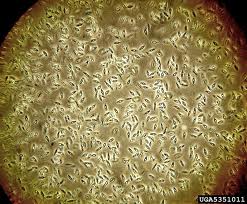
Milky spore is a rod-shaped bacteria that lives naturally in the soil. As grubs feed on the roots of grass plants, they incidentally ingest any number of organisms residing in the soil and on the roots themselves. The milky spore however, begins to reproduce once ingested, and slowly begins to feed on the grub from the inside.
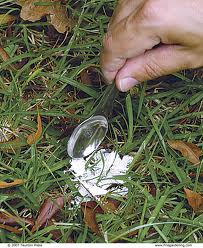
Yeah … I actually did this
every 3-4 feet
This of course results in the larvae’s death, but not until the grub turns a milky white, hence the name. Then when the dead grub decomposes it release BILLIONS of additional milky spores!
Yikes … if you’re a grub larvae.
The endless cycle produces more and more milky spore generations, which obviously can stretch the protective factor of the milky spore treatment.
And I’m beginning to like saying “milky spore”!
Now the application process sounds really weird, but really wasn’t all that drawn out for the half of my Green 1/4 Acre.
Milky spore is applied by the TEASPOON … one teaspoon every 4 feet in an alternating “checkerboard pattern”. Each level teaspoon is applied in a circle between 3-6 inches in diameter. Then you run the lawn sprinkler (or – if you’re lucky – an immediate rain) to water the white powder into the soil.

Now you tell me …
I held true to the process and pattern, except where I knew or suspected that I had a grub presence where I made sure to place one of my “powder circles”. It didn’t take as long as you might expect. and I intend to treat the rest of the lawn next year.
Now doing this in October is not the recommended time of the year, since the grubs tend to retreat deeper in the soil when the temperatures start to drop, and are not then actively eating. My bet is that the spore I applied this weekend will still be present in the soil when the grubs pop back up closer to the surface with next Spring’s warmth.
I’ll keep you apprised of the results.
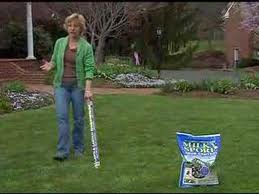
Lazy lawn bio-warfare specialist

Thomas Jefferson
3rd President of the United States
Jon Meacham‘s Thomas Jefferson: The Art of Power is the fourth book of his I have read.
Meacham makes history easy to read for even the most casual fan of U.S. history. His management of theme through the issues of the day and the personality of the subject helps the reader see a broader picture of a man like Thomas Jefferson.
His approach to describing in overview the important events and critical issues; developments and solutions that evolved; giving the reader the essential insights without bogging down in a load of minutia. Meacham’s works are thoroughly footnoted, which helps the real history junkie decide where they might like to do more in-depth reading or research.
The American Revolution, and the birth of the country which followed is a favorite subject of mine. Of particular interest is the collection of men that came together in challenging times to take a dangerous stand against England; risking life and property for Liberty; then steering a course towards constitutional government that resulted in a Republic now over two centuries old.
These men were the wealthiest, most educated, and most successful in the American colonies. But …
These men were not perfect. They had their flaws. Yet they came together and created a politically complex national union out of disparate regions and competing interests in such a way that enabled growth; promoted its survival through the tests of time; and allowed it to emerge from the crucibles of several dramatic – even catastrophic – national and international crises as an even stronger nation.

George Washington appointed Jefferson
the first U.S. Secretary of State
Thomas Jefferson‘s contributions to the success of The Great American Experiment in the period between George Washington‘s inaugural as our first President and Jefferson own presidency (following John Adams) were – in my opinion – the most compelling .
Citizens with a casual appreciation for American history might believe that once the U.S. Constitution was ratified as the Law of the Land, the Forefathers simply finger-skimmed the honored document whenever a question of function or politics arose. But The Constitution was but a “blueprint” with many operational and philosophical issues undefined or at the very least open to all manner of nuance and interpretation.
Thomas Jefferson was one of those flawed individuals that rose to play a prominent role in taking that constitutional blueprint and – if I can stretch an analogy – installing the wiring and plumbing that allowed the Government to relate as best as possible to the People it would govern. It was a herculean task that required the input and at times the nastiest of opposition between Federalists and Jefferson’s Democratic-Republicans to negotiate a national vision from contending philosophies of governance.
Jefferson was a study in contradictions throughout his personal life and public service.

Sally Hemings
1. He was a man who passionately subscribed to the concept of Individual Liberty. He made several attempts early in his public career to advance the concept of slave emancipation in the Virginia colony. He provided insights for the French Declaration of the Rights of Man and of the Citizen via the Marquis de Lafayette, which became the central theme of the French Revolution; and he fought hard against John Adam’s Alien and Sedition Acts.
Yet he continued to own slaves; using one – Sally Hemings – as a concubine; and went so far as to maintain their offspring as slaves until they turned age 21 or until his death in 1826.
2. As a member of Washington’s first American government, serving as its first Secretary of State, Jefferson fought aggressively with fellow Democratic-Republican James Madison to counter the Federalist’s efforts (Led by Alexander Hamilton and John Adams.) to create a strong national government with a singularly powerful Chief Executive. Jefferson was fearful that such a strong centralized authority, with the prospects for close ties with Great Britain, would eventually whittle away at individual liberties.
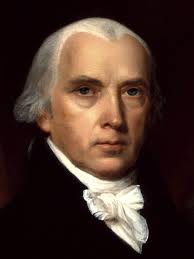
James Madison
Fellow Democratic-Republican
However, when he served as President himself, he found a way to expand the powers of the presidency in order to take full advantage of a French proposal to effectively double the size of the United States through the Louisiana Purchase.
3. Jefferson was an accomplished author of A Summary View of the Rights of British America (a list of grievances against King George III), The Declaration of Independence, and as contributor to the French Constitution.
But he wrote only one published book in his life, Notes on the State of Virginia. And he was not much of a public speaker for such a renown politician and communicator!
Meacham’s primary theme emphasizes that in his quest for power, that he wanted for the good he felt he could accomplish, Jefferson was a practical politician. He had his ideologies, his strongly held positions. But Jefferson believed in “limited government” only to the extent that it was practicable. If he thought a more expansive government was the better option in the best interests of the country (e.g. Jefferson’s quick actions to accept and ratify the Louisiana Purchase), he held no qualms about pushing the National Government’s reach and authority.
In the end, both the Federalists and Democratic-Republicans enjoyed a mixed success influencing the path of The Grand Experiment. As bad as contentions grew in the early years of the Republic, it was clear both Federalists and Democratic-Republicans were advocating what they believed was best for The Country.
One can only hope the current crop in Washington, D.C. feels the same way for all the right reasons. They certainly give you reason to question their over-arching objectives
A very cool John Adams
Thomas Jefferson and John Adams formed the opposing poles of American political thought from 1790 to 1809, when Jefferson left the presidency. They were close friends at one point, including Jefferson’s pleasant plutonic relationship with Abigail Adams; strong allies during the colonial confrontations with Britain; friends and co-commissioners to Europe (along with Ben Franklin) for the infant U.S.; and then nasty political opposites during those formative years of the constitutional republic.
They served as consecutive Presidents, then went to their separate corners of the country after leaving office. They eventually renewed their friendship years later with frequent letters. And on July 4, 1826 – coincidentally the 50th anniversary of the issuance of The Declaration of Independence – within hours of each other, first John Adams and then Thomas Jefferson shook lose their mortal coils and left the rest of the work on the grand experiment to later generations of Americans.
Other interesting aspects of Thomas Jefferson learned from Meacham’s Thomas Jefferson: The Art of Power:

Patrick Henry gives his
Stamp Act speech

Memorial marker at Jefferson’s
Monticello gravesite

The real John Adams
Interesting Jefferson quotes …
” … what country can preserve its liberties if their rulers are not warned from time to time that their people preserve the spirit of resistance? Let them take arms. The remedy is to set them right as to the facts, pardon and pacify them. What signify a few lives lost in a century or two? The tree of liberty must be refreshed from time to time with the blood of patriots and tyrants. It is its natural manure.”
“Believing as you do that religion is a matter between Man and his God, that he owes account to no one for his faith or his worship, that the legitimate powers of the government reach actions only, and not opinions. I contemplate with solemn reverence that act of the whole American people which declared that their legislature should ‘make no law respecting the establishment of religion, or prohibiting the free exercise thereof,’ thus building a wall of separation between Church and State.”
“I am a great friend to the manly and healthy exercise of the gun.”
“If they approve the proposed Convention in all its parts, I shall concur in it cheerfully, in the hopes that they will amend it whenever they find it work wrong.”
I share this somewhat shameful chain of events as illustration that no one, least of all Cranky Man, is anywhere near perfect …
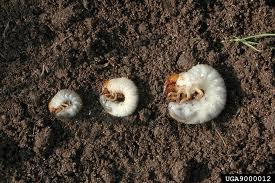
Bane of my existence …
(www.maine.gov)
Once upon a time there was a self-professed Lawn Guru, who proudly touted the Technicolor Green Coat that gently swaddled his little slice of surburban heaven. He was a prolific font of turf grass knowledge and theory; yet he held a certain disdain for the clamoring Merchants of Lawn Care, eschewing their advice whenever he determined they were simply out to make a buck off his highly developed fear of Potential Lawn Disaster.
So, when the Lawn Care Merchants came to him with their dire warnings of bugs, grubs, and certain death of large swaths of his carefully tended turf, he poo-pooed their pricey solution; boldly straddled his lush green lawn carpet; and declared all within his sight, “Good and Green and snug as a bug … “
It was a poor choice of words.
Three months later the Lawn Guru emerged from the Other Side of Summer; placed both hands to his head; and screamed “What the …!!”
The Grubeths hath cometh.
Let’s recap …
So it’s no real surprise that I look for those ways I might be trapped into putting out money I don’t necessarily have to spend. This goes for my lawn like anything else. So I tend to research what the real lawn experts suggest when it comes to the practical care and treatment of my Pride ‘n Joy (Non-Human Category).

Front lawn area
after removal and treatment
You try to be pragmatic by realizing no lawn damage could be so traumatic or tragic that a little recovery work couldn’t solve whatever problems you might cause by being a little cheap and a lot stubborn.
And certainly all of the above applies to this situation.
Some well-respected turf authorities suggest that unless you have a grub population on average of 12 per square foot of lawn, you do not have a serious grub problem.
So … cheap lawn guy that I am … I checked a few areas of my lawn over a few recent seasons and determined that my grub-per-square-foot population appeared well below the Problem Benchmark. I had them, but they weren’t a big problem. As a result, I have saved myself a few bucks in the recent past on what I felt were unnecessary grub treatments!
Still those nasty grubs can damage your lawn. But at what point is that line where a little damage becomes too much damage?
The Answer: When a) it makes the rest of the lawn look like crap, and b) I should have known better.
The REAL problem … actually I did know better.
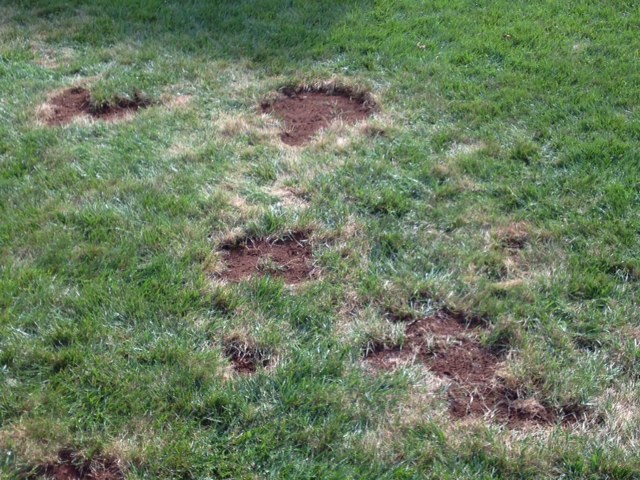
Side yard damage
It was in mid-June when I noticed quite a few very large green beetles (not your garden-variety Japanese beetles) cavorting wildly on and about the front yard. I made a mental note to consider the benefits of applying a grub treatment. Unfortunately, like many of my mental notes, the thought never re-appeared.
At least that’s my story. And I’m sticking to it! It’s a self-inflicted wound nonetheless …
The rest – as they say – is history.
Detection and Treatment:
Under normal conditions, you would treat for grubs in the weeks between Memorial Day and the 4th of July, when the beetles are getting a bit randy in their seasonal way. But if you’re the cheap knucklehead like me, and wait until the damage is done …
Look for unexpected brown spots in your lawn. These I found, and they bothered me because we had a fairly good Summer for lawns in our area. Plenty of rain, cooler than normal temperatures, few long periods of intense summer heat …
Using a rake, see how much of the dead grass comes up easily. If you can pull the grass up like a poorly installed carpet, you got problems … like I did. Once a healthy grub population gets established, they eat your lawn’s root system. Soon there will be nothing attaching said grass to Mother Earth aside from gravity, hence the hair hat effect.
One good tug and “Hello, baldy!”
Now in my case, I’m talking two areas of grass, roughly 9-foot and 16-foot square, where roughly half the area was affected, and a few much smaller spots here and there. Not a huge problem, but one section was right out in front of the house and very, very noticeable. So it would be a bit much to leave there untreated.
After peeling away the dead grass and removing the grubs, I threw down some seed and covered it with soil. I’m hoping to take advantage of warmer-than-normal temperatures this week to generate a little growth before the grass goes dormant for Winter.
And next year I promise a grub treatment, cost be damned!
The Self-Inflicted Wound
Of course, once you think things are bad enough, you do something really stupid. In my defense, the thing was freakin’ huge!
I don’t like spiders. Actually what I really don’t like is cobwebs. The spiders don’t bother me, so I don’t bother them … usually. This was the exception.
One aspect of approaching Fall, I have found I really hate … Spider Season! There’s nothing quite so disgusting as walking out the door in the morning, after a nice hot shower and dressed in freshly pressed cloths, right into a face full of cobweb. Has to be the ickiest feeling known to Man.

My attacker (actual size)
Of course those dinner plate-sized marvels of filament engineering come with spiders the size of half-dollars!
Hence my problem that day.
The kicker? I was pushing a hopper full of lawn weed ‘n feed!
You can imagine where this is going.
Head down, I’m plowing mindlessly along (Well, how else would I be doing this?) pushing 15-20 lbs. of weed killer and fertilizer across the lawn, right in front of the garden. Suddenly I feel cobweb across my face and over my ear.
What’s worse is the tarantula still hanging on said web just in the periphery of my vision. Not sure where he ended up, but he probably clung to my wildly spinning, thrashing body until his laughter caused him to lose his grip.
Little bastard …
Anyways, once I got every conceivable molecule of web off me, I turned back to find the hopper of weed ‘n feed on its side. Half its cargo – at least – was sitting in a pile on the lawn.
Not good … No, not good at all.
It’s been a bad lawn week.
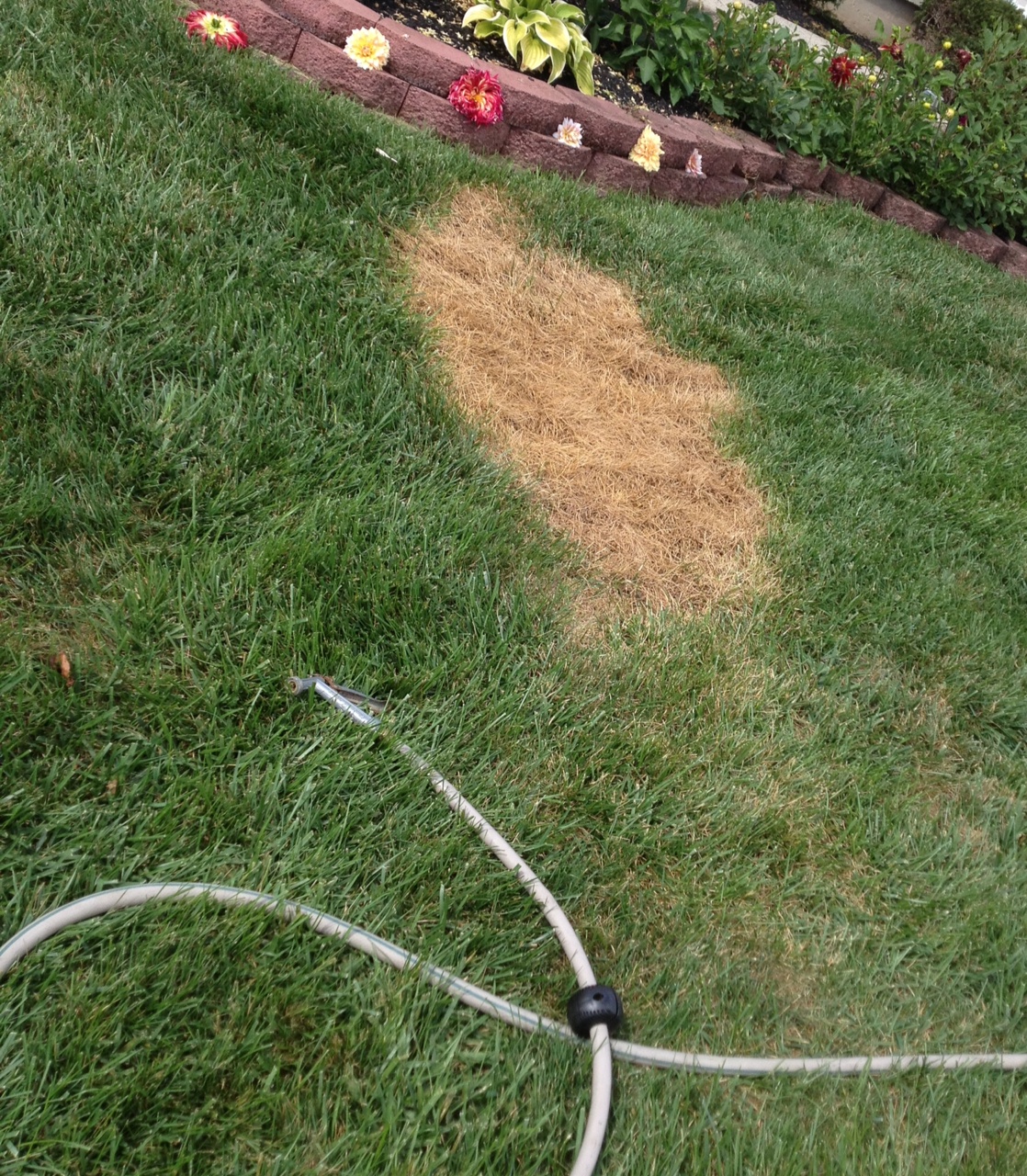
Suburban tragedy
I didn’t see this coming. I guess Sandberg has his own guy in mind. Sucks though … I thought Dubee did very well with whatever talent was given him.
 Rich Dubee will not be back as Phillies pitching coach next season.
The Phillies announced this morning they will not renew his contract. Dubee had been pitching coach nine seasons, which is tied with Cy Perkins (1946-54) and Ray Rippelmeyer (1970-78) for the longest run in that position in franchise history.
The Phillies could make more coaching staff changes, although they said those announcements could come at a later date.
“Rich was a big part of a wonderful era here and in his nine years he served our organization very well,” Ruben Amaro Jr. said in a statement. “We believe it is time for change as we move forward. We thank Rich for his professionalism and contribution to the Phillies.”
Dubee’s fate seemed set the moment the organization fired Charlie Manuel on Aug. 16. He knows how the business works, and he probably figured new manager Ryne Sandberg wanted his…
View original post 234 more words

Once a month the Horsham Republican Committee meets to discuss political developments – both local and regional; to strategize on political organizing within Horsham Township; and to update the Committee on issues of Party management.
To be honest, the meetings can be a bit dry, and that’s even if you’re a bit of a political junkie. It’s not often that we get into REAL political discussions that provide interesting insights into the issues of the day.
This past Wednesday was different with a small but animated gathering of committee representatives (who represent township Republicans in matters of Party interest), local Republican pols, and the local Party leadership.
My keenest interest is always with the progress – or lack thereof – in Horsham Township’s redevelopment plan for the NAS-JRB Willow Grove property. At present the Horsham Local Redevelopment Authority (HLRA) is awaiting the approval of its redevelopment plan, which was submitted in the Spring of 2012.
It’s been a year-and-a-half, and no decision as yet from the U.S. Navy. The Federal Government, which must review and approve the plan before fully vesting the HLRA with redevelopment authority, indeed takes its time when mulling over any decision. In this case, the Navy, charged with the responsibility of conducting an Environmental Impact Statement (EIS) has met delays in completing their evaluation. The plan – due this Fall – will not be ready until Winter at the earliest.
Which means, look for it in the Spring or Summer.
The Navy blames the effects of sequestration. But frankly, as a federal employee, I can speak confidently that, if it wasn’t the effects of sequestration, it would have been something else that would delay such a huge and complex evaluation. No, not unexpected at all …
Several other issues were also touched on briefly as updates from Harrisburg.

PA Governor Tom Corbett
The discussion I found most interesting this night dealt with the recent Corbett Administration proposal for expanding Medicaid. Some of the facts and issues covered …
So it’s pretty easy to see why the Corbett Administration is not all that anxious to get on board an ACA-mandated Medicaid expansion.
As with the Philadelphia School District’s annual funding crisis, the Corbett Administration has taken a very responsible approach to any expansion of the financial commitment falling to Pennsylvania’s tax payers. The Governor realizes that without reforms accompanying this constantly growing financial responsibility, the economic health of the State will be threatened.
 In the Philly school crisis, by which you can calibrate your calendar each year, additional funding was offered to the City through negotiations with Mayor Michael Nutter’s administration. The catch was that the settlement required reforms that call for concessions by the Philadelphia teacher’s unions.
Concessions are necessary on the cost-side of the Philadelphia school issue, if the cycle of funding crisis followed by funding crisis is ever to be broken. You should not be surprised in realizing that funding solution never really had a chance to succeed.
As for the Medicaid expansion, the facts are that without serious reforms in the way the Pennsylvania program is managed, the state’s’s tax payers and businesses will be on the hook for that rather significant $200 million hole in the Pennsylvania budget … on top of the projected $400 million shortfall for FY13-14 … plus all other projected increases. Cost reform is essential to Pennsylvania’s future fiscal sanity.
There’s also the very real possibility that the Federal government may not be able to uphold even its 90% Medicaid expansion funding as promised. And what happens then?
For these reasons, the Corbett Administration’s approach to the ACA federal exchange and Medicaid expansion proposal should be lauded as the kind of fiscal sanity one should expect from their Governor.


 Cranky Man's Lawn