The Shame in Where We’re Headed

hqdefault

Shelby Foote

Today I finished the three volume Shelby Foote classic “The Civil War: A Narrative“, a years in the making goal developed from my mid-life interest in the American nation’s biggest challenge to defining its character and identity.  If one period can be recognized as the foundation for all the United States accomplished in the decades to follow, through two World Wars; a global depression; its period of international leadership following WWII; and the social upheavals still occurring to this day, it would be the sense of Nation that resulted through the challenges of The Civil War.

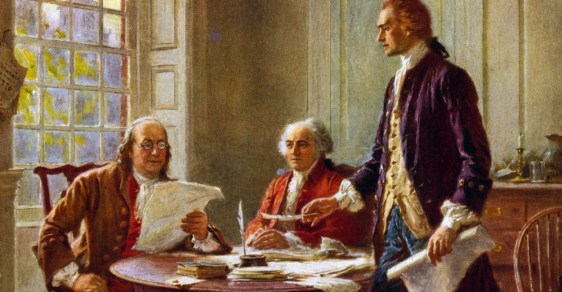
The reasons why the Civil War was necessary are readily apparent.  The men, who created the country from a collection of separate colonies and wrote our Constitution, were inherently human.  Which is to say, they were imperfect and eminently fallible.  Yes, they made mistakes … huge mistakes.  They made a terrible compromise in the name of creating a constitutional republic.

They allowed the possession of other human beings as property to hold the Southern states of the post-Revolution, pre-Constitution confederation.  And that was just their biggest mistake.  Early American politics were complicated, tenuous, and riddled with figurative minefields.  When examined through the lenses of history, humanity, and modern social consciousness, a lot of modern, current day Americans fail to grasp what the expression “grand experiment” means.
150408_LeeBookReview

It’s important to appreciate the extent to which these early American leaders knew they were imperfect and eminently fallible.  For that reason, they recognized that The People needed to be protected from the vagaries of Government, which in all practical matters is motivated and directed by imperfect and eminently fallible men.  The U.S. Constitution protected the States from the power and the potential for abuse from the National Government.

The Grand Experiment – as described by non-slave holder Alexander Hamilton (pre-Broadway version) – was hardly intended to be THE perfect solution to the many problems and challenges those early American leaders faced in creating a new nation.  The necessity of amending The Constitution almost immediately (i.e. two years after USC ratification) in 10 ways – The Bill of Rights – was proof that blind spots had existed when the US Constitution was written.  The Rights of the Individual – only the white male ones at the time – had to be protected as well from infringements by all levels of Government.

The Civil War was the inevitable solution for the most egregious shortcoming of those Founding Fathers.  Though not all were slaveholders, and an argument could be made that many who did opposed it as an acceptable practice, they were an insufficient number inadequately strong – in influence and political power – to exclude it.

All out war in the end was the only remedy.  And yet, slavery was not the ONLY reason the Civil War was fought.  It was however the BIGGEST reason and the impenetrable barrier to a peaceful solution to several issues!

1-Q4Vx5EgE9OyvIRPEbO7NPA

Foote’s “The Civil War: Epilogue” totaled the casualties of setting right the biggest mistake of The Founders:  640,000 Union, 450,000 Confederate casualties.  200,000 total killed in battle; 365,000 total dead for the Union; 256,000 dead Confederates when you include those who died from disease, unrelated crimes, drowning, suicide, etc.  That’s 620,000 military dead from all causes.  Add in another 470,000 wounded (total both sides) to almost reach 1.1 million total war-related casualties.  And that does not include civilian losses.

I would normally write a good bit more about the book in a blog, but my reading of the third and last volume coincided with the egregious death of George Floyd and the latest rise of the Black Lives Matter (BLM) to such events.  The Floyd death and calls for justice were traumatic enough and certainly understandable.

But then the movement morphed.

FRI.00_03_18_17.Still001

It morphed first into violence and vandalism.  Then avowed anarchist usurped a theretofore justifiable outrage.  It became more about hatred for and retaliation against law enforcement officers; disdain for modern social constructs and government; and a desire to gut American society in favor of certain not-so-grand experiments that have NEVER proved successful in past attempts (e.g. socialism, anarchy, elimination of law enforcement, the overthrow of systems of justice).

As one who admires our history with all its faults, mistakes, and injustices, it’s maddening to see the destruction of monuments to it.  Yes, you can understand the desire of many who want to tear down statues to slave holders; their sympathizers; and their military protectors … as much as I might disagree.  Such reactions are an insult to the our history, warts and all.

If humans cannot achieve perfection, what they create can never be perfect.  Change will ultimately be necessary; and some of that change will be bloody, violent, destructive. How does one learn from history, and prevent the reoccurrence of destructive change, by removing all monuments and remembrances?  How does that help to prevent history’s repetitive inclinations?

Foote’s epilogue contains a quote that appears surprisingly pertinent to recent events. Anaximander, an ancient Greek philosopher, once stated:

“It is necessary that things should pass away into that from which they are born.  For things must pay one another the penalty and compensation for the injustice according to the ordinance of time.”

Ea7Y0hwUYAAFdg7

U.S. Grant helped end the Confederacy threat

No stretch of consciousness should dismiss such a concept.  At some point all our acts will be subject to human judgment through the prism of time and the evolution of Man’s thinking as expressed through social mores and their behavioral expression.  Certainly slavery would fit that suggestion.  Judgment of it as one of the bleakest points in the American Experiment is undisputed.  Those that fought to preserve it as tradition, economic essential, or evolutionary dictate paid the physical price 160 years ago.  But we cannot ignore that the emotional scars and even some social behaviors (i.e. racism) remain to this day.

So I can see why removing Confederate statuary would be a comfort to some … or even a political/social imperative.  But there should be a process resulting from consensus and protected by local government for their removal, relocation, or destruction, providing no lesson for history continues to exist.

“… Providing no lesson for history continues to exist” is the crucial thought.  Can we honestly say American society is beyond its racist past?  Are there not still lessons to be learned about what transpired 160 years ago?  How would current and future generations learn from invisible legacy, if all reminders are swept from view?

There’s a difference in suggesting the statue of Bedford Forest, who was a prominent member of the Ku Klux Klan, should be removed for its obvious racist symbolism; but quite another to suggest the statues of Robert E. Lee, Jefferson Davis, or James Longstreet offer nothing of value in the way of historical or military lessons.  What do we learn from the past, if we erase all physical evidence of its existence?

In this the anarchist, anti-American factions betrayed themselves.  They went far beyond righting the wrongs of racial suppression.  When you cannot tell the difference – or more accurately don’t care – between Robert E. Lee and U.S. Grant or Abraham Lincoln, you allow us to glimpse the true purpose of your “protest”.
800

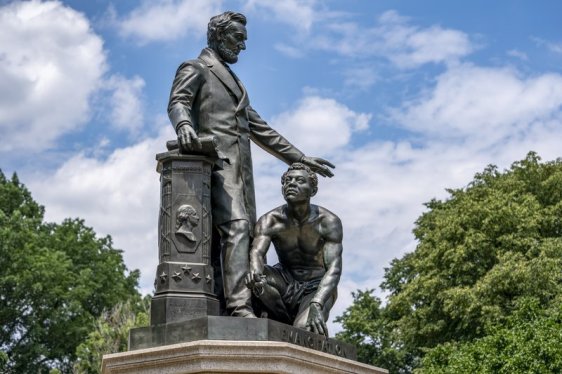
Freedman’s Memorial:  On Lincoln’s first visit to Richmond after its fall in the Civil War, he told former slaves, who bent knees to pay homage to him, to stand up; to kneel before no man; and to kneel only before God.  It was paid for entirely by former slaves!

It’s easier to understand the visceral reaction of the black community to the death of Floyd.  But in essence that movement was usurped by those with broader motivations as we have seen before.  There is no interest there in making America a better example to the world at large.  They simply want America to die with no regard for all the good the country has accomplished since 1776.

This happens not because they cannot grasp the inherent fallibility of 18th century man or credit the foresight they displayed by even attempting such a Grand Experiment!  They simply hate the fact that the system created 230 years ago requires they appeal to The People to make a difference.  Not just some people, but all The People.  They hate that they have to work hard to convince us that their insight is superior, let alone whether such insight offers a better world.

They don’t want to work for it.  They want to convince you to destroy it.  They want to be able to convince you without offering even the remotest idea of what those changes would look like.

For those reasons alone, you know their ideas are bankrupt!


The Irish Catholic Hajj Lived

The trek towards Middle America is daunting in an Econoline van, 700 miles and 11 hours long.  Yet the draw for a 17-strong contingent of Philadelphia area products from the Roman Catholic Church and school systems is irresistible, as witnessed by a core group that has made the South Bend trek to University of Notre Dame football games 17 times now.  

The underside of an obscure card table, inscribed with the names of past participants documents the participants from year-to-year.  Those making the Hajj for the first time dutifully add (R) to their names to signify their rookie status.  We also made habit of marveling at the precision organization, courtesy of Major General (Honarary) Edward Brady (Father Judge ’74), and execution.  Staying out of the way – unless called upon – for fear of ruining the mojo.

The group was not nearly as rowdy as might have been – and probably was – years ago.  Then again most of use are on the downhill side of 50 or below sea-level of 60!  It does seem to mute the wackiness.  The one exception being the call to “Huddle up!!” by Staff Sargeant (Hon) Lenny, a call to imbibe shots of intestinal fortitude.

You learn to celebrate Life more managably as you grow older.

Friday was for a tour of the Notre Dame campus, steeped in history not limited to football.  As a Philly guy, never quite bitten as badly by the ND bug, hearing the story of John Cardinal O’Hara (former Philadelphia Cardinal of the Archdiocese and President of Notre Dame) next to his marble crypt is one example.  The Battle of Gettysburg story of Reverend William Corey, steadying New York’s Irish Brigade in the hours before their date with Destiny at Little Round Top and the wheat field, is quite another.

As for the football experience, the pageantry and loyal following the Fighting Irish inspire is evident at every venue.  For me, the excitement generated by the Notre Dame Band of the Fighting Irish, on Friday particularly with the horn section warming up the crowd inside The Rotunda was simply spectacular!


.

Saturday, the focus was FOOTBALL … not to be overshadowed by perhaps the nicest stretch of weather shining down on the Best Tailgating Experience ever!  (OK … Honestly the guy with the satellite dish and 40+ inch screen might have an edge here.)  It’s difficult to imagine a better day.

The Miami of Ohio – Notre Dame game was anticlimactic, given the obvious talent gap and the Irish’s ability to step on Miami’ s throat in the 1st Quarter (Final: ND 52 – Miami 17).  But the highlight truly is that there’s much, much more to enjoy at the Notre Dame Football experience than just a lopsided victory!

.

View of our rental’s backyard in the vicinity of the University of Notre Dame

Ponder the true purpose of Memorial Day

On Friday, May 22 I will strap my golf bag to a noble electric steed (i.e. golf cart) and spend four non-productive hours chasing a small, dimpled ball over hill and dale in a contest against Nature, technology, and my inner golf demons.

memorial-dayOn the same date in 1863, 79 Union soldiers would earn the Congressional Medal of Honor in what would be called the “forlorn hope” of a volunteer storming party attempting to breach the Confederate defensive works surrounding Vicksburg, Mississippi.

The plan, ordered by Union General Ulysses S. Grant, required the building of a bridge over a moat and the placement of ladders against the heights surrounding the town in preparation for the main attack which was to follow. Knowing the odds of survival were minimal to non-existent, only single men were asked to volunteer.  Despite this knowledge twice the needed number of volunteers stepped forward.  Many were turned away.

After being pinned down by Confederate fire in the ditch they were to cross, the party unsuccessful in their forlorn hope was unable to withdraw until nightfall.  Of the 150 men who made up the storming party, nearly half were killed.

On Saturday, May 23 I will cut the lawn; plant my usual late May impatiens; and perhaps finish off my piecemeal effort to mulch all the flower beds.

USS Squalus

USS Squalus

On the same date in 1939, the submarine U.S.S. Squalus suffered a catastrophic incident while conducting a “crash test” off the Isles of Shoals.  The crash test, designed to simulate the sudden dive of a submarine to avoid enemy detection, went horribly wrong.  A valve used to supply fresh air to the boat’s diesel engine was mistakenly left open.  The aft torpedo room, both engine rooms, and the crew quarters were immediately flooded. Thirty-three (33) survivors rushed to the forward compartments and awaited a rescue they had little hope of seeing.  A sister sub coming out of Portsmouth found the boat’s telephone buoy, and 40 hours later they were rescued.  Twenty-six (26) sailors drowned in the initial flooding.

On Sunday, May 24 we will take the three-hour trip near Williamsport, PA to visit our son, his wife and our first granddaughter, Harper.

On that date in 1968, 75 U.S. servicemen lost their lives in Vietnam.  To be honest, I could not find sufficient information to do justice to those who died that day in a land far, far from home. So I will simply list their names.

  • JOE E. ALLEN; Bay St. Louis, MS
  • MICHAEL F. ANDERSON; Evanston, IL
  • FREDERICK V. ARENS, JR.; Boston, MA
  • CLARENCE J. BALDWIN; Cherry Valley, NY
  • STEPHEN L. BEAN; Saco, ME
  • JAMES P. BIRKS; Pattotomie, OK
  • JAMES D. BOWERS; Johnson City, TN
  • MICHAEL J. BURKHART; Chicago, IL
  • DONALD B. BUTTON; Charleston, SC
  • FRANCHOT T CALHOUN; Anniston, AL
  • RICHARD A. CARLSON; San Franscisco, CA
  • RICHARD CARRILLO; Los Angeles, CA
  • DWIGHT W. CARROLL; Springfield, TN
  • WILLIAM E. CASSIDY; Baltimore, MD
  • CLINTON CHAPMAN; Newton, MS
  • CHARLES M. CHESSHER; Crestview, FL
  • JERRY M. CHITWOOD; Washington, OK
  • GEORGE W CLARK; Lakeville, CT
  • JOHN C. COLLINS; Moorehead City, NC
  • THOMAS C. CONNOLLY; Chicago, IL
  • RONALD J. COOK; Phoenix, AZ
  • KEVIN CORCORAN; Garwood, NJ
  • DAVID W. CRAWFORD; Grants, NM
  • RONNIE J. DAUGHERTY; Newcombe, TN
  • JOSE DAVILA; Chapman Ranch, TX
  • MICHAEL L. DEANE; Westfield, MA
  • ANTHONY A. DISCEPOLO; Cleveland, OH
  • MELVIN DIVENS; Chicago, IL
  • FRANK G. EAVES; Atlanta, GA
  • ROBERT A. FEDEROWSKI; Lansing, MI
  • RICHARD C. FINA; Hudson, WI
  • WALLACE A. FORD; Huntington, WV
  • GARY D. FOX; Sheridan, WY
  • RONALD L. FRAZER; Cambridge City, IN
  • JEFFERY A. GOSS; Oren, UT
  • ROBERT A. HAYDEN; Bridgeport, WA
  • LYNN G. HIEBERT; Thief River Falls, MN
  • JERRY L. HILBERT; Louisville, KY
  • JERRY J. HILL; Minneapolis, MN
  • DAVID A. JACKSON; Tulare, CA
  • JOSEPH M. KAMINSKI, JR.; Wilmington, DE
  • DALE D. KENYON; Sioux Falls, SD
  • WILLIAM E. KNOX; Canton, OH
  • JOHN G. KOMERS; El Monte, CA
  • AL R. LEWIS; Memphis, TN
  • PAUL LEWIS; Saugerties, NY
  • JOSEPH D. MACK; Prairie Point, MS
  • GEORGE E. MASSIE; Clear Spring, MD
  • LARRY R. McFADDIN; Paintsville, KY
  • RUSSELL A. MICHALKE; Saline, MI
  • LARRY D. NOVAK; Platt Center, NE
  • GERALD T. PARMETER; Cazadero, CA
  • JOSEPH J. PASSAVANTI III; Park Forest, IL
  • GARY L. PATTERSON; Seattle, WA
  • ROBERT M. PAULK; Vallejo, CA
  • GARY W. PURCELL; Torrance, CA
  • LAWRENCE G. RENO; Cincinnati, OH
  • HU B. RHODES; Shelbyville, TN
  • GLOUSTER RHYNES; Fort Pierce, FL
  • LARRY L. RILEY; Midwest City, OK
  • EMMETT RUCKER, JR.; Wichita Falls, TX
  • GERMAN A. SANTIAGO; Hato Rey, PR
  • HERBERT E. SCHMIDT; Kansas City, MO
  • JAMES L. SHANKS; Freeport, NY
  • RONALD J. SHEWMAN; Los Angeles, CA
  • MICHAEL A. SMOGER; Two Harbors, MN
  • FREDERICK G. STEFFEN; New Baltimore, MI
  • BRENT L. SWABBY; El Monte, CA
  • PAUL R. THERIAULT; Cambridge, MA
  • TOUSSAINT L. TITUS; Fairfield, TX
  • PHILIP G. TURNER; Jackson, GA
  • NICHOLAS S. VRANKOVICH; Beaver Falls, PA
  • DAVID H. WHITEHILL; Newburgh, NY
  • ROGER D. WILLIAMS; Roanoke, VA
  • FLOYD L. WILLIAMS, JR.; Northglenn, CO

On Monday, May 25 I will spend much of the day chilling and perhaps do some light yard work.

On that same date in 1862, 2400 Americans died in the First Battle of Winchester, VA. The battle proved to be an important strategic victory for Stonewall Jackson in his Shenandoah Valley campaign.

An undersized Union Army formation was forced to flee the town of Winchester, VA, which had been outflanked by Jackson’s defeat of the Union garrison at Front Royal, VA. The battle was one of many smaller conflicts during The Civil War that do not receive the attention of the larger, more notorious battles in the War Between the States.

Regardless of how one feels about the goals and motivations of the Confederacy, one must keep in mind that all who died had been Americans, and their sacrifice helped define what the United States of America would become in the decades to follow.

On Tuesday, May 26 the long Memorial Day holiday will be a wistful memory as many of us head back to work.  I will cheat a bit here to include one more memory in salute to those World War II veterans that are leaving us in sad, alarming numbers every week.

On May 26, 1942, Admiral Nagumo’s 1st Carrier Fleet sailed from Japanese waters for Midway Island.  His task force contains the carriers Akagi, Kaga, Soryu and Hiryu with two battleships, cruisers and destroyers as escort.  The Battle for Midway Island was fought a few days later, from June 4-7.  The sea conflict occurred just six months after the attack on Pearl Harbor, at a time when the Japanese were largely unstoppable throughout the Pacific.  Three hundred and seven Americans died over those three days (Japanese losses: 3000 men, four aircraft carriers) as the American Pacific Fleet dealt a blow that would in effect end the hegemonic wave surging from Japan.  From that day forward, the tide of war in the Pacific would flow The Allies way.

10404121_10152078664097823_8863390345067128923_n

Now this post is not intended to sour anyone’s Memorial Day holiday, although I have to admit, copying those 75 names from May 24, 1968 was more than a little sobering for me.

No, my intent is to simply encourage you to take pause during the weekend to remember the true purpose of Memorial Day … To remember those who died to birth our Country, to build and shape its future, and to protect that future from forces hostile to the ideals it embraces.

Have a great holiday!

Thoughts for a Memorial Day

memorial-dayAnother Summer is upon us!  As always, the quasi-official start of Summer is marked by the three-day Memorial Day weekend and its rituals of beach days, barbecues, and neighborhood parties.

It is no doubt the most favorite time of the year for Americans from Georgia to Oregon, Minnesota to New Mexico.

As Americans however, it is also important that we take a bit of time during what looks to be a glorious weekend in the greater Philadelphia area to remember the meaning of Memorial Day, a day set aside to honor the sacrifices made by thousands and thousands of citizen soldiers since the founding of the United States of America in 1776.

Common people – not unlike many of us – chose to leave families, to forego careers, and to risk the opportunities that a full and vibrant life offers in order to preserve those same possibilities for their fellow Americans.  It’s a Choice many of us, be it through luck or timing or fortuitous periods of peaceful coexistence, may never have had to face.

This post is dedicated to those who faced the danger, to the sacrifices they made, and to the loved ones they too often left behind.

There but for the Grace of God …

.

One Congressional Medal of Honor posthumous recipient only recently returned home after 50 years lying in a North Korean grave.

Army Lt. Col. Don C. Faith Jr.

Army Lt. Col. Don C. Faith Jr.

Army Lt. Col. Don C. Faith Jr. of Washington, Indiana

At the time of his death, Faith and his unit — 1st Battalion, 32nd Infantry Regiment — were attached to the 31st Regimental Combat Team as it advanced along the eastern side of the Chosin Reservoir in North Korea.

During attacks by the Chinese People’s Volunteer Forces, Faith assumed command with his supervisor missing, and he continuously rallied his troops, personally leading an assault on an enemy position.

He was seriously injured by shrapnel on Dec. 1, 1950, and died a day later from those injuries. However his body was not recovered by U.S. forces at the time.

In 2004 a joint U.S.-North Korea team returned to the spot where Lt. Col. Faith was last seen and recovered his remains.  He was returned to his family and interred on U.S. soil just this past April.

.

Throughout American military history, there have been 15 Congressional Medal Honor recipients who earned The Medal for actions taken on the date May 27th.  Eleven of those 15 Medals were awarded during the American Civil War, five of which were earned by crew members aboard the Union ironclad U.S.S. Cincinnati when the ship was shelled and sank during a maritime assault on Confederate gun emplacements in the Siege of Vicksburg, Mississippi.

.

U.S.S. Drexler (DD-741)

U.S.S. Drexler (DD-741)

On May 27, 1945 – Okinawa, Japan – American forces attacking southward, continue to encounter heavy Japanese resistance. Japanese aircraft begin a two-day series of strikes against the Allied naval forces around the island. The destroyer U.S.S. Drexler is hit by two kamikaze planes and sinks so quickly 158 sailors are killed.

.

One particular Medal of Honor recipient from the Vietnam era caught my attention for his selfless bravery.

CHARLES CLINTON FLEEK

Rank and organization: Sergeant, U .S. Army, Company C, 1st Battalion, 27th Infantry, 25th Infantry Division. Place and date: Binh Duong Province, Republic of Vietnam, 27 May 1967. Entered service at: Cincinnati, Ohio. Born: 28 August 1947, Petersburg, Ky.

UnknownCITATION:  For conspicuous gallantry and intrepidity in action at the risk of his life above and beyond the call of duty. Sgt. Fleek distinguished himself while serving as a squad leader in Company C, during an ambush operation. Sgt. Fleek’s unit was deployed in ambush locations when a large enemy force approached the position. Suddenly, the leading enemy element, sensing the ambush, halted and started to withdraw. Reacting instantly, Sgt. Fleek opened fire and directed the effective fire of his men upon the numerically superior enemy force. During the fierce battle that followed, an enemy soldier threw a grenade into the squad position. Realizing that his men had not seen the grenade, Sgt. Fleek, although in a position to seek cover, shouted a warning to his comrades and threw himself onto the grenade, absorbing its blast. His gallant action undoubtedly saved the lives or prevented the injury of at least 8 of his fellow soldiers. Sgt. Fleek’s gallantry and willing self-sacrifice were in keeping with the highest traditions of the military service and reflect great credit on himself, his unit, and the U.S. Army.

.

The purpose of these posts during our most American of holidays is not to spoil the mood of a dawning Summer or to lay guilt at the feet of those of us who benefitted from selfless acts in far, far away locales.  It’s simply a reminder that as you enjoy your long weekend, take a moment or two to reflect on those – both living and deceased – who have made good times and fun weekends possible.

Lifting-an-Inflatable-Tank-620x412In closing I leave you with a happier story.  It’s about a group of soldiers in World War II, known as The Ghost Army, whose actions were purported to have saved many American lives in the lead-up to the invasion of Normandy, France and later in battles across western Europe

These soldiers were responsible for the creation of fake Army units designed to mislead German intelligence-gathering efforts and the tactical decisions that would result.  The unique way in which they were able to deceive enemy strategists was through the use of inflatable forms in the shape of tanks, vehicles, airplanes and artillery.

Although there is no definitive way to determine how many Allied soldiers might have been spared over Ghost Army efforts, one would conclude that the efforts German units undertook to destroy what amounts to an Army of Balloons, including artillery bombardment and air attacks, certainly had the desired effect on enemy decision-making!

And with that, I send wishes for a glorious Memorial Day weekend!

On Bravery, Honor and Commitment at Gettysburg

My eldest son and I just spent a day-and-a-half exploring the Battlefield at Gettysburg, PA.  This was a very typical Guys Weekend, doing the things we enjoy or simply find interesting and provocative.  We spent Saturday in Washington, D.C. witnessing the Phillies lose to the Nationals on our first visit to Nationals Park.  On Sunday we drove out to Gettysburg.

Historic-type excursions were not something we did much when the kids were young.  It’s difficult to justify dragging three children through an age-old battlefield when you’re the only one who finds it “interesting and provocative”.  The kids and the wife get bored; you feel rushed and more than a tad selfish; and it ends up not being a very enjoyable time for anyone.  Yet I was embarrassed by the fact that I had never visited Gettysburg, despite living in Pennsylvania my entire life.

Recently Mike Jr. started reading up on Civil War history; something I did somewhat intensely around 10 years ago.  Suddenly we had a new and fascinating subject on which we could talk and share opinions, insights, and information.  A few months ago, we agreed to visit the Gettysburg National Military Park together.

George Gordon Meade

The Battle of Gettysburg was the largest land battle ever fought on the North American continent.  Fought during the Civil War, it was a major turning point in Abraham Lincoln’s heroic efforts to preserve the Union of the United States.  Over 165,000 men converged on Gettysburg in late June 1863 in a dance of movement and counter-movement with which both armies were well acquainted.

Although there were no plans to engage at Gettysburg (Jubal Early‘s Confederates had raided and left Gettysburg days earlier.), the vagaries of war, where many men under different commands spread out over a wide area, resulted in a dramatic confrontation that lasted three days.  All that was needed to set off the conflagration was the rumor that Gettysburg had a supply of shoes, a cherished commodity for the often shoeless men of the Southern Armies.

General George Gordon Meade led the Union’s Army of the Potomac despite having been promoted from his Corps command to replace General Joe Hooker just three days before the battle.

The combined engagements were the bloodiest of the Civil War.  Over 7000 men were killed, over 33,000 wounded.  And almost 11,000 were listed as missing or captured.  Yet despite fighting that surrounded a well established town of 2400 people, only one civilian was killed.  Mary Virginia Wade died when a stray shot ripped through the door of her sister’s house.

When we arrived at the National Park, we headed out to visit the sites of the first day’s battles, all the while reliving scenes from the well-known historically based movie Gettysburg.  When you begin to get an overview of the battleground, you begin to realize the size and scope of the event.  Those of us without military experience fail to appreciate how much ground is involved in a major military engagement.  The depth and breadth of space required to accommodate major armies is truly impressive.

George E. Pickett

But the true magnitude of what occurred in Gettysburg in that hot, humid July in 1863 does not hit home until you visit the sites of fighting that occurred on Day 2 and Day 3.

Since we were saving the bulk of the Day 2 fighting (particularly Little Round Top and Devils’ Den) for our second day, we decided to take the walking tour of Pickett’s Charge (also known as Longstreet’s Charge), as provided by a National Parks Ranger.  If you ever have the opportunity, this is a great way to get both an overview of events as well as insights into the small individual feats and personal stories that underscore the drama.

As we stood on Cemetery Ridge looking west towards Seminary Ridge you suddenly realize the difficulty of that final charge made by elements of Longstreet‘s First Corps (Pickett in charge with Andrews’ and Pettigrew’s Divisions).  Across roughly a mile of wide open ground, exposed to artillery and then musket fire along the entire route.

Nowhere to hide, few places to take cover, against Union forces behind low reinforced battlements on high ground with undisputed command of the field and unobstructed fields of fire.  The dedication, courage and sense of honor necessary to march into that Field of Death is – simply put – unimaginable!

James Longstreet

Regardless of your views on the Confederate struggle, you cannot help but be awestruck by the bravery demonstrated that day by those wearing the ragtag uniforms of the Army of Northern Virginia under the command of Robert E. Lee.

At times I have found myself embroiled in heated discussion about the legitimacy of the South’s struggle. Not from the viewpoint of defending slavery, but in trying to place into perspective the role of everyday Southern farmers, artisans, college students, and back woods folk who did not own slaves themselves, but believed they were fighting to define their Right to Self-Determination.  Their allegiance was to their State as their Country at a time when the U.S. of A. was still trying to define itself as a Country of States.

Too many people want to boil it down to the preservation of slavery as the only motive behind The Civil War.  But that’s an over-simplification.  There were other issues at stake …  a strong centralized government vs. a weaker national presence in favor of strong, independent States; the economic interests of the agrarian South (slavery) in the face of a more populous, industrialized North; the Right of individual States to come and go as they chose, depending on their agreement with National policies and actions; and the State Nullification of Federal Laws when States disagreed or were disadvantaged by said laws.

Both sides in the conflict were pushed to war by fiery speeches and political posturing that portrayed “the other side” as threats to the existence of the other.  In the end, it was mostly the common man who paid the price on blood-soaked fields defending their homelands or in not-so-distant sister States.

Our second day was spent on a paid two-hour car tour led by an elderly gentleman named John Everude.  For a reasonable $65 (not including tip) we received an interesting and enthusiastic overview of the entire three-day battle as well as events leading up to the largest land battle on American soil.  This is well worth the price should you ever decide to visit Gettysburg.  (Reservations must be made at least three days prior to your visit.)

We spent the rest of the day exploring the sites of the Day 2 battles at Little Round Top, Devil’s Den, the Wheat Field and Peach Orchard.  We visited the site of the 20th Maine‘s heroic stand and bayonet charge down Little Round Top as made famous in the aforementioned movie, Gettysburg.

Joshua Chamberlain

When you walk and gaze upon a terrain broken by boulders the size of cars piled atop and massed together in the low-lying Slaughter Pen and along the heights of Devil’s Den, you acquire an appreciation for the hardships both sides faced as they struggled to control the far left segment of the Union line, as it was attacked by Longstreet’s Corps.

Mike and I marveled at the terrain held by the Joshua Chamberlain‘s 20th Maine and over which it executed its bayonet charge against John Bell Hood‘s 15th Alabama Regiment.  You cannot imagine how the 15th charged up that rugged hill, let alone how the 20th Maine could possibly have charged down it!

It’s only when you walk this ground that you realize it’s impossible to comprehend the Bravery needed to Honor one’s Commitment to Country and to comrades.  Yet these men did it to the ultimate betterment of us as a People and as a Country.

Friday musings …

  • The pictures and stories out of the Pacific Rim this morning are both frightening and awe-inspiring.  Nature in its most primal form is downright overwhelming.  Hopefully the people of Japan, familiar with and prepared for deep earth violence, will not suffer huge losses; will get all the necessary assistance they will need from the international community; and will bounce back quickly. 
  • Been checking in with my brother, who lives in Long Beach, CA, on the progress of the tsunami.  Was a bit apoplectic when he texted me saying he was sitting in the parking lot of the marina!  Fortunately at the time he had a few hours to kill before the lot might become a lake.      
  • Made The Philadelphia Inquirer Letters to the Editor on Wednesday with a message about Lincoln’s struggle with slavery.  Always nice to see one’s name in print!
  • Courtesy of Kim, who e-mailed me on the above letter … If you haven’t discovered The New York Times series Disunion, a day-by-day accounting of the news and reportings on The Civil War and the months building to Fort Sumter, you should check it out.  Any history nut would LOVE this retrospective.  I just started trying to catchup with the series that started in October, and already I’m hopelessly hooked!
  • Another neat website, stumbled upon via the NYT Disunion series, is this for the Architect of the Capitol.  The site provides virtual tours of D.C. buildings, a commemoration of Lincoln, and education on the National Hall’s collection of statuary.
  • The crocuses are popping through the chilly soil and our Phillies tickets arrived in the mail!  Spring must be right around the corner!!
  • My oldest son, a Millersville University student, sent me a Facebook message in semi-jest that he was going to bill his mother and me for the added costs on his future tuition because we supported Tom Corbett, Pennsylvania’s new governor, who announced significant reduction in education subsidies for the next state budget cycle.  Of course being the good liberal my son is, he neglected to mention that the only reason his recent college costs had been mitigated is the fact that education in the state had been subsidized by the stimulus packages granted by the federal government.  Since that financing is no longer available, Pennsylvania education subsidies are simply returning to 2008 levels.  My no-jest response was that he could deduct the costs from his drum corps bill, which was in the thousands for the three years he competed. 
  • By the way, he’s currently vacationing in Punta Cana.  And I’m sitting here … in chilly, wet Pennsylvania! 
  • After my recent rant about my inability to enjoy no boundaries, no limits jazz, I found it quite possible to enjoy Yusef Lateef’s album, Eastern Sounds.  Of course it did have a bit more in structure and boundaries than did Wynston Marsalis.

Was slavery the only issue in U.S. Civil War?

The following was written as a letter to the editors at The Philadelphia Inquirer in response to several letters (See fifth letter down.) in the past week or so protesting commemorations of The Civil War as “glorifications” of slavery (i.e. commemorations in the southern U.S.).

I really do not understand all the sudden angst over observances related to the American Civil War.  I do not understand the insistence on framing the war totally within the context of slavery.  Anyone, who has taken the time to study the development of the American experiment through the 18th and 19th centuries and the origins of the hostilities that broke out in 1861, recognizes that slavery was not the only issue that defined the war.   

The American republic had many more issues before it than the horrors of slavery.  The questions of states rights, the strength of a centralized federal government, the interests of agrarian vs. industrialized economies, even the success of a Lincoln-led administration were all factors of immense national interest at stake.  As such, both the North and the South had legitimate vital interests in the conflict that went beyond the insidious practice of slavery. 

Slavery as the only issue related to the war does not explain Lincoln’s own admission that he would have resolved the conflict – if he could – without freeing a single slave.  It also does not account for the fact that hundreds of thousands of poor, non-slave owning Southerners fought willingly against the overwhelming advantages of the North.  The fact is that hundreds of thousands died in that war with no stake on the issue of slavery.  Many of them unemployed immigrants fighting for the North just for money to survive in a new world. 

There is no reason to restrict “glorification” of a preeminent event in American history solely to the issue of slavery.  To do so dismisses so much more that can be learned about how the United States stayed a united nation and the experiment continued on its epic journey.  

Mike —-

 All the angst seems motivated by the fact that the wrong people – Southerners – might want to commemorate an event that was also crucial to the history and development of that region.  Not to mention the fact that hundreds of thousands died there also, many of them dirt-poor farmers who did not own and could not afford slaves.

This is so much more about Liberal guilt over American history than it is any attempt to put that event into its proper historical context.