Cranky Man’s Lawn ’13: Following up on a good Spring

photo 2

When the plan comes together just right, the payoff can be very rewarding.  If you have performed all the recommended treatments, your lawn might look like mine … The Best it has looked in years!

All the Spring lawn projects have been completed, including a long overdue aerating and a seed ‘n feed in one troublesome area in the backyard.  Mother Nature has cooperated with a run of cool, sunny weather and just enough rain to keep the momentum on the growing.  The lawn is quite remarkably absent of any weeds.  The turf is thick, long and a healthy dark green.

Enjoy it while you can before the heat of Summer begins its attack!

The one promise you can always count on when it comes to lawn care is that there is always something else to do … especially in Spring … especially when Summer is right around the corner.

If you have visited Cranky Man’s Lawn in the past, you might recall tirades of mine about a good lawn in the Spring is only half the battle.  My buddy, Bob, still gives me grief about a post a few years ago by reminding me – when I speak loftily about my Spring turf – that “Everyone’s lawn looks good in April!

True that is, even for May!

I won’t belabor all the points made previously.  You can indulge yourself here  or here …

What I can do is summarize a few keys points …

  • Let your lawn grow longer BEFORE it gets hotter.  Pay attention to the heat index and act accordingly.
  • If you have a contractor cutting your grass, tell him to cut the grass higher.  They will cut it as short as they can in case they miss a week due to inclement weather.

Remember what my grandpappy used to say …

“A fairway in May, will be a runway in August!”

  • If you don’t have an in-ground irrigation system, buy a decent lawn sprinkler and use it.  Watering every 2-3 days, if rain is not in the forecast, can make a world of difference.
  • Don’t discourage over browning grass.  If you let the grass grow sufficiently, the grass-roots will be protected enough – most times – under excessive heat and dryness even if the grass itself looks like death.
  • Pray for rainy days or moderate thunderstorms during the Dog Days.
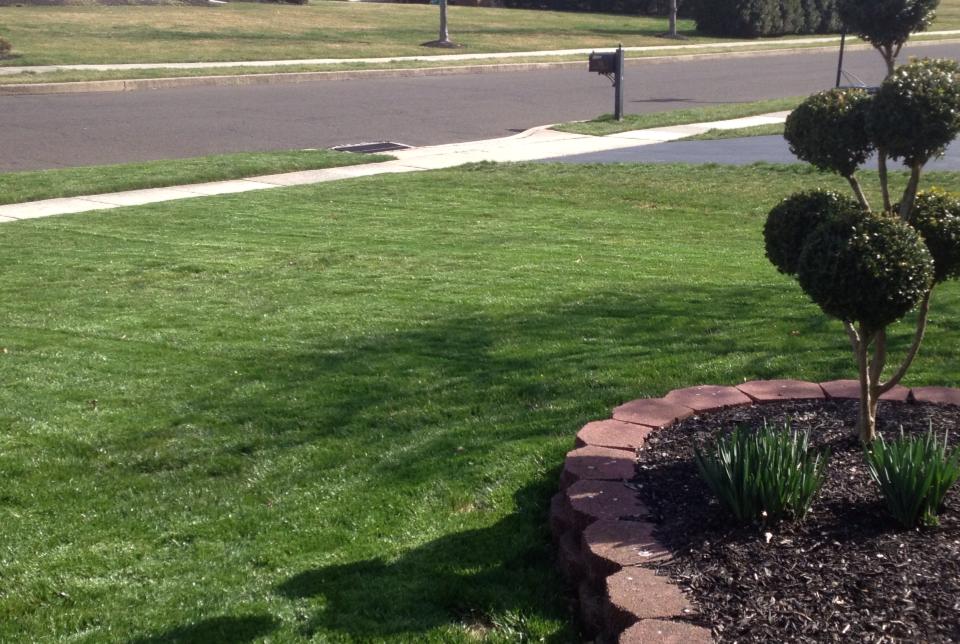
I call this picture  "Shadow of a Cranky Man"

I call this picture
“Shadow of a Cranky Man”

Finally, about now in the my neck of Southeast Pennsylvania, more than a few lawn owners in the Obsessive-Compulsive category are bemoaning the need to bag lawn clippings for their thick, luxurious, rain-fed lawns.  The Solution?  Cut it more often!

OK, probably not The Answer you wanted to hear.

But cutting your lawn every three days, instead once a week, will eliminate the need to bag your clippings (if you have a decent mulching mower and the lawn is not too wet).  It may not sound like much, but it’s a nice change of pace to all that bending, lifting, dumping, moving …

And if you’re working something like the Lose It! app for weight loss …

Hey, 640 calories for an hour-and-a-half of pushing the grass eater!

Horsham’s Big Wait

Horsham LRA Redevelopment Plan - Plan D

Horsham LRA Redevelopment Plan – Land Use Plan, Option D

Over a year has passed since the Horsham Local Redevelopment Authority (HLRA) completed its first major tasking in deciding the future of the 862-acre question mark formerly known as the Naval Air Station-Joint Reserve Base Willow Grove (located entirely within Horsham Township, Montgomery County, PA).

As someone who took a rather vocal interest in the potential future of the airbase – particularly its runway and the possibility of an airport – I decided it’s time to see where we are in the process and to take a gander at the base’s admittedly murky future.

The HLRA effort resulted in the submission of a redevelopment plan intended to demonstrate to the Federal Government the recognized Local Redevelopment Authority‘s ability to take charge and execute a plan for the base’s property that would address the needs of the surrounding community.  It’s important to note that any local government entity or planning organization could have applied for LRA status during the initial stages of the Base Realignment and Closure (BRAC) process.  Horsham residents should be mindful that smart local leadership jumped at the opportunity to form the Horsham LRA organization and preserved local control over those decisions that will shape the property’s future.

Where are we now?

For the year that has passed since the HLRA submitted its redevelopment plan all meaningful action has been in the hands of the U.S. Navy as it gathers data; analyzes the work of the HLRA; and prepares an Environmental Impact Statement (EIS).  The EIS is intended to promote informed decision-making on the part of the Federal Government when it comes to actions that will affect local communities.  The EIS is intended to set forth the positive and negative effects of any redevelopment decision through the detailed analysis of several scenarios.

imagesFor this reason the EIS – in the case of NAS-JRB Willow Grove – will look at four potential versions for redevelopment of the property.  In addition to the 1) HLRA-approved version, it will also evaluate 2) a denser version of the HLRA plan; 3) the pros and cons of doing absolutely nothing with the property; and 4) the locally unpopular potential of employing the runway and former base as an airport.

For those like me, who oppose an active private/commercial airport in the middle of Horsham, that last alternative might sound a bit alarming.  However, the EIS is intended to address all reasonable versions of redevelopment in one comprehensive evaluation.  Therefore, the EIS will have to address the broadest range of redevelopment options, including its use as an airport.  This does nothing to change the official HLRA position that an airport is out of the question.

Do not mistake an Environmental Impact Study as one limited to the impact of hazardous waste dumping on the ecological environment.  An EIS will certainly deal with those ecological issues.  More importantly, it will also address the social and economic impacts on the community of future business and residential development, the addition of roads through the airbase property, and any potential impacts to threatened species or historical sites (if applicable).

What does all this mean (Part 1)

First and foremost it means that this EIS process will take a very long time to complete.  As anyone who has dealt with or worked for the Federal Government knows, EVERYTHING takes a long time; and naturally, the timeline gets longer in direct relation to the complexity of the task.

Back in December 2012 the BRAC Program Management Office Northeast held a public presentation on the EIS process, where community comments and questions were solicited.  At that meeting the BRAC PMO estimated that it would take 12-18 months to complete the study.  Translation: Maybe they will complete it in 18-24 months … if we are lucky.  My expectation is not to see the EIS completed until sometime in 2015.

That’s not intended as a knock on the BRAC PMO’s office.  It’s more a recognition of just how complex and necessarily time-consuming a study of this magnitude is.  It’s also an acknowledgement that a study of such importance really should be as complete, as thorough, and as well-documented as possible.

What does all this mean (Part 2)?

The Government’s timeline – of course – directly impacts the HLRA’s ability to move forward on development of the base property, since no action can be taken until such time as the Navy officially disposes of the property.  The Navy has the option – once the EIS is completed – to negotiate grants of the conveyances included in the HLRA redevelopment plan or to attempt to dispose of the property themselves.

More on that later, but suffice it to say, that this will also take a good bit of time to complete.  And in the meantime, no one will be allowed access to the base who are not there with the express approval of the U.S. Navy.

You can't get any more Horsham than this!

You can’t get any more Horsham than this! (Photo by Geoff Patton for Montgomery Media)

The point here is that you can expect to continue to see the airbase property deteriorate … grass growing high; buildings falling apart; roads and fences in disrepair; etc.  These conditions would exist regardless of whether or not Horsham wants to redevelop the base; whether it was allowed to become an airport; or even whether Ed Rendell’s Federal Emergency Management/Homeland Security plan had successfully preempted the HLRA redevelopment.  Applicable BRAC law prevents any non-federal access to the property until such time as the BRAC process plays out completely.

This will not be a pleasant time for the Township or its citizens.  But the issue – insofar as it relates to the physical conditions at the base – are outside the control of Horsham Township or the HLRA.

That’s important to remember if anyone suggests this situation would be different if only Horsham had agreed to turn the base into an airport!  It’s simply not true.  The base would look exactly the same as it does today even if Horsham had fallen for the shortcomings of The Airport Promise!

Those who consider this timeline unacceptable should keep in mind the delays in redevelopment progress caused by then-Governor Ed Rendell’s FEMA/HSA initiative.  Though admirable in the opinion of this Horsham resident, the end effect of that attempt was a significant delay in the BRAC process.

How will all this play out for Horsham?

This is crystal ball time!  There are many, many possibilities and a multitude of permutations resulting from those possibilities.  The quick, dirty answer is that – like most sophisticated, comprehensive plans – if and when the U.S. Navy agrees to convey the property to the HLRA, that detailed HLRA redevelopment plan could very well end up in the trash.

No development can take place without interested developers and the funding to make it happen.  And unfortunately, in its current condition the base has little-to-no value to the Township.  Between the necessary investment in infrastructure (roads, sewage and water, utilities, etc.); the limitations on usage imposed by its status as an EPA Superfund site; the need to raze buildings; and the question of what to do with the runway and tarmac areas, the costs of redevelopment to the Township would be exorbitant.

892 acres of Yet-to-be-Determined

892 acres of Yet-to-be-Determined (BRAC PMO photo)

The HLRA hopes to win approval to subdivide the NAS-JRB property into known-clean vs. known-contaminated sites in order to make those clean parcels more attractive to potential developers by removing the stigma of the Superfund label.

These same issues also restrict the Navy’s ability to sell it directly should they decide to dispose of the land themselves.  This is a common problem with BRAC-designated disposal properties of this type.  In the past, attempts by the military services to dispose of excess lands outside the conveyance to an LRA have met with little – if any – success.

Regardless of all the difficulties and challenges presented by the redevelopment,  Horsham made the correct decision in getting out in front of the NAS-JRB Willow Grove BRAC process.  By doing so, they ensured local community control over the future of a significant portion of Township acreage in a central location with the potential for a huge impact on the community’s future.

No one ever said it was going to be easy or cheap; and certainly no one suggested that it would be quick.  And with a little patience and an appreciation for the complexity of the task, Horsham Township will control the future of the NAS-JRB Willow Grove property and how that future impacts the people of Horsham!

Cranky Man’s Lawn ’13: Cold Spring Stupor

lawn1Spring was still a rumor here in Southeast Pennsylvania up until this past Sunday afternoon.  Yet I remained skeptical until Monday, when I could actually feel Spring’s warm caress on my hair-challenged head without the benefit of three layers of insulating clothing.

Last Spring was recognized as one of the warmest in recent history.  Good if you like warm weather in March, not so good if you’re a climate alarmist.  But there was no problem this Spring worrying about frantic warnings of rising oceans, melting ice caps, and dying forests.  Everybody was too busy trying to keep warm … on Easter Sunday … in Southern Florida …

So, with Spring delayed what’s a Lawn Junkie to do?

For one thing, hopefully you didn’t jump the gun!

Observed several neighbors putting down lawn treatments LAST WEEK!  Way, way too cold for that to accomplish anything.  Few but the hardiest weeds have appeared and crabgrass season was still weeks away.  A little bit of rain and anything that rotary spreader was meant to accomplish was a wasted effort.

Such is the price of not paying attention.

The only piece of data to pay attention to this time of year is ground temperature, not air temp.  The only treatment you should even remotely prepare for – right now – is crabgrass. And it is still too cold for even a pre-emergent application.

Quite possibly, this weekend will be the first where a pre-emergent will be effective.  Look for the blooming of the forsythia!

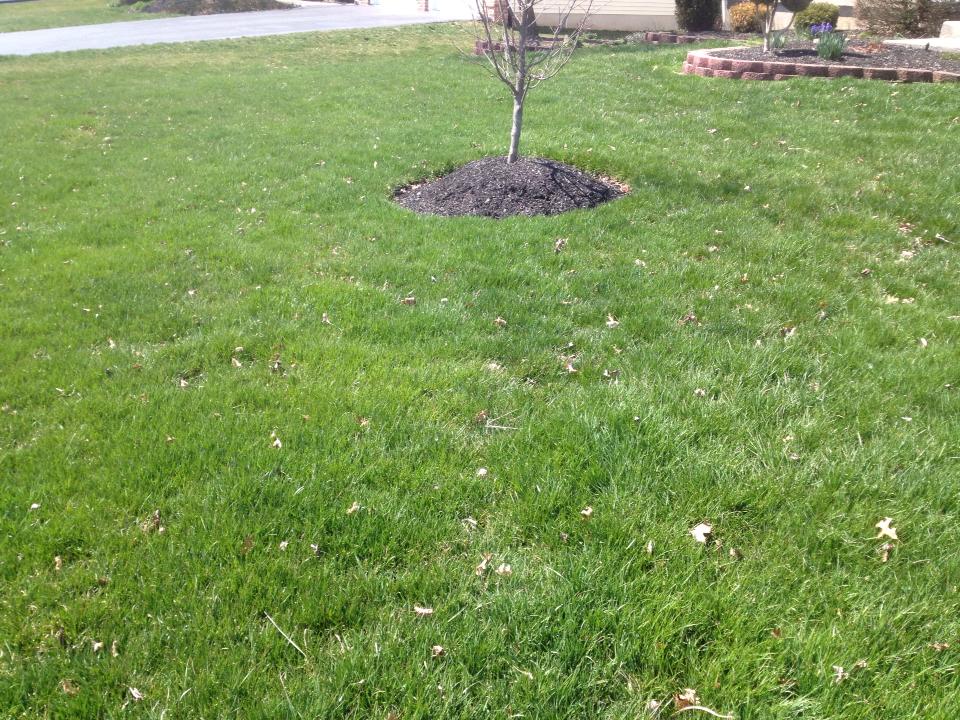
lawn2Get your lawn clean-up done!  This is what my lawn looked like pre-cleanup.  The picture heading this post shows how it looked after three hours of raking, mowing, and trimming.

Found some weed infiltration along the edges of the lawn, which is common since the edges of a well-fertilized lawn is the only place generally where a weed seed can gain a foothold.  It’s best to try to eliminate them early to deny them the opportunity of spreading.

But it’s still too early for an effective weed ‘n feed application.  Let that go until the end of April at this point.  Instead, I expect to find a good weed product in spray form to hit those edge areas where weeds have popped up.

Just make sure whatever product you grab will not affect the grass around it.

602097_628034453876978_1726053180_n

Note brown lawn across street. Just sayin’ …

Cranky Man’s Lawn ’13: Getting a Spring-loaded Start

images-6It won’t be long now.  Warmer temps … Green things popping out from the ground … Spring rains … Trees beginning to bud …

And all that %@#&*?! yard work!

So now’s the perfect time to plan your Spring and Summer lawn program; to consider what changes you might need to make; and to plan the timing of your fertilizing lawn treatments.

If you are forward-thinking, you recognized the need to review your lawns condition last September and October, when the problems would still be fresh on your mind.  If not, just hope your memory didn’t go as soggy as your yard over the Winter!

There were several issues I identified last year with my lawn that I plan to work on this Spring.

Early Spring aerating and over-seeding

One of the problems I noticed was bare spots in the backyard and the usual areas out front that burn to a crisp every year in the Summer sun.  And I must admit, I have neglected to aerate the past several seasons, so I’m overdue for an good aeration and over-seeding.

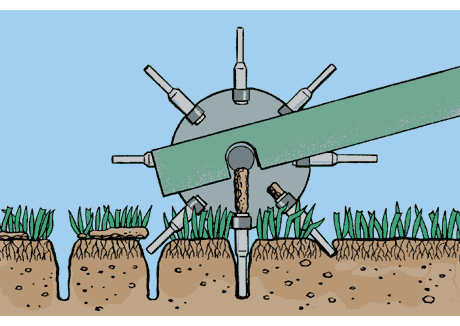
How core aerator works

How core aerator works

Plan to pick a weekend in March or early April when the weather is warm and the ground is still soggy, which makes working with a core plug aerator easier and more effective.  You can aerate in the rain, if it’s relatively warm.  Aerating when it’s cold and raining is not fun.

Pick up a bag of lawn seed, a rye and fescue mix is what I prefer.  Rent, borrow or buy a drop spreader which is more efficient for putting down seed.  Spread the seed after aerating (over-seeding).  But try to avoid dropping seed if it’s very wet.

Don’t forget to water new seedings if we do not get appreciable Spring rains locally.  That would be unusual.  The point is to always monitor rainfalls, especially if you spent the money to throw down seed!

It’s important to note that all advice provided here is the product of an underutilized mind residing in the head of an AMATEUR lawn aficionado.  The tips you are reading are not the result of training, collegiate study, or professional experience.  They are simply the learnings via the trial-and-error method and ad hoc research of a homeowner – located in Southeast Pennsylvania – who is too cheap to pay someone for an effort he was all too willing and able to do himself.  

With those caveats in mind, take what you read here for what it’s worth.  You can always get similar – if not better – advice from your local lawn product supplier.  It just wouldn’t be so full of charm and humor!  

Fertilizing strategy

Drop spreader

Use drop spreader for seed

For the sake of review, I prefer fertilizing at least five times a season:

  • March – crabgrass pre-emergent (optional)
  • April – Spring weed ‘n feed
  • June – crabgrass post-emergent (optional)
  • early July – grub control (optional)
  • September – Fall weed ‘n feed
  • November – Winter feed

Of the six treatments listed I’ll always go with the two weed ‘n feeds and the Winter feeding as a minimum, then pick and choose from the other “optional” treatments.  It’s been a few seasons since I have felt a grub control treatment was necessary.

Watch the timing of your fertilizer treatments, always giving at least 4 weeks – preferably 6 – between applications.

Lately, my recurring issue has been crabgrass, refugees from a bordering lawn, where apparently no value is placed on lush, green lawn-scapes, free of brownish-yellow weeds and assorted alien species.

It’s just one of the crosses I bear every year.
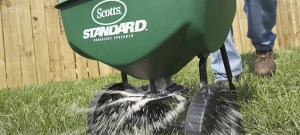
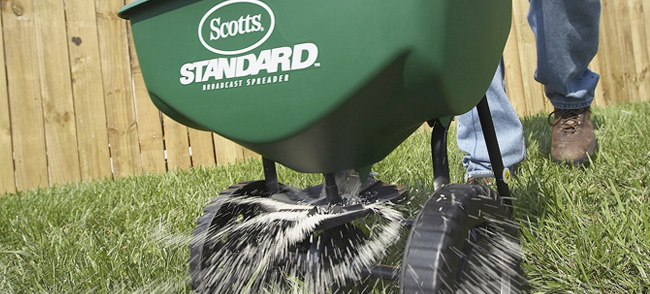
Rotary spreader, best for fertilizing

Rotary spreader, best for fertilizing

The Plan?  Go whole hog on the crabgrass treatments, both pre and post-emergent, to knock down the crabgrass.  This is probably going to be the routine from here on out, unless the neighbors reach a stage of Enlightenment and figure out how to use a rotary spreader!

I’m betting that once again we won’t need the grub treatment; but that’s something that can be decided by observation in May and early June.  You simply look for the Japanese beetles, which have been not been present in sizable numbers in this area (eastern Montgomery County, PA) for several years.

Crabgrass Pre-emergent: Watching the Soil Thermometer

Edited to add:  A casual reader reminded me that applying a pre-emergent after a seeding would retard the germination of the grass seed as much as it would the crabgrass.  

I will take it one step further and caution that any treatment that prevents germination (pre-emergent or a weed n’ feed) should not be applied for at least six weeks after a seeding!

As for my Spring strategies, I will not be applying crabgrass pre-emergent to the same areas I plan to over-seed after aerating.
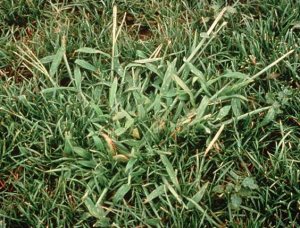
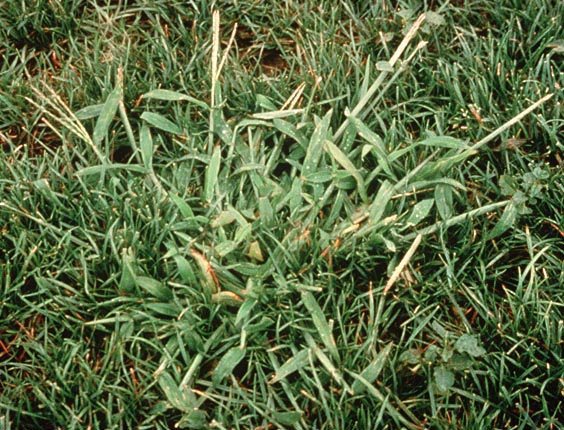
mature crabgrass plant

mature crabgrass plant

OK, whatever you do, don’t run out of the house to buy a soil thermometer!  Yes, they do have them.  But it’s not likely you would use it but once a year, unless you’re really obsessive about keeping the carrots in your garden at a toasty temp.

Anyways, it’s not like pre-emergent temps are a Magical Moment.  You can be off a day or two and the Universe will not implode.  So put the car keys down and keep reading!

Anyways, the issue with applying a crabgrass pre-emergent is the soil temperature during the early Spring when a pre-emergent is best applied.  Soil temps must be over 55°-60° for crabgrass seed to germinate; and since germination is what you want to prevent, you must wait for said seed to be in the process of germination for a pre-emergent to work most effectively.
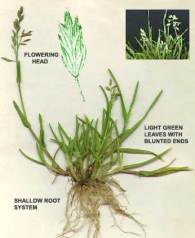
Poa annua

Poa annua

Pre-emergent, which will also prevent the growth of poa annua, retards root growth by forming a chemical barrier in the soil.  (And no, I had no idea what poa annua is until I looked it up … just now!)

Personally speaking, I simply wait until we get at least 3-5 days of air temps above 70°, since the ground takes longer to warm up than the air above it.  You can also watch for the blooming of the forsythia, since that has been traditionally linked to warming ground temps.

Unlike your other weed ‘n’ feeds, crabgrass treatments must be watered into the soil to be effective.  Suggest you watch the forecast and try to apply said treatment prior to a decent rainfall.  If no rainfall occurs after 3-4 days, you should water the lawn to activate the pre-emergent.

obligatory Forsynthia shot

obligatory Forsythia shot

Miscellaneous tips and preps

  • Now is a good time to get your lawn equipment in top working condition.  Start looking into qualified lawn mower repair and maintenance businesses. Compare prices and get your mower in for its seasonal tune up now.  (Or just go to Sears as I usually do.  Sears will usually run a pre-season maintainance special for mowers.)  If you are a dedicated mower or you did not have your mower serviced last year, make sure the service person replaces the mower’s cutting blade.
  • Read up on aeratingfertilizingdethatching, and other lawn-health related topics.  Only you have the best, closest perspective on what your lawn needs.
  • A great source for turfgrass information is the Penn State Center for Turfgrass Science.  These people are THE Professionals!
  • With that in mind, pick a good weather day and complete a walk-around survey of your lawn.  Note bad spots where thinning or bare areas exist. Look for spots where thick dead growth lies just beneath or even blocks out underlying grass plants that might need dethatching.

In short, get ready for another lawn season.  The time you spend and planning today will ensure the biggest dividends from your lawn work all season; and it will give your lawn the best shot at surviving the hottest stretches of the upcoming summer.

One last tip:  If you are on the down slope of Hill 50, consider using this time before Spring to work on your body’s core muscle groups.  Nothing will put you behind your Lawn Schedule like a balky back!

Sequestration: The President’s ugly Child

obamaHow many people realize sequestration, which The White House continually warns will be a “disaster” for the country and its citizens from Arizona to Connecticut, was actually The White House’s brain-child???

Don’t listen to the hype … or the lies.  The sky, if it falls, will not be the sole responsibility of Congress.  Heck, it wasn’t even their idea.

The Public is a pawn in this chess game.  The political pressure being applied by The White House, in the form of Dire Economic Impacts on individual states and even the victims of Superstorm Sandy, is intended to force Congress (i.e. Republicans) – by portraying them as the troublemakers – to cave in so they can pass to the American people an even bigger financial federal budget burden without cutting a single one of the Democrats’ Sacred Cows.

Sequestration was the gamble suggested by then White House Chief-of-Staff Jack Lew (Secretary of the Treasury nominee) and White House Congressional liaison Rob Nabors.  It was endorsed by President Obama before being presented to the Senate Finance Committee, and proposed as a negotiating strategy to Senate Majority Leader Harry Reid (D-Nev) during the 2011 negotiations to raise the National Debt Ceiling.

Certainly House Republicans accepted the sequestration as part of those negotiations, but it wasn’t their idea; it wasn’t their gamble.

It was the President’s idea of “leadership” in difficult political times.  Push it off; deal with it later.  Maybe, just maybe it will go away on its own.

Keep that in mind as you continue to hear about how Sequestration will damage your benefits; your income; your local economy!

Remember it when The President shows up on C-Span or the nightly news speaking about the dangers of sequestration and surrounding himself with Emergency Responders, teachers, healthcare workers, and seniors warning about all the damage the sequestration cuts will entail.

Sequestration:  The President’s ugly child!

Joe Rooney vs. 1% Allyson

Joe Rooney – PA 13th Congressional District

It’s almost over, really it is!  And it’s taking everything I have to write just one more Election 2012 post.  Not sure I can make to the end, but the importance of this election mandates not only a change in The White House.  This election calls for wholesale changes at the Congressional and Senate levels as well!

I have given you my reasonings for both Mitt Romney and Tom Smith for the Pennsylvania Senate race against Bob “Senator Zero” Casey.  Now let’s take a look at the race in the Pennsylvania 13th Congressional District.

I met Joe Rooney in February of this year as he made the rounds of the GOP establishment trying to drum up support for his primary candidacy.  I was immediately impressed by Joe’s honest, straight-at-you demeanor and his grasp of the important issues facing us.  My reaction to his visit and remarks were that he was head-and-shoulders over the entire field that vied for the same primary endorsement in 2010.  There were 5 …. or 6 candidates back then; and none of them seemed strong enough to shine their lights through a brown bag, let alone in competition with Allyson Schwartz.  (Joe Rooney for Congress website)

But all that changed once Joe began laying out his background, experiences (including service to this Country as a Marine pilot flying F-4 Phantoms and F/A-18 Hornets, the mainstay of the U.S. Navy and Marine Corps air fleets), and goals for Congressional service and the interests of PA 13th constituencies.  Like many well-rounded military officers, Joe Rooney had his political game wound tightly and focused.  He has confidence in his understanding of what the Country needs to be successful domestically, internationally, and Economically.

Joe Rooney is an American Optimist.

 “The American economy can be the engine that drives the rest of the world out of the economic hole that currently exists.”   –  Joe Rooney

His message resonates with Everyone, whether you are hard-working mother or father trying to get your take-home pay to at least wave at your Budget, if not actually try to meet it!  It resonates with retirees on fixed incomes, with students who will be out looking for Jobs in the years to come.  Joe’s message will especially resonate with those who have been victimized by an Economy mired in 8% Unemployment, 12.3 million people out of Jobs, mounting debt both National (up from $10 trillion to $16 trillion during the Obama/Schwartz years) and personal.

One thing about Joe Rooney really impressed me.  He was ready to take on all comers to earn the right to face Allyson Schwartz in this crucial election.

Allyson Schwartz swings a big stick when it comes to Democratic competition

Allyson Schwartz of the 1% had an entirely different approach to entertaining an opposing voice in the Democrat primaries.  She very coldly forced one Occupy Wall Street candidate, Nate Kleinman out of the primary race through dirty tricks (making a staff-less Kleinman sit with a team of Schwartz operatives to verify each individual nominating petition) and through financial intimidation (filing lawsuits intended to make Kleinman responsible for the legal costs incurred by the Schwartz campaign).

Not exactly the kind of free and open Democracy we are used to, eh?  Why, it was downright Nixonian!  Yes, Richard Millhouse would be very, very proud!

But that’s what happens when The Queen rules the roost.

Schwartz has benefitted mightily from a wide array of political benefactors in the form of large dollar corporate donors and Political Action Committees.

Schwartz’s funding for the 2011-12 election cycle came primarily from large individual contributors (57%) and Political Action Committees (38%), only 3% came from small individual contributors.  Her biggest corporate and association sponsors include Comcast Corp, Teva Pharmaceuticals, and the American Association of  Orthopaedic Surgeons.  Her top industry support comes from lawyers, health professionals, pharmaceutical and insurance companies.

Not exactly residents of the 99% …

Now no one really knows how the headline political confrontation will end up Tuesday – or whenever the last Electoral College votes get cast; but certainly it’s easy to see which candidate in the PA’s 13th Congressional District is more like you and me!

It’s Joe Rooney for Congress!

Has anyone seen Bob Casey?!?

The only place to find Senator Bob Casey

In Pennsylvania, we’re deeply concerned.  It seems that one of our U.S. Senators is MISSING!!

At first, no one was very concerned.  After all, Senator Bob Casey wasn’t exactly a Public Presence anywhere in Washington, D.C. – let alone in Pennsylvania – for almost the entire SIX YEARS that he’s been Pennsylvania’s lesser light in U.S. Senate.

Go ahead and take a minute … Think back as far as you can over the past six years and ask yourself, how many times you have heard of Bob Casey accomplishing anything for Pennsylvania or anything for the country?  How many times have you heard Senator Zero speak out to you – as Pennsylvanians or as Americans – on the important issues of the day?  What has he DONE during his SIX YEARS in the U.S. Senate?

For comparison look to the public profile of Pennsylvania’s other U.S. Senator, Pat Toomey.  If you pay attention, you will see him cable and TV news outlets, advocating for those programs and actions he believes would improve the country. Whether you agree or disagree with Toomey is immaterial; he is out there putting his reputation and political future on the line!

Senator Zero – The REAL Bob Casey

Bob Casey?  His biggest contribution as a U.S. Senator has been as a Silent Supporter of President Obama’s policies and programs, including Obamacare, the Economy with its 12.3 million people out of work, the National Debt which is up from $10 Trillion to $16 Trillion, and the decisions to “distance” the U.S. from Israel.

Then ask yourself, Where has Senator Casey been on the important social issues of the day?  Issues like women’s choice or gay marriage??  As a devout Catholic, Bob Casey believes Rowe v. Wade should be overturned and is opposed to gay marriage.  Yet a review of Bob Casey’s website shows NOTHING on EITHER subject.

You want to know why you won’t find them?  You won’t find them because Bob Casey knows many Democrats, those who will vote this Tuesday for President Obama, would not normally vote for an anti-Choice, anti-gay marriage candidate!

Bob Casey would rather stay SILENT than take a public stand that would potentially damage his Political Prospects!

.

Tom Smith … Facing the Issues. Bob Casey? Not so much …

Tom Smith is a self-made man, who mortgaged everything he had to create Jobs and Opportunity in Pennsylvania.  He managed several successful Businesses through tough economies in highly regulated industries.

As a fiscal conservative, he wants to simplify the tax code and to reign in out-of-control Federal spending.  As a successful creator of energy jobs in Pennsylvania, Mr. Smith is in favor of developing American energy opportunities to provide jobs for Americans.

Visit the Tom Smith for Senate website to learn more or to make a donation to the American Red Cross for those affected by Hurricane Sandy.  You can also check out Tom Smith’s DETAILED plans for the Country on his issues website.

You may not agree with Tom Smith on every issue; but at least he’s not shy about telling you where he stands!

Then, when you leave the Smith website, take a wander over to Bob Casey’s website for the three-sentence blurbs he provides on the important issues in this country.

Just don’t expect anything on Women’s Rights or LGBT issues.  They aren’t there, and for good reason.

Senator Zero – The REAL Bob Casey

Now ask yourself, is this the kind of Senator Pennsylvania needs?

Knocked cold by Sinister Sandy’s Shoulder

Photo by Colleen Wilson

It’s complacency really.  That’s my defense.  Complacency – along with a side order of impatience topped with boredom – is how I came to post such a silly thing as From the Shoulder of Hurricane Sandy early on Monday evening.  Ho hum … another “Monster Storm” bearing down on the East Coast.

I was so thoroughly unimpressed.

Three days later without electricity, heat, hot water … Creeping towards the edge of Unplugged Insanity … You tend to learn a few things about yourself.

  • You take way too many things for granted.  Could not count the number of times I mindlessly pawed a wall switch expecting the lights to come on as I entered a room.  After the first 100 failures, you would think your brain would make the adjustment.
  • When the Power goes out, you lose all perspective of what’s going on around you.  All you care about is how YOUR problem(s) will be resolved.
  • You resent The Lighted People, that cluster of homes just 100 yards from your backdoor that somehow had their power restored two days before you.
  • You can handle the stress of family challenges, work issues, health scares, and an important election.  But let a creature comfort – or two or three – disappear, and suddenly you’re fighting a long slide down into hysteria.
  • When the Power comes back on, and you see what other people are dealing with here and elsewhere as the result of Sinister Sandy, you feel like a schmuck for complaining about your situation.
  • And you come to realize if The Big One hits, you probably won’t make it – physically or mentally – to the end of the Week 1!

Sad that last one, but probably true.  You realize how fragile your relatively sane existence is, based as it is on mass technology, connected to a network that can be thrown into chaos by a few strategically placed trees and a good huff from Mother Nature.

Yes, that’s an over-simplification of what happened this week.  But you get my drift, don’t you?

Photo by Tara M. Smith

If the definition of Insanity is repeating the same action over and over again – like pawing at a powerless wall switch – and expecting a different result, I was technically insane by Tuesday evening.  The same holds true for reacting as though every truck you hear coming down the street is a caravan of utility trucks (The techs wearing white hats and halos, no doubt.) coming to the rescue … or that every rumor you hear (“The guy who lives down the street from my sister’s hair dresser says we’ll have power by 8:00 PM tonight!”) is based on any whiff of fact.

You resolve to change a few things, you know you won’t.  Buy a generator; pay serious attention to the weather forecasters; take a survivor skills course (for The Big One, ya know!); watch Doomsday Preppers without laughing; learn to camp, fish, hunt; pledge to reduce your Carbon Footprint …

eh … Who am I kidding?!?  When the NEXT 50-year storm hits, I’ll be long gone.  Won’t I?!?

(Tip of Cranky’s Lawn Mower to the guys from Illinois, whose company name I cannot recall that were responsible for getting a nice chunk of us Horshamites back on the grid!)

Exaggerating the Pennsylvania Voter ID “crisis”

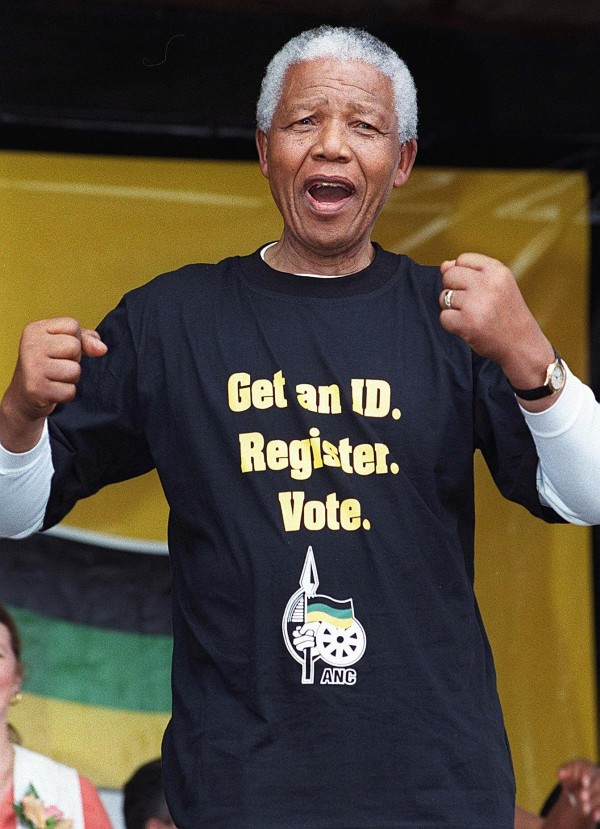
Nelson Mandela expresses his views on Voter ID laws

Nelson Mandela expresses his views on Voter ID laws

The news sent shock waves throughout the Commonwealth of Pennsylvania and the national political media networks.  Over 700,000 Pennsylvanians lacked the most common, state-provided form of photo identification, meaning that over 9% of the Pennsylvania’s registered voters might be unable to vote in this year’s Presidential election!!

The claims of a voting rights armaggedon were prolific!  Ten percent of registered Pennsylvanian voters would be turned away at the polls because they lacked photo ID!  In Philadelphia, the numbers are supposedly TWICE as bad!  The nefarious plot, born of Republican designs to defeat President Obama in November, was working to perfection!  Woe is us!  Democracy was D-E-A-D!!!

As you can see, I love an overabundance of exclamation points!  It never really makes silly arguments any more plausible or intellectually honest; but it does gives the eyes a thrill.  Best of all, it might even distract one from looking at what’s behind the numbers.

So let’s take a peek under the curtain.

The first statistic that jumps out is that 22% of those 758,000 Pennsylvania voters would statistically fall into the “inactive voter” category, meaning that they have not voted since 2007.  In other words, these 170,000 Pennsylvanians have been sitting on their voting hands for at least 5 years.  It also means – by the way – that not a single one of them bothered to vote in the 2008 Presidential election. 

Frankly, I find that 22% to be well on the low side.  From my own experience working on the polls in Horsham Township, the number of voters who do not bother to vote in even the most important presidential races is much closer to 40% than it is to 20%.  A 22% inactive voter rate would conversely suggest a 78% voter turnout, which has not been experienced in Pennsylvania since 1992 (82%).  In 2008, in one of the most provocative national elections in U.S. history, only 68% of Pennsylvania voters cast ballots.  That’s a 32% “no-vote rate”.  If that rate is applied to the 758,000 without PA photo IDs, 242,000 would not be expected to vote in this year’s Presidential contest.   

In addition, the gap in voter registration-to-PENNDOT photo ID includes college students who lived in Pennsylvania while attending in-state colleges and universities; registered to vote during their studies here; then left the state following graduation to pursue their careers.  There are roughly 590,000 college students attending over 3200 schools in Pennsylvania.  According to a 2010 Student Retention Survey, Philadelphia enjoys a 58% student retention figure.  Even though this would be considered a bit on the high side for the entire state, let’s assume it applies.  It still suggests that every four years roughly 62,000 college students leave the state (590,000/4 years x 42%). 

Without even trying all that hard with admittedly fuzzy math, I’m able to whack that 758,000 by 40% (304,000).  And that’s without addressing the multitudes living in large city environs who simply have not needed a PENNDOT drivers license because they rely on mass transit. 

Now let’s consider that a goodly number of these mismatched Pennsylvania voters have other acceptable forms of identification: 

  • Accredited Pennsylvania colleges or universities (with photo and expiration date)
  • Pennsylvania care facilities
  • Military identification
  • Valid U.S. passports (cannot be expired)
  • Other photo identification issued by the federal or Pennsylvania government
  • Employee identification issued by the federal, Pennsylvania, or a county or municipal government

It’s impossible to count those who will have the above at their disposal; but a valid assumption is they would significantly reduce the number of those left without acceptable forms of voter ID.

Finally, comes a number that illustrates why Democrats really fear the numbers being thrown around by PENNDOT.  That number is 2477, or the total number of voters – according to Karen Heller’s column in The Philadelphia Inquirer – who have sought photo voter IDs from PENNDOT since the new voting law was passed in March 2012.  That’s just 620 people per month!

Is that a systemic problem, caused by inaccessible PENNDOT facilities, long lines, poor transportation options, bad customer service, overly complicated documentation requirements, etc.?  Or is there another reason why citizen response has been slow and not nearly adequate to address this “constitutional crisis”?

The critics would like you to believe that all the remaining individuals who haven’t bothered to seek the required photo IDs, are all physically disabled, obscenely poor, or 93-year-old grandmothers born in far away Southern states where racial discrimination rendered them unable to produce native state birth certificates. 

The real problem for Democrats might just be that those they count on to carry the vote in urban locales – like Philadelphia – simply won’t be motivated enough by their precious constitutional right to vote to bother trying to get a valid photo ID.  Excuses will abound for this.  Some will be valid; others will be nothing more than excuses.  You can be certain that, if our newly minted and recently upheld Affordable Care Act required a photo ID to obtain federally subsidized health insurance, the lines outside local PENNDOT offices would be long and suddenly so very easy to reach.

Certainly the truth lies somewhere in between my admittedly cynical, sometimes sarcastic analysis and the breast-beating wails of Jim Crow and poll taxes.  If you were in Houston this week, you could have heard the Obama Administration’s view of the voter ID controversy from none other than U.S. Attorney General Eric Holder, who addressed the NAACP’s convention on the issue.  Unfortunately you could only get inside the convention site by showing up with your government-approved photo ID!!

For me, it’s incredibly difficult to reconcile a view that requires photo ID to cash a check, ride an airplane, visit a new doctor, sign for a mortgage, or taking an opportunity to listen to the insights of the U.S. Attorney General, yet shuns the same added integrity and transparency for one of our most precious freedoms with the same level of effort.

Only in America …

What qualifies one to serve as Pennsylvania’s Attorney General?

As a registered Republican voter and local committeeman, I tend to stay out of Democrat primary contests.  But I appreciate the benefit of having Minority Party participation in positions like Attorney General and Comptroller.  In my opinion, such an arrangement – regardless of which party is in the majority – ensures a system of checks-and-balances that instills confidence in Government. 

 There is no better firewall from the abuses of power than having someone from your opposing party holding onto the purse strings or being the Chief Law Enforcer.  Even if you inherently don’t trust Government, you should find comfort in such arrangements.  

So with this in mind, I must ask the following question …

How is Patrick Murphy qualified to be Pennsylvania’s Attorney General?

Patrick Murphy

Patrick Murphy

Not a problem is Murphy”s failure to take the Pennsylvania Bar Exam.  Lawyers may take the bar in one state and get licensed by other states based on the out-of-state test results.  Murphy claims to have taken Wisconsin’s Bar Exam simply because Wisconsin was known for releasing Bar Exam results faster than other states. including Pennsylvania.  One caveat I add here is the extent to which the PA Bar might be tailored to cover Pennsylvania-specific laws, guidelines, and requirements.

What is an issue is that Patrick Murphy has NEVER prosecuted a criminal case in Pennsylvania!  This is a MAJOR ISSUE!  How does one present themselves as AG material having NEVER experienced a Pennsylvania criminal court.  He’s never been before the judges; never worked with public defenders; never worked with, perhaps never even met the Commonwealth’s AG personnel; has never been a part of PA Justice system’s political network.

I don’t get it.  It’s very difficult to conclude that Murphy would be the Most Qualified to fill the Attorney General’s office.  To me, it smacks of a politician simply look for a paycheck and a place to hang his hat until something better comes along.  Murphy joined other AG candidates in promising to serve their full terms; yet he’s already violated one promise to avoid negative campaign ads just days after making it.  So go figure …

I do not profess to know what Patrick Murphy’s eyes are on.  But I doubt it’s staying on as Pennsylvania’s Attorney General if a more sexy political opportunity arose. 

Kathleen Kane

Kathleen Kane, on the other hand, has served as an Assistant District Attorney for Lackawanna County.  She has fought crime, insurance fraud, sexual abuse and murderers here in Pennsylvania!

A far better choice … if you ask me … as an interested outsider who appreciates the benefits of a highly qualified investigative and enforcement watchdog.

Although I applaud Murphy’s service in the U.S. Army – in Bosnia and Iraq – and the Judge Advocate General (JAG) Corps.  I just do not believe that experience makes him The Best Choice for Attorney General.  As a Republican, I could see myself voting for Kathleen Kane, not so Patrick Murphy.

The Republican Party has settled on David Freed, current Cumberland County District Attorney since 2006 with DA experience in York and Cumberland County since 1997.  He is obviously well qualified! 

Donald A. Bailey, a civil rights lawyer and perennial Pennsylvania political candidate – for everything from Congressional Representative to Governor – is also running as an independent. 

No Democrat has held the office of Attorney General in Pennsylvania since it became an elected office in 1980.