Choking down a day at Pebble Beach

pearlpbLiterally, I was choking down my Pebble Beach experience.  My big chance to play one of the iconic golf courses in the country and the sport, and an hour-and-a-half before our tee-time my Anxiety-O-Meter was shutting down my internal organs!  I had NEVER felt like this before playing a round of golf.  As much as I tried to relax; to take in the surroundings; to enjoy my Eggs Benedict, I was very, very close to a Critical Mass Event!

There were several possible reasons.

  • We had left Mission Ranch, where we had stayed the night before with the woman folk, at 0-it’s-still-so-freakin’-dark hundred hours, so it felt like we were sneaking onto the most famous golf resort in America like a pair of illegals.  I half expected the immaculately uniformed attendants and valets to lay hands upon us and eject us from the premises!
  • Everything about this place is intimidating when you allow the mystique of Pebble Beach and the potential heights of its golf experience to get a stranglehold on your emotions.
  • And of course, every golfer can appreciate the phenomena of First Tee Jitters.  Now just multiply that by several orders of magnitude and suddenly those Eggs Benedict are like trying to swallow a chunk of fairway turf.  My biggest fear was cleaving a foot-sized divot from the first tee and seeing my golf ball mocking me from its perch, untouched by my TaylorMade!

Yes, that would explain a lot!  But eventually it passed, though I’m not sure exactly when or how.  After a ride out to the range and a bucket of balls, it was time to face the legacy of Pebble Beach and those golf legends that had played there before us.

Of course I had to make a few adjustments to my golf-playing expectations, given my surroundings, the difficulty of some of the holes we would play, and the fact that I was still battling the flight side of my fight-or-flight survival instincts.

  1. I knew – or at least expected – that unless I morphed into my Tiger Woods PGA Tour video game icon, the quality of my golf game was going to be a distant second to the overall aura of playing Pebble Beach.
  2. I was going to enjoy the atmosphere, scenery and uniqueness of what could be a once-in-a-lifetime experience, regardless of how well or poorly I played.
  3. I wasn’t about to permit the demons of my sporadic golf game to ruin such a monumental day!  But – may Johnny Miller forgive me – if I did chunk up a big piece of Pebble Beach fairway, it might just be ground-under-repair for a few months; because THAT hunk of turf would be heading back East with me if I had to wear it as a hair hat the rest of the trip!

And then we were on the first tee!  I think that the overload of panic I felt earlier that morning somehow mitigated the horrendous crush of first-tee jitters I had anticipated.  The first tee area wasn’t nearly as crowded as I had anticipated for our 9:00 a.m. tee time, which I’m sure helped.  And all the ancillary distractions of meeting our caddy, Josh (another first for me!), our playing partners, and even the relatively tame layout of the first hole allowed me to swing my driver without hurting anyone.

Of course, that dreaded high fade didn’t help.  But I wasn’t the only one who needed to hit a provisional ball off the 1st tee.  The second drive was much better; and I played the first two holes pretty well, including a bogie on the par 5 #2 hole.  On Hole #3 you get your first glimpse of the Pacific Ocean.  It’s just a teaser for what’s to follow; but it’s enough to make your putter take notice!
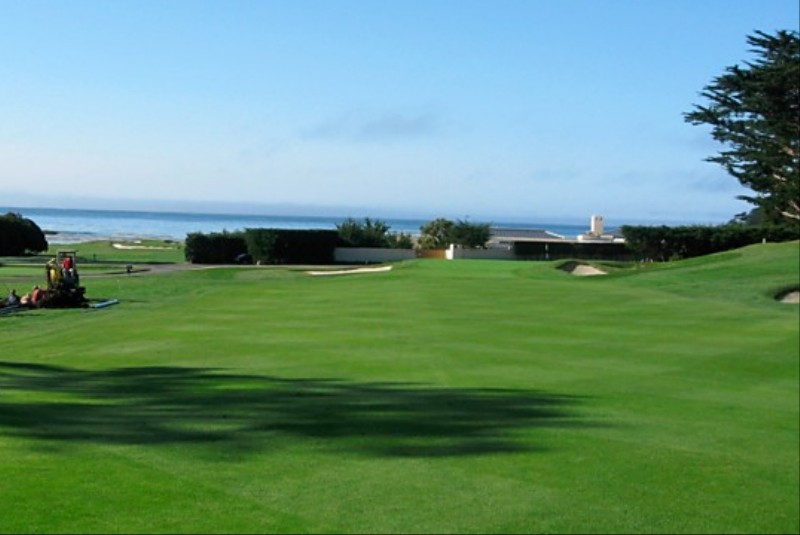
First glimpse of ocean at #3

At #4 my dastardly fade cost me my first ball on the first true ocean hole.  (I would only lose 6-8 for the day, which was far better than I expected!)  Then the REAL FUN began.  #5 is a par 3 that runs along the ocean cliffs; and I didn’t play that hole too badly, given the difficulty of finding my pulled tee shot after it bounded down the cart path.  My brother, Pat, deposited his tee shot off a tree and into what was purportedly Charles Schwab’s backyard!

Little bro, Pat putting on #4

Holes #6, 7 and 8 are three of the most beautiful holes in golf.  And I would say that #8 is indeed one of the greatest holes I’ve ever played!

The second shot up the hill to the second fairway and green of #6 is the first of those grip-grinding moments you face at Pebble, at least if you’re a short hitter like me and it looks like you have to clear a 8-story building to reach the upper portion of the fairway.  You have to marvel at those strong and brave enough to play right-to-left over the most dangerous portion of the sea cliff.

The par 3 #7 was the setting for my closest encounter with Pebble Beach greatness!  #7 is not particularly long at 106 yards; but the backdrop gives you much pause.  Golf jail here is in the form of a high, steep ocean cliff surrounding the green.  No one in our foursome found the green most likely due to an overabundance of caution.  Once I travelled down to the putting surface, I found my tee shot in the green-side bunker left of the pin.  In a classic “ugly but effective” moment, my semi-crisp sandwedge barely cleared the lip; was slowed by the thick grass lining the top of the trap; and tracked right at the hole.  (My cinematographer has the video evidence!)  Despite shouts of encouragement (“It’s right at the hole!”), the ball struck the edge of the cup and rolled away.  Of course I missed the comeback putt, but that couldn’t diminish the thrill of almost holing out from the sand of #7!
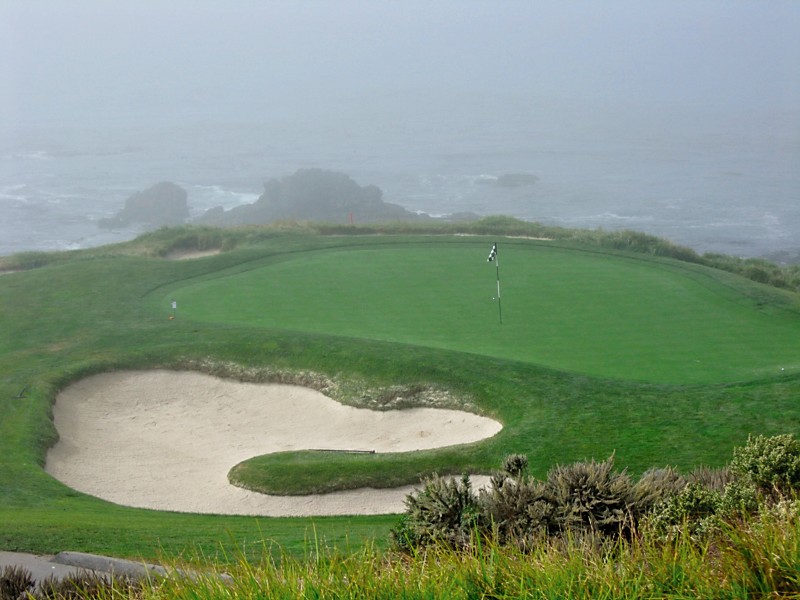
My “almost” sand shot position can be seen just pin high in the sand!

When we arrived on the tee of #8, Josh – our caddy for the day, warned us not to hit anything further than 200 yards off the tee.  His advice was timely given the amazing challenge awaiting us.  All four of us hit perfect tee shots to within 20 feet of the edge of the fairway, only to look down at one of the most awe-inspiring approach shots in golf.
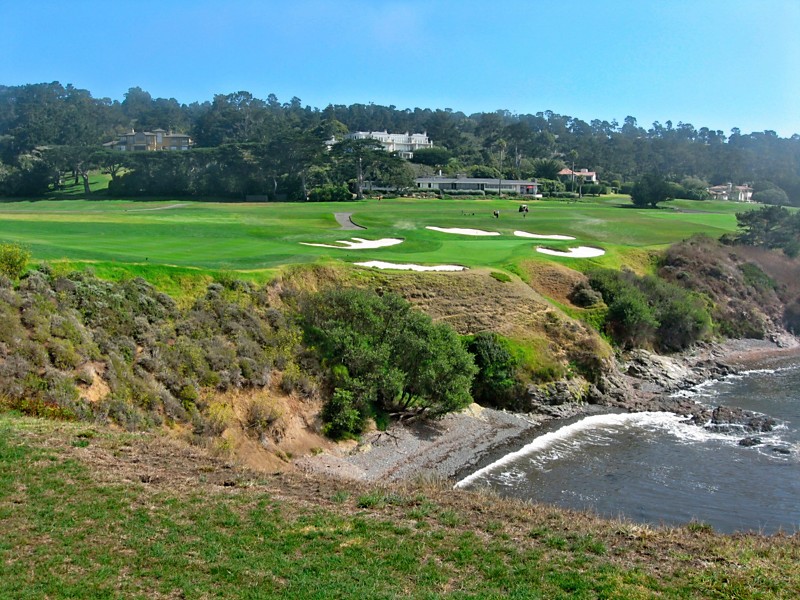
The approach shot on the magnificent #8 at Pebble Beach

Two balls later, I had just missed clearing the yawning sea chasm.  My playing partners were more successful; but that was the kind of day it was for me.  Regardless, I was pumped at having played the kind of golf shot I might never see again!  The fascinating part of #8 is that there is no protection whatsoever – aside from politely placed signs warning of a steep drop – to keep an unsuspecting golfer (as difficult as that might be to imagine) from taking a slip ‘n slide dive into the most hazardous hazard known to the sport!

The above photo and those following show the dramatic changes in fog conditions we encountered resulting from the cool ocean layer.  Shortly before playing #8 in bright, clear sunshine, this was the view down #6 (below).  The fairway lies just left of the bunkers.

The fog was a minor nuisance.  But it did curtail the number of dramatic photo-ops we encountered, especially on those holes along the cliffs and lower shoreline (#17 & 18).
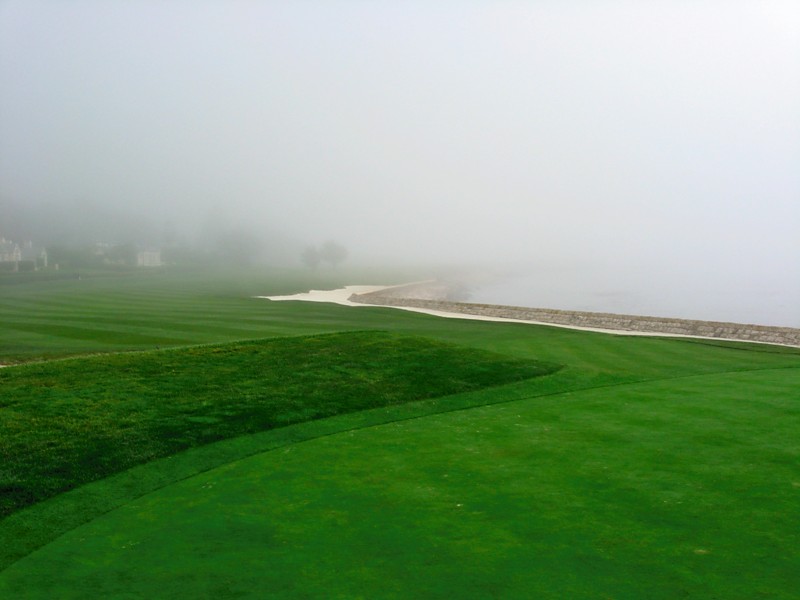
Infamous #18 along the beach from the green

This is what #18 looked like from the green down the fairway (left). You can make out the well-known seawall and sand trap that line the craggy shoreline that is death for any stray shots.  Off in the distance you can see the form of the two trees that mark the aiming point for drives off the tee.  My lone disappointment was not being able to appreciate the full incredible vista of #18 from the tee box.

It was just that kind of day on the Monterey peninsula!

The rest of our round from #10 through #16 – though devoid of spectacular vistas – was full of excellent golf holes and mind-boggling putts.  My one recommendation for anyone looking to experience Pebble Beach (or Spyglass Hill which will be posted later) is to spend the extra cash and arrange for a caddy to accompany you.  You cannot ride a cart up to your ball at Pebble as carts are always restricted to the cart paths; so the caddy (hauling both our bags) is advisable for getting the most out of your round.

In addition, the putts alone on some of the greens REQUIRE an experienced guide.  I could have easily 4 or 5-putted a number of greens without the assistance of Josh.  The first few times your caddy tries to give a read on some of the greens, your brain won’t allow you to follow his advice.  Your mind simply can’t overcome the difference between what the eye sees and what you’re being told to do.  After just one or two bad misses though, you learn to listen to your caddy and tell your brain to shut up, sit down, and enjoy the ride!

On #14, which we were told is shaved like cue ball for tournaments, I faced what looked like a severe uphill 20-foot putt.  Not so fast, counseled Josh.  It’s actually a DOWN HILL putt!  (Putting so near the ocean turns everything upside down.  Downhill can be “up”; and uphill “down” depending on your orientation to the sea.  The physics of which I cannot comprehend!)  Josh points to a spot barely 3-4 feet away from my ball and a good 8 feet – directionally – AWAY from the flag!  “Trust me.”, he says.  “Hit it here and gravity will do the rest!”  So I hit it where I’m told, then watch in disbelief as the putt breaks not once, not twice, but three times as the ball meanders UP the 8-inch slope.  The putt finishing just inches away from the hole!

Trust me, take a caddy!

Flying with Tennessee

Carol and I were heading home from a visit to relatives in California on a flight out of LAX.   As we settled into our seats, a man sat down next to me on what was to be a full flight.  He was a tad older than me and sported a definite southern accent.  He was headed to our intermediate point, Nashville.  (Details specific to him have been left out of this story to preserve his privacy.)

He was obviously alone, and we struck up a conversation … something with which I’m not always comfortable or likely to do normally on a crowded airline flight. 

Mr. Tennessee was on his way to family in Nashville, where he planned to make a new home after being forced – via eminent domain – to sell his house for a Southern California highway improvement.  He was quite happy with this situation as he felt he had received a very fair buyout.  He was a transplant who had settled in California out of the Vietnam-era military; and he was ready to use this life-changing opportunity to head back Home.

Tennessee told me at some point during our chat, he likes people and likes to talk until he runs out of interesting things to say.  He did not disappoint!

So Tennessee launched into an overview of places he had served in Vietnam and military units of which I could make little sense, let alone remember.  He spoke indirectly about some of the things he had seen there and of some of the things he did.  He also spoke of more peaceful experiences he had enjoyed while in-country and how he felt his service there had shaped his later life.  He expressed his admiration for those serving now, and spoke of how serving in the military has changed since he served as a volunteer in a draft-filled military. 

Needless to say, I was in full Listening Mode. 

Then as the conversation became more two-sided, we shared what our fathers did during World War II.  My dad serving in Alaska’s Aleutian Islands, then the Philippines preparing for the invasion of the Japanese home islands.  His dad getting destroyers shot out from beneath him in the Pacific.  Then Mr. Tennessee turned to what he did in his post-military work-a-day world.  How much he enjoyed his sideline craftsman’s hobby; how he looked forward to doing it more – as a man of retired leisure – in his still-to-be-determined Nashville locale; and how much he looked forward to his new life situation.

At one point during the 3 1/2 hours to Nashville, Carol leaned over and whispered, “Lucky you, you got the talker.”  But I was having perhaps the most enjoyable flight ever. (Let’s face it!  We’ve all looked around those departure gate waiting areas, picking out the people we don’t want to sit next to … especially not for a 4-hours flight!)  I was enjoying the passing of time with good, interesting conversation with someone whose life experience was very different from my own.

It’s puzzling to me the way certain normal, everyday interactions pique my interest more than other normal, everyday interactions.  Maybe I project something into them.  Maybe I focus on interactions that fit in some way my view of the world.  Maybe they just strike a chord in a place I value. 

In any case I was happy for him – a complete stranger – and for the comfort level he has found in his life.  He seemed to have “It” figured out for himself; and he was at a good place in his life.  He seemed genuinely satisfied with Life and happy for what the Future held.  And who wouldn’t want to live in that part of Tennessee?!?

California Dreamin’

Having just spent 12 days vacationing in sunny (when it wasn’t foggy) California, it was time to venture back to reality and the “joy” of returning to work.  And an ominuos beginning it was.

Woke up to a weather report that included flash flood warnings for low-lying areas of Montgomery County, so it seemed like I never left!  Actually had a dream where I rolled over in bed to a beautiful blue sky full of puffy white clouds and the warm California sun gently caressing my face.  Of course I was actually just half-asleep – obviously suffering from the effects of jet lag – and standing in front of the bathroom sink; the facial warmth provided by the blinding glare of the vanity high-beams.  The protruding toothbrush and flavor of Crest should have been the first clue.

The worst moment of the day however, was pulling up to the security gate at work (not until 10:00 a.m., mind you) and viewing a pitch-black sky that promised the imminent arrival of a drenching downpour.  (A more appropriate segue from vacation-to-salt mine I dare you to find!)  Of course said soaking rain waited very patiently for me to park and exit my vehicle before commencing to further dampen my already soggy spirit.     

Ah … September in Philly!

Needless to say, the rest of the day could have been worse … and was.  Did you get the mandatory training done?  Where’s your labor input??  Your program funding was half-a-month short!  Did you sign those approvals yet?  The contractor wants to know where those documents are! 

If it hadn’t been for both Atlanta and Boston getting booted out of the MLB playoff picture last night, I would have just curled up in the fetal position under the desk.  Oh well … Enough about me.

I know you have all missed me while I was gone; so I’ll give you a look at what I plan to talk about for the next few weeks.  And in no way is any of this intended to make you jealous or uncomfortable about the state of Mike’s life.  (OK, maybe just a little …)  

  • A Yankee in La La Land
  • The wonders of golf at Pebble Beach
  • Pebble Beach?!?  Wait ’til you play Spyglass Hill!! 
  • Eating my way through California
  • Mission Viejo: How mountain lions and rattlesnakes cured my slice (almost)

Of course somewhere in there I also have to work in a few posts about some important local political fodder.  But it’s going to take a week or so for me to regain the frame of mind needed to do that justice. 

In the meantime, GO PHILLIES! 

Discomfort and disbelief with 9/11 coverage

I had considered writing a personal 9-11 perspective for this past weekend’s remembrances, but felt it would have been an inappropriate self-indulgence.  So many others were more directly and frightfully affected by the events of that day, to add my own personal noise to the remembrances of survivors and those who lost friends and family members seemed superfluous.

However, after reading much of what was published Sunday in The Philadelphia Inquirer, I became sufficiently motivated to address what I consider the wayward perspectives on what has happened since that day in this country and in its responses to those attacks. 

The Inqy’s coverage of such an emotional event was quite detailed, complete, and somber.  It’s certainly not easy to strike the right balance when trying to accurately portray such a huge, complicated picture.  This is especially true when trying to put into perspective the hard data (costs in blood and treasure) along with the social, psychological, and emotional toll of such an event.  Maybe the smart thing would have been to treat this data separately, perhaps at another time even.  And yet – I’m sure – many people would have complained had not “the other half” of this story been presented on such a momentous anniversary.  

For instance,  The Inqy ran two charts in its paper edition on Sunday, describing both The Human Toll and The Financial Toll since the 9/11 attacks.  I thought it an unfortunate juxtaposition, having both of these displayed together.  (I would link them here, if I could find them on the philly.com site.  After two days of searching, I have given up.) 

Several data points caught my attention.

  • The Financial Toll of 9/11 was split between War Costs and Security Costs.  Among the latter category (Totaling $819 billion) was included $100 billion for the “Cost of delay to passengers for airport screening”! 

After seeing that, I was interested in how that was calculated and searched for the source from which the numbers came.  What I found was a study performed for an financial-based risk-assessment/benefit analysis by two professors analyzing the costs of preventing terrorist attacks vs. the actual risk of loss from such attacks.  The authors attempt to equate the value or benefit of prevention to a number of successful attacks needed to reach a so-called break-even point.

I was – almost immediately – sorry I dove into the deep end of this pool.  My problem being that one must be able to put a price tag on the value of a life.  And although this is something that’s certainly done in instances such as the cost and design of highway/auto safety features or in analyzing the costs of environmental protection measures; it’s still a nasty concept with which to deal.  

In this case, it’s a lose-lose situation, even if you’re able to get past the human element of the equation.  The psychological effects of massive casualty events puts an equation-type approach in evaluating responses to such attacks well beyond the realm of acceptability. 

For example, one conclusion made by the authors was that it would require 1667 Times Square-type attacks (i.e. like the one thwarted by poor design this past New Years Eve) to reach the break-even point of security measures needed to prevent any such attacks.  I doubt we could get to the point – psychologically – where, if one such attack was successful, that even two such events would be acceptable. 

You just have to wonder whether the likes of an Osama bin Laden understood that concept to the extent that it did not matter – to him anyway – what might happen to himself or to his organization.  They would win either way.  

It’s not a comforting thought.  But it’s not like we, as a nation that cherishes its domestic freedoms, would have the choice to consider the alternatives of such cost-benefit analyses either.

(I never did find an explanation of how they calculated the cost a traveler incurs waiting for a security screening, as opposed to the coast of being vaporized as a passenger on an 175 ton missile.  I guess I’d have to buy the book to find out, but that’s not going to happen.)

  • The Human Toll of 9/11 included U.S. and Iraqi military casualties, the civilian losses on 9/11, and a section on Iraqi civilian deaths, estimated to be 125,000.  The fine print attributed the Iraqi casualty estimate to a professor working on the Costs of War project at Boston University.  It attributed an estimated 15% of those Iraqi deaths to American and Iraqi military operations; the rest to sectarian violence, insurgent assassinations, and other criminal acts.

It was as early as 2006 that Iraqi War protestors were claiming upwards of 600,000 civilian Iraqi deaths as the result of the war.  Supposedly, these estimates were gleaned by surveys conducted on less than 2,000 Iraqi households and were then extrapolated for the entire war-ravaged country.

I never bought that methodology.  It was just too difficult to balance the claims of such widespread and willful violence and death in an almost lawless environment with what I imagined were census-type surveyors going door-to-door in Baghdad.  Even the margin-of-error (426,369 to 793,663 deaths) was over three times the figure now claimed in The Inqy chart!

I also found it odd that there was no information provided on estimated Afghanistan civilian deaths.  If your intent is to present “the whole picture”, it’s difficult to get past this glaring omission.

In another area of Sunday Inqy Karen Heller, a regular contributor, provided her perspective on that day in Forgetting isn’t possible.  One segment drew my attention.  

Everything about that morning, and almost all that came after, was characterized by speed: the planes crashing, the buildings falling, the deaths mounting, the rush to a wrongheaded costly war.

Now Ms. Heller and I rarely agree.  She being quite to left of me in her opinions and writings.  And my first take on this statement was that she was speaking about Iraq, not Afghanistan.  On the other hand, her piece was presented as a reflection on the events of 9-11 and the developments that resulted from the events of that day.  Yet she never once mentions Afghanistan; but does make mention of Saddam Hussein and even Niger yellowcake.  

So I’m left to wonder whether the “rush to a wrongheaded war” is an oblique reference to Afghanistan that coyly attempts to seek cover from the later – more deliberate – decision to overthrow Hussein.  Or was she unwilling to concede that Afghanistan was a “rightheaded war”, and so glosses over that episode in order to stick to the Liberal storyline. 

I suspect that latter, since I cannot fathom one suggesting after 9-11 that invading Afghanistan wasn’t “rightheaded”.  Then again, there is that storyline …

Finally on Sunday, a Letter to the Editor in the Currents section (no link still available) relates how the writer called his mother on 9-11 to check on her, and in their conversation compares the events of the day to Pearl Harbor.  Mom rather pointedly declares that the attacks were nothing like the 1941 attack that kicked off World War II.  She claims the 9-11 attacks were the result of America’s years of bullying other countries.  He concludes after ten years that he agrees with her, ” … as he watches America … launching one preemptive war after another.”

Sentiments like these are difficult to accept, given how ignorant the logic is. 

Bin Laden’s so-called justification for the 9-11 attacks was the presence of U.S. troops in Saudi Arabia, as they protected Islam’s holiest lands from the invasion threat posed by Saddam Hussein, who had just crushed the Kuwaiti armed forces.  This son should be prohibited from further editorials until he lists the multiple preemptive wars we have launched since 9/11. 

But I know of only two wars initiated by the U.S. since 9/11.  One was reactive, one preemptive.  Am I missing a few wars?!?  Even the “preemptive” war on Iraq was preceded by a decade of U.N. pronouncements and Congressional resolutions under the Clinton Administration declaring Hussein a lethal threat to his regional neighbors, the international community, and national security!

It boggles my mind the extent to which people cannot – or simply will not – admit who the aggressor was that day; why they attacked us; or that our response had to go beyond flushing out and punishing the cowards who perpetrated 9/11 and were responsible for everything that followed. 

 What’s really, really disturbing is that I’m not at all surprised that they still don’t get it.

CML Idiot’s Guide to Lawn Care: Summer Recovery & Winter Preparations

(As stated in previous lawn posts here, these tips are based on my experience alone.  I offer no illusions of formal turf training or professional experience.  This is solely what seems to work for me and my Southeast Pennsylvania lawn.  Always proceed with caution and be mindful of conditions in your specific region.)

Few lawns in the mid-Atlantic region of the good ol’ US of A survive the summer unscathed, unless they are blessed with an in-ground irrigation system or a bountiful canopy of shady trees.  Mine has neither.  So every September consists of efforts at lawn recovery from another long, hot summer. 

Even with adequate rain, exposure to the summer sun and heat will cause brown and dead spots, usually in the same areas of the lawn year-after-year.  My trouble spots are concentrated along the eastern and southern exposures where the sun stays high in the summer sky for most of the day.  Each year I try to mitigate the damage; but regardless of what tricks I use, I have to repair sun and heat damage to the usual areas every September.

This is the best time of the Summer/Fall season to fix what the sun has wrought.  Any repairs taken now will give your lawn 8-10 weeks of Fall growing season, and a head start in the Spring.  I normally begin this effort over the Labor Day weekend.  Warm temperatures in the day and cool, dewy nights during September makes this an ideal time to regenerate growth.       

Remove browned dead grass:  An obvious problem is how to grow new grass with all that dead, matted grass in the way.  There are two ways of approaching this problem, depending on the size of the affected areas.  In my case I usually end up with one or two manageable patches of dead grass with other small patches spread throughout the lawn.  For me, the more practical solution is a good dethatching rake.    

Dethatching rake

  No human looks forward to raking in any way, shape or form; and as a warning, dethatching is probably the most physically demanding raking activity known to man!  So take your time and take care to rake lightly along the top of the lawn to minimize damage to healthy lawn plants and to the roots that remain from the dead grass you are removing.  Even roots from dead growth can regenerate if deep enough to escape the worst effects of sun and heat.  (For this reason, I suggest leaving dead, brown grass in place during the hottest summer weather.  I believe it provides some cover from excessive heat for salvageable grass roots.) 

Concentrate on small areas; pulls towards yourself, then rake forward to remove the dead growth from the rake tines. Work “up” the dead spot as dead growth will be dumped closer to your feet as you move along.   

Do not fret the removal of some green growth.  It’s inevitable given the technique and tools.  As long as you’re not pulling up healthy roots, any green growth removed will grow back.

Lawn comber

Now if you have large areas or – Heaven forbid – an entire lawn in summer shock, you can rent a dethatching machine (a.k.a. lawn comb) from an equipment rental store.  The lawn comb makes much easier work of dethatching; and it’s not a bad idea to dethatch your entire lawn every couple of years.  Dethatching will not only remove topside dead growth, but also that underlying layer of dead growth from seasons past as well as any accumulation of dead leaves, twigs and other debris.  (I dethatched my entire lawn with a machine last September, and the results this Spring were impressive!)

 The combing action of the machine version also does a nice job of disturbing the top layer of soil that makes over-seeding a bit more effective.  Save yourself unnecessary clean-up raking by using your lawn mower with bagging attachment to remove the dead growth pulled up by either the dethatching rake or the lawn comber.

To seed or not to seed, that is the question!  Generally, I do not over-seed, unless I’m doing the entire lawn every few years as mentioned above.  Instead I prefer to let nature take its course, since I consider my lawn’s root system to be healthy enough to regenerate growth on its own. 

Weaker lawns should definitely be over-seeded.  If you decide to seed and live near me (southeastern Pennsylvania), try to avoid Kentucky blue grass and Bermuda seed in favor of a rye and fescue mix.  In my experience, neither blue grasses nor Bermudas tolerate the mid-Atlantic summers very well.   

If you apply seed, I suggest an application of starter fertilizer which will give the entire lawn a more concentrated boost that a weed ‘n feed.  REMEMBER: Never apply a weed ‘n feed to freshly seeded grass.  The “weed” component of a weed ‘n feed will inhibit the germination of any new seed.  Generally, you must wait six weeks after a seeding to apply a weed ‘n feed product. 

Fertilize:  Covered fairly well above.  Just let me reiterate … Starter fertilizer for either seeded or unseeded lawns.  A starter fertilizer will work regardless of whether you are seeding or not.  Weed ‘n feed not only fertilizes but also gives you a leg up on maintaining momentum against weed incursions the following Spring/Summer.  (I prefer to apply an extra weed ‘n feed application in September.  It will give my lawn a nice jolt going into Indian Summer, and it maintains the momentum of anti-weed efforts taken in the Spring.)  

One side effect of any fertilization at this time of the year is that you should plan to be mowing well into November.  But a thick, healthy lawn is worth it, right?!?   

Watering:  Don’t forget to water!  Keep an eye on your forecast; and make sure your lawn gets a sufficient watering, especially if you face a hot September and little rain.  An astute observer will also pay attention to the presence of dew on the lawn in the morning during late summer and early fall.  Warm daytime temperatures, followed by cool evenings can provide heavy dews that act to essentially self-water the lawn.  If you pay attention to these condition, you can better gauge whether watering the lawn is really necessary.  When in doubt, get the hose out!

Aeration:  If you did not aerate in the Spring, doing so in the Fall is a good alternative.  Some lawn aficionados will aerate in both the Spring and Fall!  I don’t.  But if you are faced with hard-packed soil, or your lawn gets a lot of foot traffic, aerating twice a year could be beneficial. 

Leaves:  Once the leaves fall from the trees, make sure you get them off your lawn as best you can.  Allowing leaves to cover your lawn over the Winter will exacerbate a number of problems, and can block early Spring growth.  (I have but one small cherry tree on my property, yet I get a thick covering of leaves from HUGE trees in neighboring yards.  I love the trees and the shade they provide our backyard in the summer, so I deal with the fallout begrudgingly.  My sole concession to my inherent desire to avoid unnecessary work is my refusal to undertake my final leaf roundup until every tree around my property has lost every single leaf, hoping in the meantime for windy weather favorable to blowing said leave into someone else’s yard!)       

Winterize:  Yes, this is another form of fertilization.  But since it’s done separately from your lawn recovery efforts, I treat it separately here.  Winterizing fertilizers are applied in the Fall, usually between Halloween and Thanksgiving.  The nutrients delivered by a winter fertilizer are stored in the grass’ root system, and provides a nourishment to your lawn in the early Spring.  It should be applied before the lawn goes dormant for the Winter.

Hurricane Chronicles

Monday, August 22 – Looks like we might get Hurricane Irene sometime this weekend.  I enjoy watching the “meteorologists” on TV trying to make sense of early storm computer projections.  But it’s kinda difficult to feel threatened by a storm that’s projected to track somewhere between Aruba and Idaho. 

Tuesday, August 23 – Wonderful!  An earthquake in central Virginia gets the whole mid-Atlantic region in an uproar.  My Left Coast family members snicker at the Chicken Little easterners.  Meanwhile, the “meteorologists” have integrated a new way of looking at the This-Thing-Could-Go-Anywhere computer models.  They are now described collectively as a “Cone of Uncertainty“!  I’ll say … Now Hurricane Irene could come ashore somewhere between Cape Canaveral, FL and Greenland! 

Wednesday, August 24 – Spent the whole morning listening to the office’s Earthquake Ernie going on and on and on about convergent plates, thrust faults, and liquefaction.  Note to self: Avoid engineers following dynamic earth events!

Hey, nice dress, Cecily Tynan!  Not so suddenly now, the Cone of We-Don’t-Have-a-Clue is much more concise.  East coast all the way!  Earthquakes, smurfquakes … All those Left Coasters would just slide into the Pacific if they had to endure one of these storms!  You can sense an impending Bread and Milk Panic.  When will they smarten up and start building cows and bread factories in snowless, earthquake-less, and hurricane-free locales?!?    

Thursday, August 25 – Geez, this thing is looking like a huge storm!  Better sit down and get my Storm Supply List organized … flashlights – Got ’em, batteries – ditto, adult beverages – check, animal crackers? Yes!, milk & bread???  OH MY GOD, WE DON’T HAVE ENOUGH MILK AND BREAD!!!!! 

Friday, August 26 – Drag myself into work after getting to bed at 2 am.  Spent four hours last night combing every store in a 10-mile radius for milk and bread.  All I could find was three packages of pita pockets and a half-gallon of goat’s milk!  But at least I know, we will survive!!  Then I spent the whole morning at work listening to Hurricane Harry going on and on and on about wind forces and water dynamics.  Note to self: Just avoid engineers!

Found out my sister, Joanne – who was working in D.C. when the trembler hit Tuesday – was supposed to head to North Carolina’s Outer Banks this weekend.  Asked her if she was going to Tripoli next week.  If you are, I have this engineer …

Get home; cut the grass (You prepare for a hurricane your way; I’ll do it mine!); clear the home environment of potential missiles; and – what the heck?!? – It’s already raining!!  Rush to the store for more pita milk and goats pockets.

Saturday. August 27 – Well, it’s here.  Spent most of Friday night squinting at CNN, The Weather Station, Action News, and Cecily’s dress trying to pick up every subtle shuck and jive of Irene’s eye from the doppler and radar images.  Why?  I haven’t a clue!  Concerns abound for sis’ family already bearing the heaviest brunt of the storm and friends living in low-lying areas near creeks and streams.       

Aside from that, Mother Nature is awesome.  The power and fury are both anxiety and wonder-inducing.  Spent part of the day painting closets in one of the bedrooms – a good day for that!  Decided to try to stay up all night to watch the storm.  Tornado warnings send my son, Brian into a frenzy of impending doom and a profusion of survival tips.  I make it to 4 am before heading to bed.  Seeing nothing other than wind and rain gets boring after a few hours.

Sunday, August 28 – All over here, save for occasional showers and fits of high winds.  No dramatic damage anywhere.  The worst effects are more insidious from accumulating water.  One of our windows leaked upstairs.  We were lucky.  Several neighbors were dealing with inches of water in basements; and the section of housing behind us was without power until Monday afternoon.  And even with that our area was much luckier than others.     

Until next time …

Almost Empty Nest Syndrome

Today we moved our youngest son, Alex, into his new digs at Temple University for his freshman year of college.  A great step forward for him, another exercise in letting go for us. 

We’re not empty-nesters yet.  There’s always one who seems to hang around.  But that’s just fine by me.  I have realized I’m not quite ready for The Vacant Inn.

You hear it a lot from people our age.  How great it would be to have an empty nest.  How carefree life would become with no kids.  The freedom that’s enjoyed after nudging that last chick out of the nest.  Funny thing is, I don’t recall very many Mr. and Mrs. New Empty Nesters extolling the virtues of their hollow home.  No, it’s usually those whose lives seem way beyond full that enjoy the Empty Nest Vision that’s still way off in the distance.

You wonder how many feel the same way about it when they finally arrive at the bridge between The Vision and The Reality.

Alex and I have had this little “good night” ritual of high-fives and fist bumps.  Heck, we’re just guys trying to avoid the awkwardness of adult male displays of affection.  Mom still gets the kiss ‘n hug.  We give the fist bump.

Last night, the ritual was different.  Still a male salute for certain.  But this time the handshake, one that lingered a bit longer.  And for some reason I flashed back to Alex as child.  Nothing elaborate, just the size of his hands as an adolescent … then as a child. 

In an instant you realize how much has changed.  It’s all good though … or so you tell yourself.  More so to prevent that newfound hole from growing larger.

Empty nest?  Nah … I’m not really ready for that yet.

A Guide for Surviving your Type A spouse’s Vacation Assault Plan

Now that another summer is upon us, I offer advice for fellow Type B Personalities preparing for vacations with their Type A spouses.

Many have married Type A spouses upon whom we rely for all the high-intensity, detail-filled tasks that are essential to health and harmony.  The Type A in the family is the go-getter, the organizer, the protagonist for family involvement, the anti-couch potato … all good things.

Unfortunately, some Type As tend to transform into General Patton when it comes to the family vacation.  They plan and execute the summer get-aways like the D-Day invasion of Fortress Europe.

There are Objectives, Operational Plans, and Time Tables.  The pace of operations can be intense and unforgiving.  And if you tire; get “wounded”; or fall off the pace, you’re likely to be left by the side of the road like a piece of carrion for the buzzards.

OK … Just a bit of hyperbole there.  And maybe there’s nothing amiss with some high-intensity activity on a vacation.  Many seem not to mind …

But if YOU are the family couch potato – as am I – and come ill-prepared for the duration and intensity in this Theatre of Operations, a much-anticipated vacation could end up as your own personal version of the Donner Party.

So with my years of experience at being driven forward by my more energetic, highly motivated, hyper-vacationated spousal unit, allow me to offer some timely advice.  Keep in mind that each trial, hurdle, ache, and injury will be multiplied by the number of children you will be lunging around on wheels or strapped to your back like a rucksack full of rocks!

Hints for Type B Survival

  1. Get in touch with Type A reality:  Some people – or so I’m told – go on vacations to unwind, to regroup, to blow off steam, to reflect, to recharge the batteries … to RELAX!  But any Type A Vacation Survivor will tell you, you cannot spell R-E-L-A-X from V-A-C-A-T-I-O-N!  All you will get from your Type A partner is the “A” … and that “A” stands for Apathy!

Once rid of your Type B Vacation misapprehensions, you will understand and – more importantly – SURVIVE what is in store for you.

2. Cardiovascular health:  Make sure you are physically fit and ready for a grind.  Type A Vacations can include hand-to-hand combat, tests of agility, decision-making under extreme stress, and plenty of wind sprints.

And that’s just getting to the kiddies to breakfast!

  • So lose the excess weight.
  • Hit the elliptical trainer and the StairMaster.
  • Work on BOTH speed and endurance.

You’re going to need it!

I learned, a bit too late to save my naive impressions of what vacations are, that Carol and I were raised in families that lived at Polar Extremes of the Vacation Continuum of Leisure (VCL). 

When my family went on vacations we tended to gravitate towards the South Jersey shore points, where Leisure is spelled with a capital “L”.  What “stress” there was came in deciding where to eat; the too long/too late obligatory excursions on the boardwalk; and the occasional case of sunburn.

Not so my better-half’s family vacation experiences … 

Whereas my family’s vacations seemed geared towards resting and refreshing hard-working adults, her family’s vacations were about The Experience … Cramming in as much as they could into every trip … Trying not to miss a single offering or opportunity presented by whatever venue they visited … Hit the ground running and don’t stop until the money is gone or the hotel insists that your stay has ended!

Carol will claim it is not so; but I have the scars that prove otherwise!

3. Strength training:  You’ll want to bulk up normally for any vacation … all that baggage rustling, equipment stowage and deployment can test your back, arms and legs.

Many Type A’s look upon hotel check-in as an unnecessary hinderance to getting all the “fun” started.  If given their way, they would forego completely any hotel interaction until as late as possible on Vacation D-Day.

If given the choice, they would prefer to jump, tuck ‘n roll from the still-moving car and commence immediately with the festivities.  This is why my Type A always wore her bathing suit on our drives down to the South Jersey shore.

However, this tendency becomes a real problem when visiting far-flung, ridiculously large vacation sites like Disney World.  Dragging all those suitcases through The Magic Kingdom for hours on D-Day, before your Type A agrees to “waste time” checking-in, can be exhausting.  So make sure you pay extra attention to strengthening your large muscle groups of the legs and back!

It’s hard not to reflect on our earlier vacations to the beach when the boys were but wee lads.  The amount of equipment … strollers, porta-cribs, high chairs, toys … we had to drag along was mind-boggling. 

I can remember staring at the back of our Dodge Grand Caravan thinking, “I’ll never get all this crap in there or on the roof.” 

Of course just about then, General Patton would stick her head out the door and ask me why I was relaxing!!             

4. Get your rest before you go:  Yeah, I know … Get my rest BEFORE vacation?!?  Trust me!  As stated above, you cannot spell R-E-L-A-X …  Anyway, it’s simple.  Be prepared to GO GO GO from dawn to midnight!  You will be allowed to relax when you sleep or should you be lucky enough to eat at a food source where you can sit down and eat. (This usually depends on the progress of the Operational Plan vis-a-vis Time Tables.)

5. Know your rights!  This is the toughest part of being a Type B soul trapped in a Type A vacation.

Scenario: It’s been four days of hard-driving, high intensity, calf-burning activity.  You look longingly at the hotel pool, the water of which you fear will never get the chance to wash over your cramping, stressed-filled body.  You heard rumor that the tiki bar has been hopping the last two nights – while you were pushing four-year-old Gertrude and six-year-old Jeffrey in a double-wide dolphin stroller through 25 miles of SeaWorld until midnight.

You just want a few hours doing nothing more than read a book; float in the pool; or down a few mai tais.  But you know that the Operations Plan does not allow for idle time.  Failure to adhere to The Schedule will throw the entire expedition into chaos and anarchy.

What’s a Type B to do?!?

STRIKE!

That’s right, exercise your God-given right to refuse to do anything more than sit around and contemplate your navel!

Why should Teachers, Communication Workers, and Teamsters have all the fun?!?

Where’s the compassion?  Where’s the solidarity??  Where are the damn mai tais?!?

Now that being said, General Patton will be more than slightly miffed at your insubordination and temerity.  They will huff and puff; threaten and cajole; plead in the name of the Operations Schedule.

DO NOT LISTEN!

The sole purpose of such wheedling is to wring another day’s worth of blood from a turnip.  And oddly enough, turnips are what your knotted, cramped legs probably look like at this point of your Type A Vacation!

First off … NO TEARS!!  Crying is a sign of weakness to the Type A Personality.  They will roll over you like Hitler took the French!

If the Type A pressure persists, simply put on your Alec Guinness stiff upper lip; whistle the tune from The Bridge on the River Kwai; and stand your ground!

Simply state in your firmest, most reasonable voice that you will be taking a day off, and that you would be willing to watch the kids at the pool so that General Patton can dangle a foot off the dock for a few hours as well.

This strategy has worked for me in the past.  General Patton by this point accepts our labor standoffs with rolled eyes and an exasperated huff.  One year she actually chose to forego the pool day and went solo into The Magic Kingdom just to reconnoiter the next day’s Mission.

Like many typical Type A Vacation Generalissimos …

The Next Mission is what vacation is all about!

Book Review: American Gospel by Jon Meacham

When I saw Jon Meacham‘s book, American Gospel: God, the Founding Fathers, and the Making of a Nation,  I put it on my reading list.  I was looking for a book that would provide a layman’s perspective of how the relationship between God and government developed in this country.  Having read Meacham’s work on Andrew Jackson (American Lion: Andrew Jackson in the White House), I was hoping it would be another concise and enjoyable read. 

Meacham  is executive editor and executive vice president at Random House,  former editor of Newsweek and a Pulitzer Prize winning author.  I’m most familiar with Meacham as a guest political commentator on MSNBC’s Morning Joe (weekdays, 6-9 am), a show I usually watch while getting ready for work in the morning. 

Meacham starts off by highlighting the theme that’s consistently drawn upon throughout the book, the difference between Public religion and Private religion as the Founding Fathers had envisioned.  The concept of Public religion recognizes faith in God (in all forms in which He exists and is worshipped) as a unifying influence, one that unites “the virtue of the populace”.  In this regard, the concept and belief in God takes on whatever religious form is meaningful to an individual, be they Christian, Jew, Hindu, Buddhist, Muslim, etc. 

Private religion seems a concept that is self-explanatory.  That all people have the right to worship – or not worship – God in whatever manner they choose.  This was the antithesis of the religious atmosphere in Europe which led to the founding and colonization of America, which Meacham covers in the first chapter, God and Mammon.  The American experiment provided that no individual would be prevented from worshiping God – if so inclined – in whatever form they should choose, a direct result of what drove the early pilgrims to hazard the perilous Atlantic crossing.

From the beginning, the thinkers among the Founders recognized the importance of religion.  Although they were almost all Christian, almost all Protestant (Several deists, such as Ben Franklin and Thomas Jefferson, were also prominent players.), they recognized the importance of religious tolerance.  Yet they also appreciated the threat to religion that government could pose should the two become too close and become intertwined.  These principles hold true regardless of who you worship or how you worship them. 

(This is why I find The Founding period in our country’s history so fascinating!  The timelessness of The Founders wisdom and foresight is amazing.  The Founders were far from perfect.  Their failure to resolve issues such as slavery and women’s rights – among others – would complicate the road ahead; but the foundation and framework were sound and have survived multiple tests throughout our history. Despite their shortcomings, The Founders were incredibly prescient.)       

Meacham’s greatest accomplishment here is his discussion of the concept most commonly referred to as The Wall between church and state.  A common theme throughout the book, Meacham subscribes to the concept that The Wall was intended more to protect religion from the state as opposed to the other way around.  This is why he finds no contradiction in expressions of God in the public sphere, including mentions of God on our money or in the Pledge of Allegiance.   

As he explores the role of Public religion in America, Meacham takes us through many of the nation’s struggles and accomplishments where Public religion served to unite the country behind the causes that defined the nation, such as the fight for Liberty; the struggle to end slavery and Jim Crow laws; the Great Depression, and the defeat of both Nazi and Communist suppressions in Europe.  In these instances as well as others, Meacham illustrates how American Presidents, political and social leaders invoked the concept of God and the values that flowed from that belief as a compelling, uniting influence for the country.

The book reads much shorter than it looks, running only 250 pages in narrative length.  The rest of the book is a compendium of extensive source notes and bibliography, references to historical letters and documents, even excerpts of presidential inauguration speeches where religious themes were integral. 

Meacham’s effort here is not intended to be taken as an in-depth, historical essay.  He attempts only to provide a historical perspective to the questions “What part did religion play in the founding of the American experiment?” and “How has religion affected the moral development and success of the country?”  Regardless of where you stand on – or know of – the relationship of religion to the American experiment and American governance, you will enjoy Meacham’s perspective on how that relationship came to be.